
Share this article
Community Safety · E-Safe News
The Good Samaritan: Balancing Heart and Head While Being Kind
Local social media can turn compassion into fast action, but fake distress posts and payment traps now exploit neighbor generosity.
Local social media networks, whether Nextdoor, neighborhood Facebook groups, or community forums, have fundamentally redefined what it means to be a neighbor. Today, a single post about a financial bind, medical emergency, job loss, eviction risk, or sudden family crisis can reach thousands of neighbors within minutes.
That digital proximity has unlocked incredible waves of grassroots generosity. But this collective empathy has also created a soft target.
Communities rally to replace a stolen bicycle for a working teenager, deliver groceries to a homebound senior, help a family displaced by fire, or connect a struggling neighbor with local resources.
This desire to protect and lift our neighbors is one of the best sides of people and one of the best possible uses of social media.
But online fraud increasingly exploits community goodwill, neighbor trust, and the natural human instinct to help someone who appears to be in immediate distress.
The Rising Tide of Sympathy Exploitation
Scammers know that emotion can bypass normal caution. When we see a post from someone claiming to be hungry, disabled, evicted, stranded, grieving, or caring for children in crisis, our instinct is often to help first and ask questions later.
Modern fraud operators use sympathy driven stories designed to trigger an immediate response. They may stack multiple emergencies into one post: eviction, hunger, medical hardship, job loss, family death, car trouble, utility shutoff, and childcare problems all at once.
Real life can absolutely be complicated. But scammers often stack emergencies because urgency reduces judgment.
Some scammers create new profiles. Others use dormant profiles, aged accounts, or compromised accounts that once belonged to real people. This can make a request appear credible at first glance, even when the story itself is not.
Anatomy of a Digital Compassion Scam
While every story is slightly different, fraudulent distress posts often share several red flags.
Crisis stacking
The post combines several urgent problems at once and makes the reader feel there is no time to slow down or verify.
Vague local identity
The person claims to be local but cannot clearly identify a neighborhood, school, church, employer, landlord, utility provider, or nearby point of reference.
Direct payment pressure
The request quickly turns to Cash App, Venmo, Zelle, PayPal Friends and Family, gift cards, wire transfers, cryptocurrency, or another fast payment method.
Refusal of practical help
If the person refuses groceries, supplies, direct purchases, or local agency help and insists only on cash, that should raise concern.
Copied language or images
Many scam posts are reused across different groups and cities. Search unusual wording and reverse search suspicious images when possible.
No verification path
If there is no utility account, landlord contact, caseworker, shelter referral, report number, or other way to confirm the need, proceed carefully.
Finding the Middle Ground: Smart Compassion
When these patterns become obvious, it is easy to default to cynicism. But turning inward hurts real neighbors who are genuinely struggling in silence.
The goal should not be to eliminate empathy. The goal should be to upgrade our stewardship.
The Golden Rule of Digital Charity
Real desperation will usually be grateful for a physical blanket, a bag of groceries, direct payment to a verified biller, or connection to an official caseworker.
Digital scams are usually only grateful for a transfer code, gift card number, payment app, or cash.
The Safe Helping Toolkit
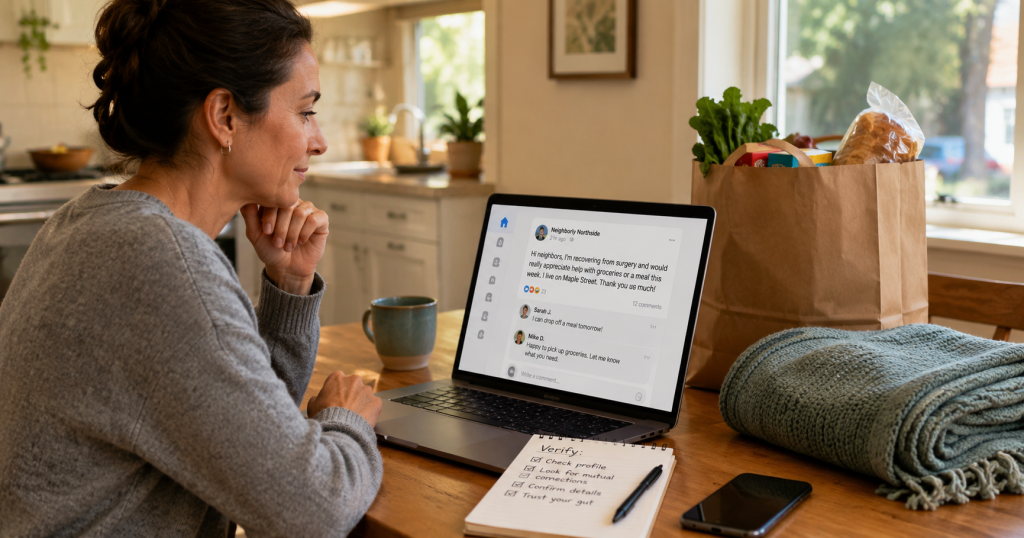
Verify the identity and the need. Review the profile history. Look for local connections. Search key phrases from the post. Ask reasonable questions. If the person claims they are about to lose power, ask for the utility provider. If they claim eviction, ask whether a landlord, property manager, caseworker, or document can be verified.
Pivot from cash to in kind help. If someone is hungry, offer groceries, a hot meal, a pickup order, or a food pantry connection. If they need supplies, offer the actual supplies. A scammer often disappears once direct cash is removed.
Use direct to vendor payments. If the issue is a utility bill, motel room, rent, or repair, independently verify the provider yourself. If the need is real and the provider accepts payment, pay the provider directly.
Protect private information. Do not ask people to post sensitive documents publicly. Do not collect copies of driver licenses, Social Security numbers, medical records, children’s personal details, bank statements, or private case files.
Meet safely. If you are handing off food, clothing, or supplies, use a well lit and public location. Avoid going alone to a private home, isolated parking lot, or unfamiliar address.
Report suspicious activity. Save screenshots of the post, profile, payment handles, photos, direct messages, and links. Report it to the platform and group moderators.
What To Do If Money Was Sent
If money was already sent, contact your bank, credit card company, or payment provider immediately. Recovery is not guaranteed, but fast reporting gives you the best chance.
You can also report suspected fraud to the Federal Trade Commission at ReportFraud.ftc.gov. Georgia residents can report suspicious charity related activity to the Georgia Secretary of State Charities Division and can also file consumer complaints with the Georgia Attorney General Consumer Protection Division.
If there is an immediate threat, exploitation of a vulnerable adult, child endangerment, stalking, harassment, theft, or an in person safety concern, contact local law enforcement. Use 911 for emergencies. Use the local non emergency number when there is no immediate danger.
Report Fraud to the FTC Report a Georgia Charity Scam Georgia Consumer Protection
Guarding the Block Together
True community engagement requires active vigilance. By watching for the structural red flags of digital fraud, we are not being cold hearted. We are defending the integrity of our neighborhoods.
Keep helping. Keep giving. Keep caring for the people down the street. Just use the same common sense online that you would use at your front door.
A good neighbor can have a generous heart and a clear head at the same time.
Sourcing
- Federal Trade Commission, New FTC Data Show People Have Lost Billions to Social Media Scams
- Federal Trade Commission, What To Do if You Were Scammed
- Zelle, Security and Sending Money Safely
- Georgia Secretary of State, How To Report A Charity Scam
- Georgia Secretary of State, Charities Division
- Georgia Attorney General Consumer Protection Division, Charities