
Share this article
Coastal Georgia · Community Awareness
High Tech Housing Fraud: How Coastal Georgia’s Housing Shortage Fuels Modern Scams
A Coastal Georgia housing shortage is giving scammers new leverage. Learn how fake rental listings, spoofed housing portals, and deed fraud work, plus how residents can verify offers and respond fast.
Coastal Georgia’s housing shortage is no longer only an affordability problem. It has also become a fraud opportunity.
When a renter or someone looking for a home to purchase finds a rare property at a price that fits the household budget, the fear of losing it can replace normal caution. Modern housing scammers build their operations around that pressure. They copy legitimate listings, impersonate owners or property managers, arrange access to real homes, send convincing documents, and collect money or personal information before the victim realizes that the person presenting the property has no legal authority over it.
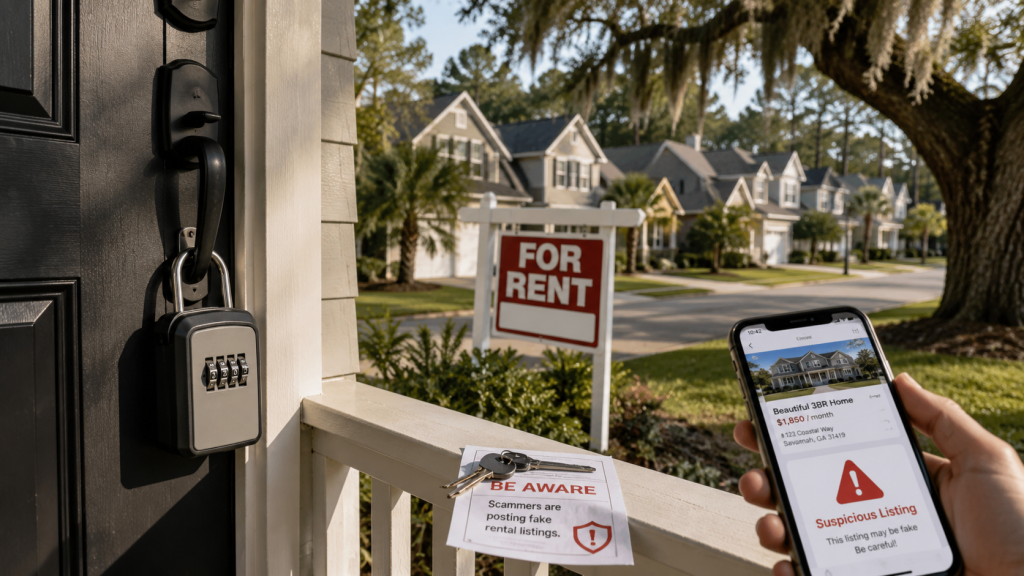
A June 2025 case investigated by Rincon Police demonstrated how convincing these schemes can become. The property was real. The photographs and description were real. The door code worked. The fraud involved the identity and authority of the person offering the home.
The case also shows why housing scarcity can create a dangerous environment. When legitimate rentals and reasonably priced homes are difficult to find, an apparently affordable opportunity may feel too valuable to question.
A real house can still be a fraudulent listing
Rincon Police began investigating after multiple people in the Coastal Empire were reportedly targeted through copied rental advertisements.
The scammers copied genuine property listings from an established rental company and reposted them through Facebook Marketplace and similar channels. The photographs, addresses, and property descriptions matched the legitimate listings, but the advertised rent was substantially lower.
A young couple contacted the supposed representative, compared the advertisement with information on the real property company’s website, and received a working lockbox code. They completed a self guided tour, signed a lease, paid the requested money, and moved into the home.
They discovered the fraud only after contacting the legitimate property manager about a maintenance issue. Their names were not in the company’s records, the home was still officially available, and they had no valid rental agreement with the lawful manager.
A working lockbox code proves that someone obtained access to the property. It does not prove that the person providing the code owns, manages, or has authority to rent or sell the home.
The scammer did not need to invent an entire property. The criminal borrowed the credibility of a real home, a real company, a real listing, and a legitimate remote tour system.
Why Coastal Georgia is particularly vulnerable
Coastal Georgia’s growing workforce, port activity, industrial development, and population have increased demand for housing faster than many local communities have expanded the available supply.
Regional housing studies have documented substantial gaps between household incomes, affordable purchase prices, actual sale prices, and available rentals. Chatham County has also been estimated to need thousands of additional housing units, with much of that need affecting households earning low or moderate incomes.
These conditions create urgency. Teachers, first responders, nurses, service workers, construction employees, government personnel, retirees, and other residents may compete for a limited number of properties. Scammers exploit that competition by presenting a copied listing as a rare opportunity that must be secured immediately.
The wider Georgia housing shortage
The housing pressure affecting Coastal Georgia is part of a broader statewide problem.
The National Low Income Housing Coalition reports a significant shortage of homes that are both affordable and available to Georgia’s lowest income renter households. Its 2026 housing analysis calculates that a Georgia worker must earn approximately $29.46 per hour to afford a modest two bedroom rental without spending more than 30 percent of income on housing.
A minimum wage worker earning $7.25 per hour can afford an estimated monthly rent of only $377 under the same standard.
Those figures do not mean every household faces the same circumstances, but they help explain why an advertisement offering an unusually low rent can attract immediate attention.
How copied housing scams work
Step 1
The criminal selects a legitimate property
The scammer finds a home being advertised by a real owner, real estate professional, builder, or property management company. Properties offering remote tours may be especially attractive because the criminal does not need to meet the victim in person.
Step 2
The listing is copied
Photographs, descriptions, square footage, amenities, addresses, agent names, and company information may be copied into a new advertisement on social media, online marketplaces, classified sites, or copied websites.
Step 3
The price is lowered
The criminal advertises rent or a purchase opportunity below the legitimate amount. The lower price is designed to attract people who have struggled to find something affordable.
Step 4
A real company or owner is impersonated
The scammer may use a legitimate company name, logo, employee name, property description, or document format. Only the contact information, payment instructions, or application link may be fraudulent.
Step 5
Property access is arranged
The scammer may provide a real lockbox code, smart lock code, self tour link, or another method of entering the property. Entering the home can eliminate the victim’s remaining doubts.
Step 6
False documents are presented
The victim may receive a professional looking application, lease, purchase agreement, deposit request, identity form, or electronic signature package. Appearance does not establish legal authority.
Step 7
Money or personal information is collected
The criminal may request an application fee, earnest money, security deposit, first month’s rent, identification, Social Security number, pay statements, banking information, or proof of funds.
Step 8
The criminal disappears
The fraud may not become apparent until the legitimate owner, agent, manager, lender, maintenance department, or law enforcement agency becomes involved.
Rental scams can also target prospective buyers
Although copied rental advertisements are common, someone searching for a home to purchase can also be targeted.
A scammer may impersonate a property owner, real estate agent, closing professional, builder, title company, or lender. The criminal may advertise property that is not for sale, falsely claim authority to sell vacant land, redirect earnest money, or send fraudulent wiring instructions shortly before closing.
Verify every payment change
A buyer should independently verify the listing agent, seller, closing attorney, title company, payment recipient, telephone number, and wiring instructions before transferring money.
Any unexpected change in payment instructions should be treated as a possible fraud attempt until confirmed through a previously verified telephone number.
Fake housing assistance and Section 8 portals
Another variation targets people seeking public housing or Housing Choice Voucher assistance.
A fraudulent website, social media advertisement, email, or text message may claim that a waiting list has opened or that only a limited number of applications will be accepted. The victim may be promised priority placement, guaranteed approval, or faster processing in exchange for a fee.
The fraudulent application may request Social Security numbers, dates of birth, identification documents, household information, employment records, and financial information.
Use only official agency information
The Housing Authority of Savannah currently states that its public housing and Housing Choice Voucher waiting lists are closed. Official openings and application instructions should be confirmed directly through the agency’s website.
Residents should not rely on an unsolicited message, social media advertisement, sponsored search result, or forwarded link when applying for housing assistance.
Rental application identity theft
Some criminals are more interested in personal information than the advertised deposit.
A fraudulent rental or home purchase application can request nearly everything needed to commit identity theft:
Identity information
- Full legal name
- Social Security number
- Date of birth
- Driver’s license or identification image
- Current and previous addresses
Financial and employment information
- Employer and income information
- Pay statements
- Banking information
- Household member information
- Electronic signature
The scammer may continue communicating after receiving the information because maintaining the appearance of a legitimate transaction delays reporting.
Sensitive documents should not be submitted until the property, owner, company, representative, application portal, and payment recipient have all been independently verified.
Property record and deed manipulation
Housing fraud can also target property owners.
Quitclaim deed fraud, sometimes described as home title theft, occurs when a criminal forges or fraudulently obtains documents that appear to transfer ownership. The fraudulent document may then be recorded and used to sell, rent, finance, or claim authority over the property.
Vacant homes, undeveloped land, inherited property, mortgage free homes, and property owned by someone living elsewhere may receive particular attention because fraudulent activity can remain unnoticed longer.
Georgia filing notifications
Georgia operates the Filing Activity Notification System, which can notify enrolled property owners when selected real estate or personal property records matching their criteria are filed and indexed.
The system is an alert service. It does not prevent every fraudulent filing, correct an existing record, or replace periodic review of property and deed records.
Red flags that should stop the transaction
One concern may have an innocent explanation. Several concerns together should stop the transaction until everything has been independently verified.
- The rent or purchase price is dramatically below comparable properties.
- The same address appears online with different prices, companies, agents, owners, or contact information.
- The supposed owner or representative creates intense pressure to pay immediately.
- Payment is requested before identity and authority are verified.
- The payment recipient does not match the verified owner, company, closing professional, or written agreement.
- Payment is requested through gift cards, cryptocurrency, wire transfer, or another difficult to reverse method.
- A working lockbox code is presented as proof that the listing is legitimate.
- The email address does not use the verified company’s official domain.
- The telephone number cannot be confirmed through an independently located official website.
- The representative refuses an office visit, live conversation, video meeting, or independently arranged telephone call.
- A supposed housing agency promises guaranteed placement or paid priority on a waiting list.
- Sensitive identity documents are demanded before the property and representative are verified.
- The written agreement contains inconsistent contact information or identifies a different payment recipient.
- The supposed owner does not match available county property information.
- A buyer receives unexpected wiring instructions or a last minute change in the account receiving closing funds.
- The representative discourages contact with the legitimate company, owner, housing authority, closing attorney, title company, or local government office.
How to avoid becoming a victim
Search the complete address
Compare the property across the management company’s official website, real estate platforms, county property records, mapping services, and other advertisements.
Contact the company independently
Do not rely only on the telephone number, email address, or link in the advertisement. Locate the company’s official website independently.
Verify ownership and authority
County tax and property records can help identify the recorded owner. A mismatch is an important reason to stop and investigate.
Treat access as only one step
A working lockbox, smart lock, gate code, or self guided tour does not establish ownership or management authority.
Verify payment instructions verbally
Use a previously verified telephone number to confirm the recipient’s name, financial institution, account information, and purpose of the payment.
Use official housing agency portals
Enter the agency’s website address manually or reach the application portal through the official website.
Avoid irreversible payment methods
Do not use gift cards or cryptocurrency. Do not send wire or instant payments until the recipient and transaction are independently verified.
Pause when the transaction feels rushed
Housing scarcity is real, but urgency is also one of the scammer’s most effective tools. A legitimate opportunity should withstand reasonable verification.
What to do after suspected housing fraud
Stop additional payments
Contact the bank, card issuer, wire service, payment application, or cryptocurrency platform immediately. Ask whether the payment can be stopped, recalled, disputed, or flagged as fraud.
Preserve the evidence
Save the advertisement, property address, website address, profile, telephone number, email address, messages, payment instructions, receipts, agreement, application, access information, and screenshots.
Report the incident
Report the matter to the local police department or sheriff’s office. Online fraud can also be reported to the Federal Trade Commission and the FBI Internet Crime Complaint Center.
Protect personal information
Create a recovery plan through IdentityTheft.gov. Consider credit freezes, password changes, multifactor authentication, account monitoring, and a review of credit reports.
Notify the legitimate organization
Contact the actual property manager, owner, agent, builder, housing authority, closing attorney, lender, or title company.
Seek legal assistance when necessary
Someone who moved into a property under a fraudulent agreement or discovers an unfamiliar deed filing may need prompt legal assistance.
How Savannah and Chatham County are responding
Housing fraud cannot be solved only through enforcement. Reducing the desperation that scammers exploit also requires additional legitimate housing.
Housing United
Housing United was launched by the City of Savannah, Chatham County, the Savannah Economic Development Authority, and the Community Housing Services Agency to expand affordable housing efforts across Chatham County.
Savannah housing programs
Savannah administers housing repair, development, purchase, and workforce housing programs through its Housing Services Department and the Savannah Affordable Housing Fund.
The 1K in 10 initiative
The program uses $10 million in SPLOST funding to acquire and redevelop at least 1,000 blighted or abandoned properties with affordable housing over ten years.
Additional SPLOST investment
Savannah’s SPLOST 8 project list includes $10 million for affordable and workforce housing property acquisition and development.
Increasing the housing supply can reduce some of the urgency criminals exploit, but construction alone will not eliminate fraud. Property managers, technology companies, housing agencies, government offices, financial institutions, and law enforcement must also strengthen access controls, remove fraudulent listings, protect payment instructions, and provide residents with reliable verification methods.
The bottom line
Housing scammers succeed when a scarce opportunity appears too valuable to lose.
The strongest protection is not simply seeing the property, receiving a door code, reading a professional agreement, or finding the same photographs on a legitimate website.
The essential question is whether the person requesting money or personal information has been independently verified as the lawful owner or an authorized representative.
Coastal Georgia needs more housing, but residents also need time, reliable information, and the confidence to pause before committing.
A legitimate housing opportunity should withstand careful verification. A scam usually depends on preventing it.
Frequently Asked Questions (FAQs)
Find clear answers about this E-Safe page, its available features, community resources, responsible use, and related services for Coastal Georgia residents. Use the source links and official contacts when making local decisions.
1. How do scammers get a door or lockbox access code?
Scammers may register for a legitimate self guided tour while pretending to be a prospective renter. They may persuade another person to complete the legitimate registration process and then share the code.
They may also attend a legitimate showing and watch a real estate professional enter the lockbox combination, observe a contractor or employee, obtain information through a compromised email or text account, reuse an older code, or persuade someone with access to disclose it.
A working code proves only that the code was obtained. It does not establish ownership or authority to rent or sell the property.
2. Does entering the actual home prove the listing is legitimate?
No. A scammer may arrange a self guided tour through the legitimate property manager, obtain a valid temporary code, or misuse access provided for another purpose.
The home can be real while the listing, representative, agreement, or payment instructions are fraudulent.
3. Can someone looking to purchase a home be targeted in the same way?
Yes. Prospective buyers may encounter copied sale listings, fake owners, vacant land scams, fraudulent earnest money instructions, impersonated real estate professionals, false title claims, or altered closing instructions.
Every payment instruction should be confirmed verbally through a previously verified telephone number.
4. How can I verify that a landlord, seller, or property manager has authority?
Search the full property address and compare the information across the company’s official website, established listing platforms, county property records, and other advertisements.
Contact the company, agent, or owner through independently located information and confirm the representative’s role, application link, payment recipient, and authority over the property.
5. Is a price far below the market always a scam?
Not always. A lower price may result from the property’s condition, location, lease terms, income restrictions, owner priorities, or a legitimate affordable housing program.
A dramatic price difference is still an important warning sign and should be independently verified.
6. Should I pay an application fee or deposit before seeing the property?
Payment before viewing is risky, particularly when the owner or representative has not been independently verified.
Some legitimate companies require an application fee, but the company, property, portal, fee, and payment recipient should be confirmed first.
7. Can someone charge me to obtain priority on a Section 8 or public housing waiting list?
A person should not pay an unofficial representative for guaranteed placement, priority status, or a reserved voucher.
Waiting list announcements and application instructions should be confirmed directly through the Housing Authority of Savannah’s official website or office.
8. What should I do after sending my Social Security number or identification?
Preserve the communication and report the fraudulent listing or application.
Create an identity theft recovery plan through IdentityTheft.gov. Consider placing credit freezes, reviewing financial accounts and credit reports, changing passwords, enabling multifactor authentication, and watching for unauthorized applications.
9. What should I do if I already paid or moved into the home?
Stop additional payments and contact the payment provider immediately to determine whether the transaction can be stopped or disputed.
Preserve the agreement, receipts, messages, listing, access information, and identification of the person who presented the property. Contact local law enforcement and the legitimate owner or property manager.
Do not ignore notices from the lawful owner or court.
10. How can property owners reduce the risk that their homes are used in a scam?
Owners and property managers should regularly search their property addresses and images online, report copied listings, use unique and time limited access codes, disable codes promptly, and review access logs.
Owners can also enroll in Georgia’s Filing Activity Notification System, periodically review property and deed records, secure vacant properties, and maintain current contact information with management companies and title insurers.
Sourcing
Rental scams hit home with $65 million in reported losses
Federal Trade Commission
Information concerning copied rental listings, self guided property access, lockbox codes, payments, and reported rental fraud losses.
Keys to avoiding home rental scams
Federal Trade Commission
Consumer guidance for identifying copied rental advertisements and verifying rental opportunities before payment.
https://consumer.ftc.gov/consumer-alerts/2019/06/keys-avoiding-home-rental-scams
FBI Boston warns quitclaim deed fraud is on the rise
Federal Bureau of Investigation
Information concerning forged property transfers and the fraudulent sale, financing, or rental of real estate.
Out of Reach: Georgia
National Low Income Housing Coalition
Georgia housing wage, minimum wage affordability, and statewide rental affordability information.
The Gap: A Shortage of Affordable Homes, 2026
National Low Income Housing Coalition
National and state information concerning the shortage of affordable and available rental housing.
https://nlihc.org/sites/default/files/gap/2026/gap-report_2026_english.pdf
Housing Authority of Savannah
Housing Authority of Savannah
Official waiting list status, application information, public housing information, and Housing Choice Voucher program guidance.
Filing Activity Notification System
Georgia Superior Court Clerks’ Cooperative Authority
Georgia property filing notification enrollment and monitoring information.
City of Savannah, Chatham County, SEDA, and CHSA launch Housing United
City of Savannah
Regional coordination intended to expand affordable housing efforts across Chatham County.
Housing Services
City of Savannah
Savannah housing services, affordable housing programs, and the 1K in 10 property redevelopment initiative.
City of Savannah SPLOST 8 Project List
City of Savannah
Savannah’s approved project list, including funding for affordable and workforce housing property acquisition and development.
https://savannahga.gov/DocumentCenter/View/35161/SPLOST-8_City-of-Savannah-Final-List_07092025