
Share this article
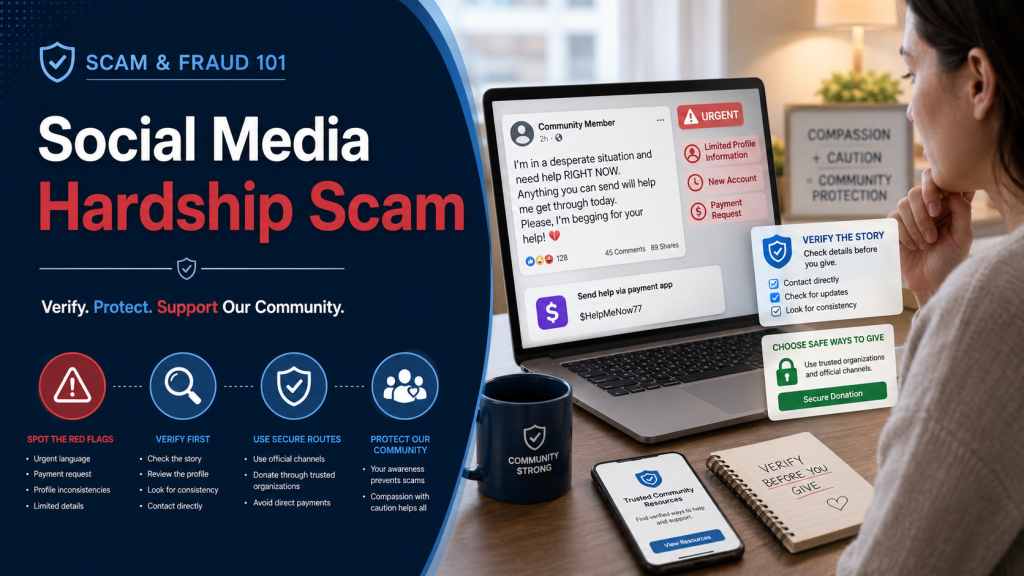
Community Safety · Consumer Protection
Social Media Hardship Scam
Urgent social media hardship appeals may be genuine or engineered scams. Learn how to verify claims, protect donations, preserve compassion, respond after a loss, and report suspected fraud with care.
Social Media Hardship Scam
Lesson Overview
Urgent online appeals involving food, shelter, children, medicine, utilities, eviction, transportation, funerals, pets, or disaster recovery can mobilize a community within minutes. The same speed and compassion can also be engineered into a fraud channel.
This lesson explains how false or materially misleading hardship appeals are constructed, who may operate them, why social media is so effective, how donations are diverted, and how community members can verify a request without humiliating a person who may be in genuine need.
Compassion and verification are not opposites. Verification is responsible stewardship that protects the donor, the intended recipient, legitimate charities, and the community’s ability to help again.
What Is a Social Media Hardship Scam?
A social media hardship scam is a false or materially misleading request for money, goods, personal information, financial information, account access, or another benefit. The request is presented as an urgent personal need and is designed to trigger action before the claim is independently verified.
Common Personal Appeals
- An empty refrigerator or children without food
- Eviction, hotel, rent, or utility expenses due immediately
- Formula, diapers, medicine, surgery, or burial costs
- A stranded motorist, disabled resident, veteran, senior, or abuse survivor
- A fire, flood, storm, accident, or pet emergency
What May Be False
The person may not exist. The person may exist while the story, amount, deadline, beneficiary, or intended use of funds is false. A real tragedy may also be copied and redirected to an unauthorized fundraiser.
The Hidden Objective
Some appeals seek more than a donation. A payment page or private message may be designed to collect card data, bank credentials, passwords, identification records, security codes, or access to the donor’s social media account.
Classification Note“Hardship scam” and “pity exploit” are useful descriptive terms, but agencies may classify the conduct as charity fraud, confidence fraud, phishing, impersonation, identity theft, account takeover, crowdfunding fraud, payment fraud, or another offense.
The Broader Digital Fraud Environment
There is no single federal reporting category that captures every fake request for groceries, rent, utilities, shelter, medicine, or emergency assistance. National statistics therefore describe the broader risk environment, not the exact number of personal hardship scams.
Nearly 30%of people reporting a scam loss in 2025 said the scam began on social media $2.1Bin reported 2025 losses from scams that began through social media 662complaints in the FBI’s narrow 2025 Charity category, reporting about $7.9 million in losses Use These Figures CarefullyThe social media totals include many scam types. The FBI Charity category is much narrower and does not capture every personal appeal, account takeover, fake fundraiser, or deceptive person-to-person request.
The Anatomy of the Scam
A hardship exploitation scheme may be simple or highly coordinated, but the operating sequence often follows the same pattern.
Target Selection
The scammer looks for neighborhood groups, parent networks, churches, veteran communities, school pages, buy and sell groups, disaster pages, and other spaces where trust and generosity already exist.
Trusted Identity
The operator may use a new profile, a cloned identity, a hacked local account, a purchased aged account, a fake organization, or a payment account controlled by a money mule.
Emotional Narrative
The story combines vulnerability, urgency, a believable amount, a short deadline, embarrassment about asking, and a reason conventional assistance is supposedly unavailable.
Manufactured Locality
The post references a school, apartment complex, store, county, landmark, church, occupation, or shared identity to make the crisis feel close and personally relevant.
Suppressed Verification
Comments may be restricted, reasonable questions deleted, warnings blocked, or the discussion moved immediately into private messages where community members cannot compare information.
Payment Conversion
The donor is directed to a payment app, gift card, cryptocurrency wallet, wire service, prepaid card, external fundraiser, fake charity page, direct bank transfer, or resalable merchandise.
Escalation
After the first payment, the scammer invents a new fee, a larger balance, a payment error, a second emergency, or a false refund process that requires another transfer.
Information Harvesting
A fraudulent page may request card details, online banking credentials, Social Security numbers, driver’s license information, security codes, email passwords, or remote device access.
Fund Movement
Money may be withdrawn, transferred through several accounts, converted to cryptocurrency, used to buy gift cards or merchandise, or passed through people who knowingly or unknowingly act as money mules.
Recycling and Retargeting
The same photographs and story may be reused in different cities. Donors may later be targeted by a recovery scammer claiming to retrieve the money for an advance fee.
Who Is Behind These Schemes?
There is no single “normal” hardship scammer. Available public data do not establish that one actor type is responsible for most personal hardship appeals. Community education should account for several possibilities.
Individual Opportunists
An individual fabricates or exaggerates a need and personally collects the money. The person may post once or repeatedly rotate emergencies.
Repeat Local Offenders
Some actors move through local groups using changing stories, relatives, payment accounts, and identities while relying on genuine community familiarity.
Account Thieves and Impersonators
A stolen or cloned account allows the scammer to approach the real account owner’s friends, relatives, church members, coworkers, or neighbors.
Fake Fundraiser Operators
These actors create false memorials, medical funds, disaster collections, community relief pages, or campaigns that falsely claim authorization from a real victim.
Organized Fraud Crews
More complex schemes may divide responsibility for account theft, story writing, posting, private messaging, website creation, payment handling, and laundering.
Money Mules
The receiving account may belong to a person who knowingly assists criminals or to someone deceived by a supposed employer, romantic partner, friend, charity, or person in distress.
Do Not Assume the Visible Account Holder Designed the ScamThe profile may belong to an identity theft victim, and the payment recipient may be an unwitting intermediary. Preserve evidence and report the activity rather than publicly declaring guilt without adequate proof.
Websites, Namecheap, and Other Service Providers
Some schemes use only a social media account and payment handle. Others send donors to a site that imitates a charity, memorial fund, relief group, ministry, or local mutual aid organization.
What a Fraudulent Site May Do
- Copy photographs and language from a legitimate organization
- Display fabricated testimonials, endorsements, or tax claims
- Hide who controls the money or who benefits
- Collect card, bank, identity, password, or security-code information
- Redirect the donor to another payment service
Do Not Misidentify the Service Provider
A domain registrar records a domain name. A hosting company serves website content. A content delivery network may route or conceal technical infrastructure. These functions may be provided by different companies.
Namecheap is a legitimate registrar and hosting provider that can be abused, just like other technology services. A registration record naming Namecheap does not prove that Namecheap operates, approves, or even hosts the site.
Can the organization be confirmed outside the website? Does it identify leadership, a physical address, and who controls the funds? Does the charity appear in federal and applicable state records? Does the payment recipient match the organization or disclosed organizer? Is the domain a slight misspelling or imitation of a known organization? Does the form request information unnecessary for a donation? Was the link supplied only through an unsolicited private message? Can the beneficiary or service provider be independently confirmed? Risk Factor, Not ProofA recently created domain, private registration, unusual domain ending, or secure connection symbol may justify additional review, but none of those details alone proves fraud. “https” protects the connection. It does not authenticate the fundraiser.
Why Protecting Donations Matters
A donor may believe that losing a small amount is less serious than failing to help someone who is hungry. That instinct is humane, but unverified giving can create harm far beyond the first payment.
Real Need Receives Nothing
Money diverted to a fraudster cannot support the genuine family, food bank, shelter, medical fund, relief organization, or local service the donor intended to help.
Fraud Is Rewarded
A successful appeal encourages the offender to repeat the story, target additional communities, and increase the requested amount.
The Donor Is Marked
An initial payment shows that the donor responds emotionally and will use the requested payment channel. That information may be reused or sold.
Identity Exposure May Follow
A small donation can become card fraud, account takeover, identity theft, fraudulent credit applications, or compromise of several financial accounts.
Community Trust Erodes
Repeated scams make members distrust legitimate appeals. Real people then face fewer donations, less sympathy, and harsher public scrutiny.
Legitimate Charities Are Harmed
Fraud creates donor fatigue and reduces willingness to support established relief organizations and verified local assistance networks.
Victims May Stay Silent
Embarrassment and shame may prevent reporting, allowing the same account, payment destination, or story to continue targeting others.
Other Crime May Be Supported
Payments can move through stolen identities, compromised accounts, money mules, laundering channels, or broader fraud operations.
Sharing Can Multiply the Harm
Forwarding an unverified appeal may expose hundreds of neighbors and lend the request your personal credibility. Verify before amplifying.
Warning Signs and Risk Indicators
No single warning sign proves fraud. A genuine person may be embarrassed, frightened, newly displaced, protecting medical privacy, or unable to accept one particular form of help. Concern should increase when multiple indicators appear together.
Profile and Identity Indicators
- A recently created account or little normal interaction
- Older posts showing a different location, language, family, or identity
- A recent name change or photographs appearing under other names
- A sudden financial appeal after years of unrelated activity
- A writing style dramatically different from older posts
- Mutual contacts cannot confirm the current circumstances
- A known person refuses a call or video conversation
- The payment account belongs to an unexplained third party
Story Indicators
- Extreme emotional pressure and a deadline measured in minutes
- Vague location details or changing facts
- Identical text appearing in groups from different cities
- Old, copied, altered, or unrelated photographs
- Inconsistent notices, bills, receipts, or identification records
- Claims that every agency, charity, church, shelter, and relative refused help
- An amount that repeatedly increases
- A refusal of reasonable private verification
Payment Indicators
- Gift cards, cryptocurrency, wires, or prepaid cards are demanded
- Only one particular payment app is accepted
- The donor is told to mark a payment as “friends and family”
- Direct payment to the landlord, utility, pharmacy, hotel, grocery store, mechanic, or veterinarian is rejected
- A verification, release, refund, or recovery fee is required
- The donor is told to send the same payment twice
- The donor is asked to receive and forward money
Website and Behavioral Indicators
- The domain closely imitates a legitimate organization
- No verifiable leadership, address, or independent history exists
- The donation form asks for a bank password, Social Security number, or security code
- Comments are disabled, questions deleted, or warnings blocked
- The conversation is moved immediately into private messages
- Questions are treated as cruelty or a personal attack
- The requester insists on secrecy or becomes aggressive during verification
- A supposed official communicates only through the requester’s account
The SAFE Giving Method
Verification should be private, proportionate, and respectful. Do not demand that a person publicly display medical records, Social Security numbers, identification documents, addresses, children’s information, or a domestic violence location.
S
Stop
Pause before clicking, sharing, or paying. Urgency is a major fraud tool. Even a brief pause can interrupt an emotionally driven transaction.
A
Authenticate
Confirm identity and circumstances through a method the requester did not supply.
- Call a number you already had
- Use video with a known contact
- Search distinctive wording and images
- Ask an administrator whether the appeal was reviewed
- Contact the organization or provider through official information
F
Fund Through a Controlled Route
- Pay a verified provider directly
- Order food or supplies for pickup or delivery
- Use a trusted local nonprofit, school, church, or shelter as an intermediary
- Use an established fundraiser that identifies both organizer and beneficiary
- Prefer a credit card or check for charitable giving
E
Evidence and Escalation
Keep the post, messages, profile address, payment information, website address, receipts, and timeline. Report suspicious activity to the platform, payment provider, administrator, and appropriate authorities.
Refusal of Direct Assistance Is Not Automatic ProofA genuine person may need flexibility, transportation, safety, or help with several expenses. The refusal becomes more concerning when combined with secrecy, inconsistent facts, an unexplained payment recipient, and insistence on an irreversible method.
Safer Ways to Help Genuine Need
Offer food, supplies, transportation, or direct provider payment. Ask whether a verified local organization is already assisting. Use 211 to locate food, housing, utility, medical, and emergency resources. Offer to place an order rather than send unrestricted funds. Ask the requester to verify privately with a group administrator. Confirm the payment recipient before sending anything. Limit assistance to an amount you can afford to lose. Never provide passwords, banking credentials, or security codes. Do not share the appeal until it has been reasonably verified. Protect the person’s sensitive circumstances from public exposure. A community can support real hardship without creating a public trial or an unrestricted cash channel.
Guidance for Social Media Group Administrators
Administrators can reduce exploitation without prohibiting every request for help.
Before Approval
- Require financial assistance posts to receive administrator review
- Require the general type of need and payment recipient to be identified
- Require disclosure when the organizer is not the beneficiary
- Search duplicate wording and images
- Contact the apparent account owner independently when takeover is suspected
- Provide a private verification route for sensitive cases
Community Controls
- Prohibit money forwarding and high-risk payment requests
- Limit unnecessary external donation links
- Keep comments available for moderated questions when safe
- Require notice when the stated need has been met
- Preserve screenshots and links before removing suspected fraud
- Maintain a directory of verified local assistance resources
Warn Without DoxingAn administrator can remove the content, preserve evidence, contact the apparent account owner, notify affected members, and report the activity without publishing sensitive records or declaring the account owner guilty.
What to Do If You Already Sent Money or Information
Act immediately. Recovery is not guaranteed, but delay can reduce the options available to a bank, card issuer, payment provider, platform, or law enforcement agency.
Stop and Contact the Payment Provider
- Do not send additional money
- Do not pay a refund, release, verification, investigation, or recovery fee
- Use the official app, the number printed on the card, or a verified statement
- Explain truthfully that you authorized the payment because you were deceived
- Ask whether the transaction can be stopped, recalled, reversed, disputed, or frozen
- Ask that the receiving account be reviewed for fraud
- Record the representative, time, case number, and response
Preserve Evidence Before Blocking
- The complete post, profile address, and group name
- Messages, emails, telephone numbers, and dates
- Payment handles, recipient names, receipts, and transaction numbers
- External website addresses and confirmation pages
- Photographs, notices, invoices, and identification records sent to you
- Additional accounts, witnesses, threats, and escalation attempts
Secure Your Accounts
- Change the affected password from a trusted device
- Secure the email account first because it controls many password resets
- Use new, unique passwords and multifactor authentication
- Sign out other sessions and remove unfamiliar devices or connected apps
- Replace a compromised payment card
- Review bank, card, payment app, email, and mobile account activity
Respond to Identity Exposure
- Use IdentityTheft.gov for a recovery plan
- Place a credit freeze with all three nationwide credit bureaus
- Review credit reports for unfamiliar accounts
- Report compromised identification to the issuing agency
- Monitor financial, tax, Social Security, and medical activity as appropriate
Notify the Community
Report the post and profile through the platform. Notify the group administrator and privately warn people who interacted with the appeal. Contact a known account owner through a previously trusted method when takeover is suspected.
Expect a Recovery Scam
A second scammer may claim to be an investigator, attorney, government official, hacker, cybersecurity company, or recovery specialist. Legitimate agencies do not require gift cards, cryptocurrency, account passwords, or an advance fee to investigate.
Evidence Checklist for Reporting
Your contact information and the date the conduct began Platform, group, profile, page, and account names Complete post, message, or solicitation Payment method, recipient, account handle, and amount Transaction numbers, receipts, and provider case numbers Telephone numbers and email addresses used Website, domain, fundraiser, or payment-page addresses Unedited screenshots and preserved messages A chronological description of what occurred Known additional victims, threats, or further demands Information or credentials that may have been exposed Names of administrators or witnesses who reviewed the post Preserve the Supporting FilesThe IC3 complaint form does not accept attachments. Law enforcement may request the evidence after reviewing the complaint.
Points of Contact for Action
Financial Institution or Payment Provider
Contact the fraud department immediately through the official app, the number on the card, or a verified statement. Ask about stopping, recalling, reversing, disputing, or freezing the transaction.
Federal Trade Commission
Report fraud, scams, and deceptive practices.
Telephone: 1-877-382-4357
FBI Internet Crime Complaint Center
Report internet-enabled fraud, account takeover, phishing, fraudulent websites, and payment schemes. Provide a clear timeline and transaction details.
Federal Identity Theft Recovery
Use the federal recovery process when identity, financial, or account information may have been exposed.
Telephone: 1-877-438-4338
National Elder Fraud Hotline
For fraud affecting an older adult.
Telephone: 1-833-372-8311
Monday through Friday, 10:00 a.m. to 6:00 p.m. Eastern Time
Local Law Enforcement
Contact the local police or sheriff when money was stolen, identity information was compromised, threats were made, or the suspected offender may be local. Call 911 for an active emergency or immediate threat.
Facebook and Messenger
Use the Report option attached to the post, profile, page, group content, or message. Use Facebook’s account recovery process for a compromised account. Suspected phishing may be reported to phish@fb.com.
Namecheap Abuse Reporting
Use only when the suspicious domain is registered or hosted through Namecheap.
Registered domain abuse: abuse@namecheap.com
Namecheap-hosted content: abuse@namecheaphosting.com
United States Postal Inspection Service
Report scams involving mailed checks, cash, letters, packages, or other use of the U.S. Mail.
Telephone: 1-877-876-2455
Consumer Financial Protection Bureau
Use the complaint process when a covered financial institution or financial service provider has not adequately addressed a consumer complaint.
Telephone: 1-855-411-2372
211 Community Assistance
Call 211 to locate legitimate assistance with food, housing, utilities, healthcare, transportation, and other local needs. This is also a responsible resource to offer a person whose request may be genuine.
Georgia Attorney General Consumer Protection Division
Atlanta area: 404-651-8600
Georgia toll-free: 1-800-869-1123
Georgia Secretary of State Charities Division
Report suspicious charitable solicitations or concerns about a charity operating in Georgia.
Telephone: 470-312-2640
Email: charities@sos.ga.gov
IRS Tax-Exempt Organization Search
Use the federal search tool to review an organization’s tax-exempt status and available filings. Tax-exempt status alone does not prove that a specific appeal or payment destination is authorized.
Final Community Message
Do not allow a scammer to redefine verification as cruelty. A genuine person deserves assistance that reaches the actual need. A donor deserves to understand where the money is going. A community deserves protection from people who weaponize empathy.
The safest response is not to stop caring. It is to care carefully.
Pause before paying. Confirm through an independent source. Use a controlled payment route. Protect personal information. Preserve evidence. Report suspected fraud quickly.
Sourcing
- Federal Trade Commission, Reported Losses to Scams on Social Media Eight Times Higher Than in 2020, April 27, 2026.FTC social media fraud data spotlight
- Federal Bureau of Investigation, 2025 Internet Crime Report.FBI 2025 IC3 Annual Report
- FBI Internet Crime Complaint Center, Beware of Charitable Fraud Related to Mass Casualty and Disaster Events, January 16, 2025.IC3 charitable fraud public service announcement
- Federal Trade Commission, Giving to Charity and Crowdfunding.FTC charitable giving guidance
- Federal Trade Commission, What To Do If You Were Scammed.FTC recovery guidance
- Federal Trade Commission, IdentityTheft.gov.Federal identity theft recovery service
- Federal Bureau of Investigation, Money Mules.FBI money mule guidance
- FBI Internet Crime Complaint Center, Frequently Asked Questions.IC3 evidence and reporting guidance
- Meta, Facebook Help Center guidance on phishing, suspicious messages, reporting, and compromised accounts.Facebook phishing guidance
- Namecheap, How and Where Can I File Abuse Complaints?Namecheap abuse reporting guidance
- Internal Revenue Service, Tax Exempt Organization Search.IRS Tax Exempt Organization Search
- United Way 211, Essential Community Services.211 community assistance
- United States Department of Justice, Elder Justice Initiative.National Elder Fraud Hotline information
- United States Postal Inspection Service, Report.USPIS reporting portal
- Consumer Financial Protection Bureau, Submit a Complaint.CFPB complaint portal
- Georgia Attorney General Consumer Protection Division, File a Complaint.Georgia consumer complaint guidance
- Georgia Secretary of State Charities Division, How to Report a Charity Scam.Georgia charity scam reporting guidance
- Project source supplied for review, Social Media Hardship Scam Tactics, reviewed August 8, 2026.
This lesson is public education, not legal, financial, or investigative advice. Reporting contacts and procedures can change. Confirm instructions through each organization’s official website before submitting sensitive information.
Why Scammers Target Social Media
Existing Trust
A request inside a neighborhood, school, church, parent, veteran, or community group feels safer than an unsolicited message from a stranger.
Borrowed Credibility
A compromised account may contain years of photographs, friendships, family discussions, check-ins, and local activity. Account age alone does not prove current control.
Personal Targeting Data
Public posts reveal locations, affiliations, recent disasters, family relationships, causes, and emotional concerns that can be used to tailor a persuasive appeal.
Rapid Distribution
A compelling story can move through multiple groups before anyone verifies it, while urgency shortens the time between emotional reaction and payment.
Visible Social Proof
Likes, shares, sympathetic comments, and claims that others donated may create legitimacy. Some activity may come from accomplices or additional fraudulent accounts.
Private Messaging
Once the conversation becomes private, other members cannot identify contradictions, compare payment details, or warn the prospective donor.
Low Operating Cost
One operator can reach large audiences without travel, postage, a physical office, or a traditional call center.
Immediate Payment Access
Posts can connect directly to payment apps, donation forms, websites, gift card requests, or cryptocurrency addresses.
Platform Legitimacy Effect
Users may assume a post is verified because a familiar platform allowed it to appear. Platforms generally do not authenticate every personal hardship claim before publication.