
Share this article
Community Awareness · Community Safety
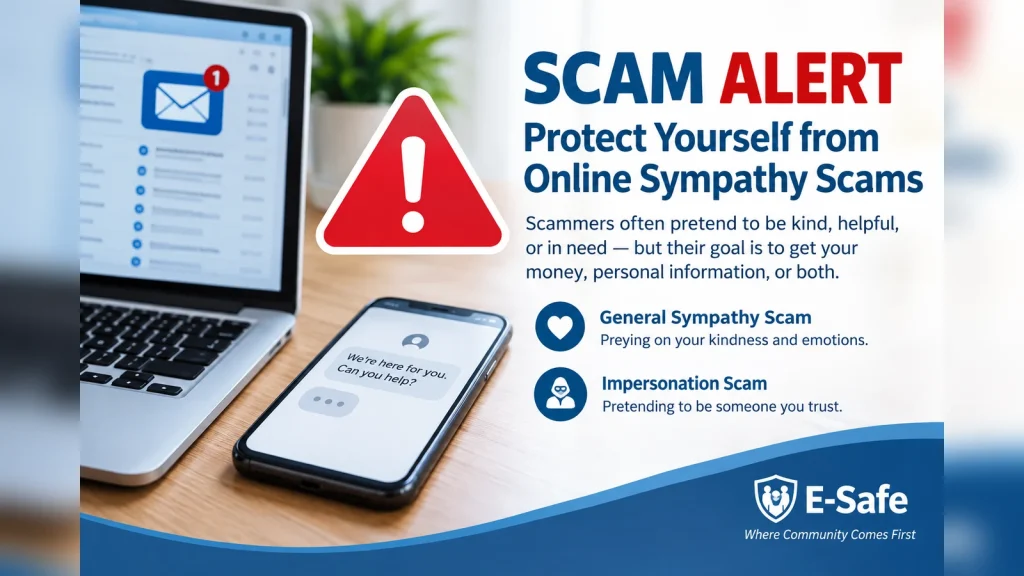
SCAM ALERT: The General Sympathy Scam
E-Safe examines a social media fraud pattern using hardship stories, prayer requests and community trust to seek money, goods, personal data, or customer leads. Learn how to verify before giving help.
SCAM & FRAUD 101 | Scam Lesson
An appeal for groceries. A parent waiting for benefits. A neighbor facing an emergency. A small business owner asking for prayers, referrals and support. None of those circumstances is suspicious by itself. That is precisely what can make a sympathy based scam effective.
E-Safe has been monitoring two distinctly different but related patterns on social media, particularly Nextdoor. The first involves personal hardship appeals built around children, food shortages, benefits, transportation problems, family emergencies and other circumstances likely to trigger an immediate desire to help. The second involves supposed local business owners describing slow business, financial stress and uncertainty before asking neighbors for prayers, referrals, customers or support.
The business pattern has produced substantially stronger indicators of coordinated activity. Personal hardship posts require considerably more caution because legitimate people routinely use neighborhood platforms when they genuinely need assistance.
The important lesson is not to stop helping people. It is to understand when compassion itself may be used as the first stage of social engineering.
Important: E-Safe uses the term General Sympathy Scam as a practical fraud awareness description. It is not a formal FBI, FTC or law enforcement scam classification. An emotional appeal alone does not establish fraud.
What Is a General Sympathy Scam?
A General Sympathy Scam begins by creating an emotional connection before asking for anything that looks obviously suspicious.
Instead of opening with a direct request for money, the person may first describe hunger, children in need, domestic problems, unemployment, illness, transportation trouble, an unexpected expense or another believable hardship.
The opening message may ask only for prayers, advice, resources, encouragement or recommendations.
That matters because the first objective may simply be to make neighbors respond.
Once someone offers help, the relationship changes. The person making the appeal is no longer approaching an unwilling stranger. The potential victim now believes that he or she voluntarily approached a neighbor in need.
The conversation can then move into private messaging where other neighbors cannot compare what each person is being told, how many people have already offered assistance, whether different versions of the story are being used, or whether several people are being given the same payment information.
If the appeal is fraudulent, the eventual objective can include money, gift cards, groceries, merchandise, payment app transfers, personal information or another item of value. In other cases, the conversation may simply identify people who respond readily to emotional appeals and could be approached again.
Why Sympathy Is Such an Effective Hook
Most people do not approach a story about hungry children, a struggling parent or a desperate neighbor the same way they approach an unfamiliar invoice or suspicious email.
Compassion naturally lowers resistance.
A reader may begin deciding how to help before deciding whether the story can be independently verified.
Social media adds another powerful element. A hardship post can quickly accumulate supportive comments, prayers, recommendations and offers of assistance. That activity creates social proof. Someone arriving later may assume that because other neighbors responded positively, someone else must already have verified the story.
That assumption can be dangerous.
Two Patterns E-Safe Has Been Monitoring
Personal Hardship Appeals
Some appeals center on children, food shortages, temporary loss of benefit access, transportation difficulties, domestic crises or other immediate needs.
None of those circumstances is a fraud indicator by itself.
Being a single parent is not a fraud indicator. Receiving SNAP or EBT is not a fraud indicator. Experiencing domestic violence is not a fraud indicator. Transportation problems are not proof of deception. A new or sparse social media profile is also not proof of fraud.
Concern increases when multiple independent factors begin appearing together, including unusually similar wording, repeated narrative order, sparse account history, matching explanations, identical closing language, repeated private solicitation or other verifiable connections between supposedly unrelated accounts.
Struggling Business Appeals
E-Safe has also observed supposed local business owners describing slow business, financial stress, uncertainty and emotional strain before requesting prayers, referrals, customers or support.
The stronger concern appears when nominally unrelated accounts begin sharing the same booking infrastructure, collecting similar personal information under differing business identities, using mismatched telephone numbers or presenting testimonials from extremely sparse supporting profiles.
In that version, the emotional story may not be seeking a donation at all.
It may be seeking a customer lead.
When Sympathy Becomes a Customer Lead
A neighbor who responds to a struggling business appeal may be directed to a booking form that collects a name, telephone number, ZIP code, vehicle information, requested service, home information or appointment preference before the business has ever been independently verified.
That information can have commercial value. An appointment can also be transferred to a different provider who had no obvious connection with the identity or business name originally presented to the customer.
This is why a person should verify the business before submitting the form, not after.
The Warning Signs
No single indicator proves a scam. The risk increases when several indicators appear together.
Emotion replaces verifiable facts The story is highly emotional but provides little information that can be independently confirmed. Sparse account history The profile contains little meaningful neighborhood activity beyond the assistance or business solicitation. Repeated unusual wording Distinctive phrases, sentence order, punctuation or closing language appear across supposedly unrelated accounts. Immediate movement to private messages Private communication prevents neighbors from comparing what each person is being told. Every ordinary solution is unavailable The story repeatedly explains why pantries, relatives, agencies, transportation or other resources cannot solve the problem. That may be legitimate, but it deserves verification when unrestricted money becomes the remaining solution. Direct help is rejected Reasonable offers of groceries, direct purchases or verified assistance are refused while unrestricted cash is repeatedly requested. Risky payment methods The person insists on gift cards, cryptocurrency, wire transfers or payment methods that offer limited recovery options. Unverifiable business identity A supposed local business cannot be independently matched to a reliable local telephone number, website, established history or other ordinary business information. Shared infrastructure Different identities use the same booking form, contact system, payment destination or other infrastructure. Information requested before verification The form requests personal, vehicle, home or contact information before the purported business itself has been verified. Questionable social proof Promotional testimonials come from profiles with little or no visible activity of their own. The deal changes after contact A low advertised price becomes a much larger charge, unexpected service or urgent problem after the customer has already committed.
How to Help Without Becoming the Next Victim
- Slow down before sending anything Emotional urgency is a reason to conduct more verification, not less. Compassion does not require an immediate money transfer.
- Verify privately and respectfully Someone describing domestic violence, children, medical problems or another sensitive situation should not be forced to publish private documents or personal information for a neighborhood to inspect. Recognized assistance organizations can often verify need more appropriately.
- Provide direct assistance when practical Groceries can be purchased through a store for pickup. School supplies can be bought directly. Certain legitimate bills may sometimes be paid directly to the provider after verification.
- Do not treat refusal as automatic proof A legitimate person may have practical reasons why one form of assistance does not work. Repeated insistence on unrestricted money while reasonable alternatives are rejected should nevertheless increase caution.
- Verify businesses independently Locate the business name, telephone number, website, public records and independent reviews yourself. Do not verify a company only through information supplied by the person asking for your business.
- Do not feed an unverified booking form A name, telephone number, ZIP code, home address, vehicle description and service need can have commercial value even when no money is immediately requested.
- Protect your payment method Avoid sending gift cards, cryptocurrency or wire transfers to an unverified individual. Use transaction methods appropriate to a legitimate business relationship when paying a verified service provider.
- Preserve evidence before reporting Save screenshots, post links, profile links, messages, telephone numbers, email addresses, payment information and booking form links before the post or account disappears.
If You Already Sent Money or Information
Contact the bank, card issuer, payment service or financial institution involved as quickly as possible and report that the transaction may have been fraudulent. Ask whether the payment can be stopped, reversed or disputed.
If account credentials were disclosed, change them immediately and do not reuse the replacement password elsewhere.
If sensitive identity information was provided, consider appropriate credit monitoring, fraud alerts or a credit freeze.
Preserve the complete conversation before blocking the account.
Report suspicious activity to the social media platform and the appropriate consumer protection authorities. If an actual theft, threat, unauthorized entry or other criminal conduct occurred, contact the appropriate law enforcement agency.
Compassion Is Not the Problem
The purpose of this warning is not to convince neighbors that everyone asking for help is lying.
That would cause a different kind of harm.
Neighborhood communities work because people help one another. A legitimate struggling family, abuse survivor, unemployed neighbor or small business owner should not automatically be treated as a criminal because scammers have learned to imitate hardship.
The safer principle is compassion with verification.
Help when you choose to help, but control how that assistance is provided. Verify businesses before becoming a customer. Protect personal information before submitting a form. Keep financial transactions traceable. Be particularly cautious when an emotional appeal is followed by urgency, secrecy, private messaging or an insistence on unrestricted payment.
A scammer wants emotion to make the decision.
You should make the decision.
Sources and Verification
Federal Trade Commission
Reported Losses to Scams on Social Media Eight Times Higher Than in 2020.
Federal Trade Commission
Donating Through Crowdfunding and Fundraising Platforms.
https://consumer.ftc.gov/articles/donating-through-crowdfunding-and-fundraising-platforms
Georgia Attorney General Consumer Protection Division
Charitable Giving consumer fraud guidance.
Federal Bureau of Investigation
Charity and Disaster Fraud.
Nextdoor
Nextdoor Publishes 2025 Transparency Report.
https://about.nextdoor.com/press-releases/nextdoor-publishes-2025-transparency-report
Michigan Department of Attorney General
Attorney General Warning About Air Duct Cleaning Scams.
National Air Duct Cleaners Association
Consumer Warning About Scams Targeting Homeowners.