
Share this article
Community News · E-Safe News
Chatham County Pauses STVR Rules as Affordable Housing Moves Forward Inland
Chatham County pauses STVR changes while Port Wentworth advances The Villages at Carter Manor. The article explains what the rules, housing project, and next public steps mean for local residents now.
Chatham County is facing two housing questions simultaneously. How should local government manage short term vacation rentals in established neighborhoods, and how can the region expand affordable homeownership for families being squeezed by growth?
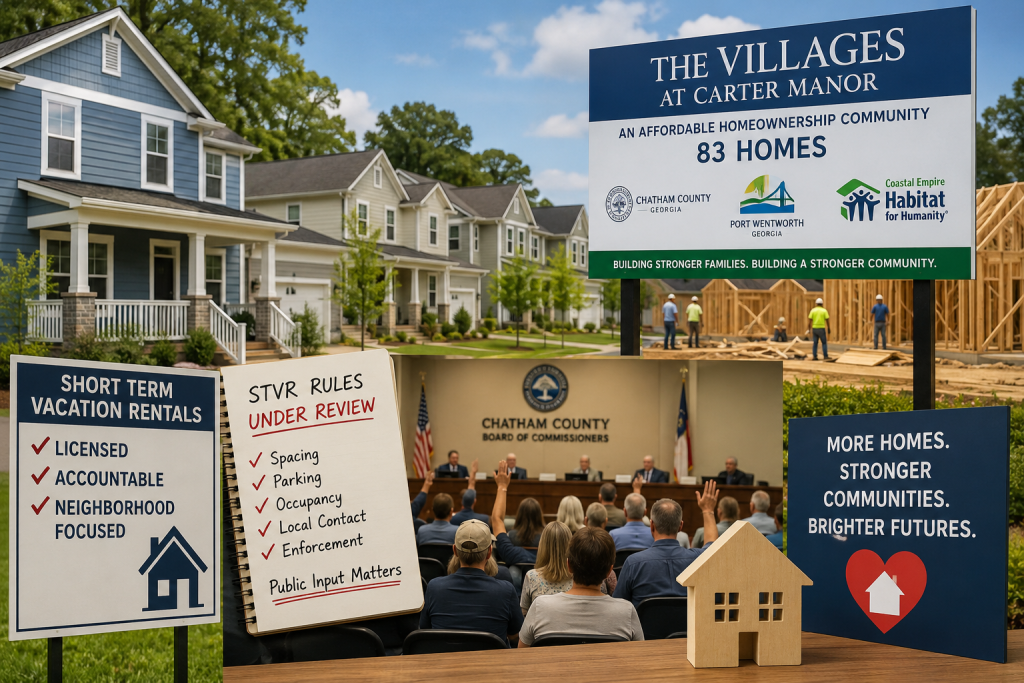
Those two questions are moving on separate tracks. Proposed changes to short term vacation rental rules in unincorporated Chatham County have been paused for more public review. At the same time, The Villages at Carter Manor in Port Wentworth is moving forward as a major affordable homeownership project backed by local partnerships and public funding.
Together, the two developments show the difficult balance local leaders are trying to strike. Chatham County must protect neighborhood stability, respect property rights, and expand housing supply in a region where growth is adding pressure on families, workers, and long time residents.
Why The STVR Debate Matters Locally
Short term vacation rentals, often listed through platforms such as Airbnb and Vrbo, have become a larger part of the housing conversation across Coastal Georgia. For some property owners, they provide income and flexibility. For some neighbors, they raise concerns about noise, parking, trash, septic capacity, public safety, and the loss of homes that could otherwise support long term residents.
Chatham County already regulates short term rentals in the unincorporated area. The current county process requires a short term vacation rental certificate, occupation registration, annual renewal, proof of insurance, proof of trash service, proof of fire service, a parking diagram, local contact information, and posted rules for parking, occupancy, noise, and emergency contact information.
That existing structure is important because the current debate is not about whether Chatham County has any rules. It is about whether the rules need to be strengthened, clarified, or enforced differently as more residents report neighborhood concerns.
What The County Paused
The proposed updates under review would go further than the current ordinance. Reported changes have included spacing limits between new short term rentals, stronger accountability for local contacts, clearer license visibility, parking requirements, occupancy controls, septic system concerns, and additional enforcement tools.
The proposal also drew attention because it would affect unincorporated Chatham County only. It would not control short term rental rules inside municipalities such as Savannah, Pooler, Port Wentworth, or Tybee Island.
After public feedback and continued discussion, Chatham County did not move forward with an immediate final vote. The county listed a press release announcing that the commission would postpone the vote on STVR ordinance changes following community input, and commissioners later continued review through a public workshop.
That pause gives residents, property owners, county staff, and elected leaders more time to consider whether the final rules are enforceable, fair, and strong enough to address the most common neighborhood complaints.
A Question Of Balance
Chatham County Chairman Chester A. Ellis summarized the issue clearly during the ongoing discussion: “How do we balance?”
That question is at the center of the STVR debate. A rule that is too weak may leave residents feeling that commercial rental activity is changing the character of residential streets. A rule that is too broad may unfairly affect homeowners who operate responsibly or depend on rental income to manage rising costs.
The strongest local policy will likely need to focus on accountability. That means clear licensing, visible registration numbers, responsive local contacts, realistic occupancy limits, parking compliance, tax compliance, environmental awareness, and consequences for repeat violations.
For neighborhoods, the concern is not simply that visitors are staying nearby. The deeper concern is whether a growing concentration of investor operated rentals changes the rhythm of daily life in residential areas and reduces the supply of homes available for local families.
Affordable Housing Moves Forward In Port Wentworth
While the STVR debate focuses on how to manage existing homes, The Villages at Carter Manor focuses on adding new homeownership opportunities inland.
Chatham County, the City of Port Wentworth, and Coastal Empire Habitat for Humanity are working together on the project, which is planned as an 83 unit affordable homeownership community. The project is designed to help working families move toward permanent homeownership rather than being permanently priced out of the local market.
A major milestone came with the announcement of a $1.2 million federal grant connected to the project. Chatham County also previously identified a $1 million ARPA contribution for soil testing, land acquisition, and site planning. Separate state funding also supports infrastructure tied to the Port Wentworth housing effort, including water, sewer, road, and drainage improvements.
The development is especially important because Port Wentworth sits in one of the region’s growth corridors. Industrial expansion, logistics activity, port related employment, and nearby job creation are increasing housing demand across inland Chatham County and surrounding communities.
More jobs can strengthen the region. But if housing supply does not keep pace, working families can find themselves pushed farther from schools, jobs, family support, and essential services.
Why These Two Stories Belong Together
The STVR pause and the Carter Manor housing project are not separate issues. They are two sides of the same housing pressure.
Short term rental rules are about protecting existing neighborhoods. Affordable housing development is about creating new paths into ownership. Chatham County needs both conversations if it wants growth to benefit the people who already live and work here.
Regulation alone will not solve the housing crunch. New construction alone will not protect established neighborhoods from disruption. The better approach is a combined strategy that manages rental impacts, preserves neighborhood livability, and creates more attainable housing options for local families.
That is what makes the current moment important. Chatham County is not only debating what should be restricted. It is also investing in what should be built.
What Residents Should Watch Next
Residents in unincorporated Chatham County should continue monitoring Board of Commissioners agendas, public workshop notices, and any revised ordinance language related to short term vacation rentals.
Property owners should watch for possible changes to spacing rules, license display rules, local contact response expectations, occupancy requirements, parking requirements, and enforcement penalties.
Residents concerned about neighborhood impacts should document recurring problems clearly, including dates, times, addresses, parking issues, noise complaints, trash issues, septic concerns, and public safety concerns. Clear documentation helps officials evaluate whether problems are isolated, repeated, or tied to specific properties.
Residents interested in affordable homeownership should monitor updates from Chatham County, the City of Port Wentworth, and Coastal Empire Habitat for Humanity regarding The Villages at Carter Manor, eligibility criteria, application timelines, and future homeowner information.
For Coastal Georgia families, this is not just a policy debate. It is about whether local neighborhoods remain livable, whether working families can afford to stay, and whether growth can be managed without leaving existing residents behind.
Community Alert
Residents can monitor upcoming Chatham County agendas, public workshop notices, and local housing updates through official county channels. E-Safe will continue sharing community focused updates at www.e-safe.us.
Sourcing
- Chatham County, Georgia: Chatham County Code Book, Article XIII, Short Term Rental Ordinance
https://www.chathamcountyga.gov/OurCounty/CodeBook - Chatham County Department of Building Safety and Regulatory Services: Short Term Rental Certificate Information
https://cms.chathamcountyga.gov/api/assets/buildingsafety/eff77bf7-d731-4ea5-bae5-f41dab02ce20?download=0 - Chatham County, Georgia: Second Public Meeting, Proposed Updates to the Short Term Rental Ordinance
https://www.chathamcountyga.gov/OurCounty/newsArticle/4bbcb535-62d0-473c-9200-a2895ddca531 - Chatham County, Georgia: Press Releases, Chatham County Commission to Postpone Vote on STVR Ordinance Changes Following Community Input
https://www.chathamcountyga.gov/OurCounty/PressReleases - Chatham County, Georgia: Chatham County Board of Commissioners to Hold Workshop on Short Term Vacation Rental Ordinance
https://cms.chathamcountyga.gov/api/assets/public-information/7bd38318-3838-48d6-ba7e-d169785ba4fc?download=0 - WTOC: Chatham County Reviews Short Term Rental Ordinance
https://www.wtoc.com/2026/06/15/chatham-county-reviews-short-term-rental-ordinance/ - WJCL: Chatham County Considers Stricter Vacation Rental Ordinance
https://www.wjcl.com/article/chatham-county-short-term-rental-ordinance-first-meeting/71256172 - Chatham County, Georgia: Student Art Contest Launch and $1.2 Million Federal Grant Announcement to Support New Homeownership Development in Port Wentworth
https://www.chathamcountyga.gov/OurCounty/newsArticle/f1664a33-004e-4b2c-91f1-69b65cf9c48c - Chatham County, Georgia: Chatham County, City of Port Wentworth, Habitat for Humanity Break Ground on Affordable Housing Project
https://www.chathamcountyga.gov/OurCounty/newsArticle/c0a234af-ae69-4491-b247-74cc4b1367f8 - Governor Brian P. Kemp Office of the Governor: Brunswick and Chatham County Rural Workforce Housing Grant Awards
https://gov.georgia.gov/press-releases/2024-09-20/gov-kemp-announces-brunswick-and-chatham-county-rural-workforce-housing - City of Port Wentworth: City of Port Wentworth Awarded $2,362,492 Rural Workforce Housing Initiative Grant
https://portwentworthga.gov/mediareleases-city-port-wentworth-awarded-rural-workforce-housing-initiative-grant/