
Share this article
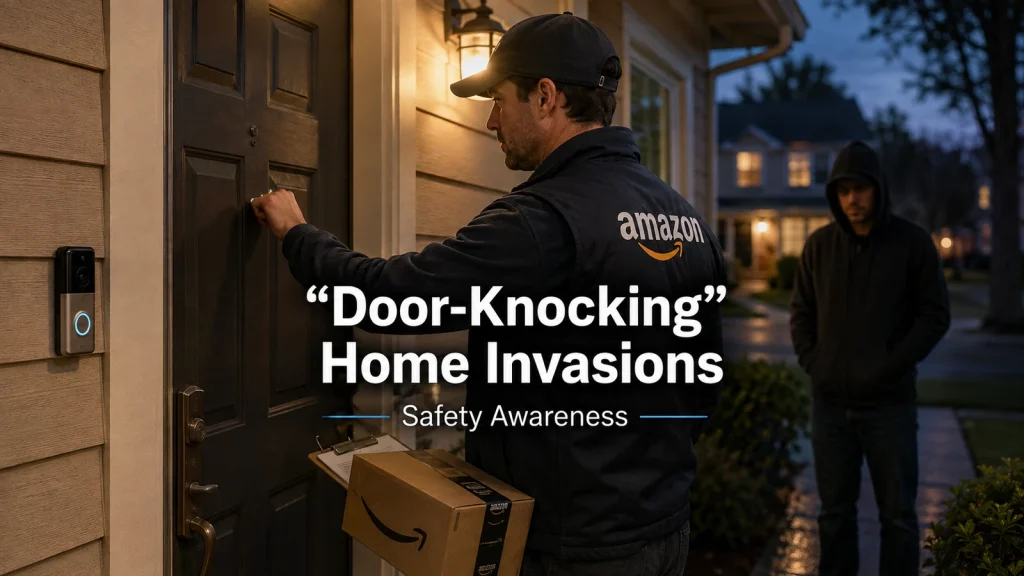
Community Safety · Crime Prevention
Door-Knocking Home Invasions
This awareness article explains how door knocking home invasions use fake deliveries, utility claims, and emergency stories, while giving residents practical steps to verify visitors and secure doors.
Safety awareness overview
This is not being presented as a current nationwide crime wave or a confirmed local trend. Current national crime reporting continues to show residential burglary and many violent crime categories moving downward. Still, recent public reminders from the Savannah fake delivery attack and the South Carolina broken down vehicle case show why the tactic remains important for community education.
The concern is not the number of incidents alone. The concern is the method. In these cases, the front door becomes the weak point because the person outside tries to make the resident open it voluntarily. Once the door opens, the situation can change in seconds.
What this tactic is
A door knocking home invasion is commonly tied to a ruse entry method. The person at the door may pretend to be a delivery worker, utility worker, stranded driver, contractor, neighbor, charity worker, or someone with an emergency.
The objective is simple. Create just enough trust, urgency, confusion, or compassion to get the resident to unlock or open the door.
Common versions
- A fake package delivery.
- A claim that a signature is required.
- A fake utility issue such as gas, water, internet, or power.
- A story about a broken down vehicle.
- A request to use a phone, bathroom, water, or charger.
- A claim that a package belongs to a neighbor.
- A person knocking while another person stays out of view.
- A prior test visit to see who is home and how the household responds.
Recent examples that explain the concern
In Savannah, Georgia, a January 2025 attack involved men posing as Amazon style delivery workers. The victim reportedly opened the door believing a package was being delivered, and the suspects forced their way inside and assaulted him.
In Spartanburg County, South Carolina, the underlying crime occurred in 2020, but recent court activity brought the case back into public view. Prosecutors described a broken down vehicle story used at the door before Kelli Curran and Timothy Thompson allowed the men inside. The case ended in murder convictions and major prison sentences.
Other public cases show the same general pattern. In Stamford, Connecticut, police reported a 2026 home invasion where suspects wore Amazon style delivery vests and claimed a signature was needed. In Michigan, authorities reported a deadly 2024 case involving men who claimed to be utility workers checking for a gas leak. In California, reported crypto related home invasion cases used delivery and service style ruses to get targeted victims to the door.
The lesson is consistent. A uniform, vest, box, clipboard, or emergency story is not verification.
Warning flags at the door
- The visit is unexpected.
- The person wants the door opened immediately.
- The person asks to enter the home.
- The person claims a package requires a signature that was not expected.
- The person says there is an urgent utility problem but you received no notice.
- The person stands too close to the door or off to the side of the camera.
- More than one person is present, but only one person speaks.
- A second person appears to be hiding near the porch, garage, walkway, or vehicle.
- The person wears generic clothing, a vest, or a logo item but has no clear vehicle or identification.
- The person asks to use your phone, bathroom, charger, or water.
- The person becomes irritated when you refuse to open the door.
- The story keeps changing.
- The person tries to make you feel guilty for verifying.
- A vehicle is parked nearby with the engine running.
- The same person or vehicle has been seen knocking at other homes.
Protective measures residents can take
The safest rule is simple. Do not open the door to an unverified person.
- Speak through a locked door, window, doorbell camera, or intercom.
- Keep the main door locked even if a storm door is closed.
- Let unexpected packages remain outside until the person leaves.
- Verify deliveries through the official app or order history.
- Verify utility visits by calling the company number from your bill or official website.
- Do not call a number provided by the person at the door.
- If someone claims an emergency, offer to call 911 for them while staying inside.
- Do not allow strangers to use your phone inside the home.
- Do not step outside to inspect a package, vehicle, meter, or paperwork if the person is unknown.
- Do not disclose whether you are alone.
- Keep porch cameras, exterior lighting, and visible house numbers functional.
- Use reinforced strike plates, quality deadbolts, and long screws into the door frame.
- Keep valuables, firearms, cash, jewelry, and crypto holdings private.
- Teach children and older family members not to open the door without approval.
- Report suspicious door knocking activity quickly.
If you already opened the door
If the person seems suspicious, do not argue at the doorway. Close and lock the door if you can do so safely. Move away from the entry point. Call 911 if the person refuses to leave, tries the handle, blocks the door, threatens you, or attempts entry.
If someone forces entry, focus on distance, escape, cover, and calling 911. Avoid trying to protect property. Property can be replaced. People cannot.
Community awareness matters
Neighbors should report suspicious door knocking activity, especially when people are moving house to house with the same story. Doorbell video, vehicle descriptions, clothing details, direction of travel, and time of day can help law enforcement connect incidents.
This awareness article is not meant to create fear. It is meant to build a simple household habit.
Do not open the door first and verify later.
Verify first. Keep the barrier closed. Help from inside when needed.
Professional sourcing
- FBI, FBI Releases 2025 Reported Crimes in the Nation Statistics
- FBI, FBI Releases Historic Early Look at Annual Crime Data
- Council on Criminal Justice, Crime Trends in U.S. Cities: Mid Year 2026 Update
- WTOC, Man accused of posing as Amazon worker during home invasion indicted
- WTOC, Man arrested in fake Amazon delivery assault should’ve never been on the streets, prosecutors say
- Fox Carolina, Spartanburg man receives life sentence for double murder after 2 shot in 2020
- Seventh Circuit Solicitor, Spartanburg County, Spartanburg Man Sentenced To 55 Years In Prison For Double Murder
- Stamford Advocate, Armed men posing as Amazon workers invaded Stamford home and assaulted couple, police say
- Associated Press, 2 men arrested in utility ruse that led to the killing of a Detroit area man
- San Francisco Chronicle, Fake deliveries, then guns