
Share this article
Community News · E-Safe News
Keller Market Square Phase 1 and the Little Neck Road Timeline Collision
Keller Market Square Phase 1 now overlaps Little Neck Road widening. This update explains the revised construction timeline, likely congestion peak, and when traffic pressure should begin to ease now.
Keller Market Square Phase 1 and the Little Neck Road Timeline Collision
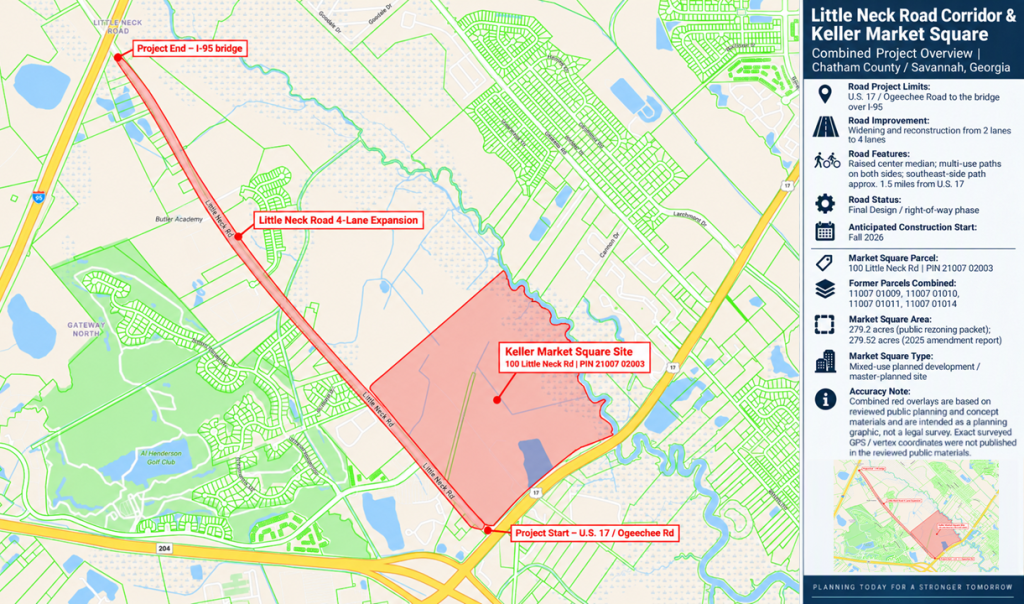
The development timeline along Little Neck Road has materially changed. When Keller Market Square was evaluated in 2024, its planning documents anticipated that Chatham County would complete the principal Little Neck Road improvements during 2026. Keller was expected to develop in phases after site development and permitting.
Keller Market Square Phase 1 has now received its major subdivision approval while the road project remains in Final Design and construction is only now anticipated to begin in Fall 2026.
That creates a new period in which major private development and major public road construction may occur at the same time.
Major subdivision approval confirmed.
Current anticipated construction start after right of way acquisition.
Current SPLOST project completion listing.
Expected period of strongest overlap if current schedules hold.
What Changed From the Original Plan
The original Keller development record and the current Little Neck Road schedule now describe two very different sequences.
A More Realistic Keller Development Timeline
Keller’s original phasing plan provides the best public framework for estimating what comes next. It said Phase 1 would begin with utilities and internal infrastructure and anticipated approximately 6 to 12 months for permitting and site development before residential vertical construction. It then anticipated as much as 24 months for that vertical construction.
If that sequence is applied from the current Phase 1 implementation stage, rather than from the original 2024 planning assumptions, the following becomes a reasonable forecast. These dates are analytical projections, not announced contractor dates.
Why the Overlap Can Make Traffic Worse Before It Gets Better
The conflict is not simply that Keller will eventually produce more traffic. The near term problem is that construction activity may be added to a corridor that is itself being reconstructed.
- Little Neck Road currently provides limited redundancy while the existing corridor is being converted to a four lane divided roadway.
- Road construction can require traffic shifts, utility work, drainage construction, median work, intersection work and reduced operating speeds.
- Keller site development can introduce dump trucks, concrete trucks, material deliveries, utility contractors and slow turning construction vehicles.
- Keller also requires new access points, turn lane improvements and potentially new traffic signals.
- Ordinary New Hampstead residential growth will continue throughout the same period.
Expected Traffic Timeline for New Hampstead Residents
The first period should be dominated by road project mobilization, remaining right of way activity, utility work and early traffic management, while Keller progresses through implementation and site preparation.
Permanent Keller traffic should still be relatively limited. The larger issue will be travel time variability and construction vehicle movements.
This is the point where substantial Little Neck Road widening work can overlap Keller civil construction, utility work, internal roads and the beginning of residential vertical construction.
Based on the schedules currently available, 2028 presents the strongest potential overlap between the road widening, Keller construction, intersection and access work, and continuing New Hampstead growth.
If the roadway project or Keller infrastructure work slips, this high pressure window can extend farther into 2029.
If the current County schedule holds, four lane road capacity should begin replacing the work zone constraint. Construction related congestion should decline, but Keller residential and commercial traffic will increasingly become part of the ordinary traffic load.
Long Term Traffic Does Not Disappear When Construction Ends
The four lane roadway should provide a substantial capacity improvement. The end of road construction therefore should remove an important temporary source of congestion.
But by that point Keller may be transitioning from construction traffic to permanent residential and commercial traffic.
At full development, the 2024 Keller traffic analysis calculated approximately 17,158 new external daily vehicle trips after the study’s stated reductions, including approximately 1,451 new external trips during the PM peak period. Those are full development estimates and should not be interpreted as traffic that will appear immediately.
What Must Be Watched Next
Several documents and construction milestones can materially change this forecast.
Bottom Line for The Palms
The original planning sequence effectively placed major roadway capacity ahead of significant Keller development.
The current schedule creates a different sequence: Little Neck Road widening, Keller Market Square development and continued New Hampstead growth can now occur together.
The most reasonable current traffic risk window is 2027 through 2028, with 2028 presently representing the greatest potential for combined construction pressure.
If the County’s current December 2028 road schedule holds, construction related traffic problems should begin easing during late 2028 and 2029 as four lane capacity becomes available. The corridor will not return to its present traffic profile because the development itself will continue generating new trips.
The long term question therefore is not simply when construction ends. It is whether the completed transportation improvements remain ahead of the permanent growth they are being built to accommodate.
Additional Detail
What October 6 Actually Confirms
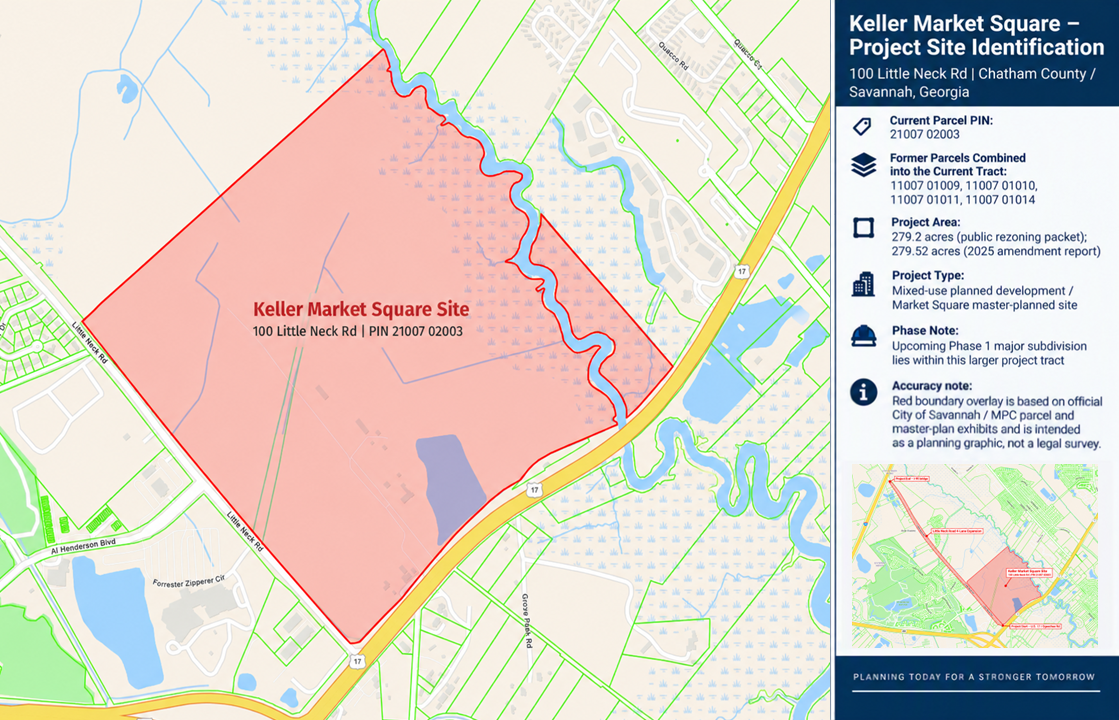
The October 6, 2026 MPC Action Minutes confirm approval of the Major Subdivision for Keller Market Square Phase 1 at 100 Little Neck Road, file 26 002790 SUBP.
That action advances the property from master planning into Phase 1 subdivision implementation. It does not by itself constitute a building permit, land disturbance permit, contractor Notice to Proceed or ceremonial groundbreaking.
Original Keller Timeline
The applicant’s May 2024 phasing narrative anticipated approximately 96 months of overall development. The document also stated that Chatham County anticipated completing the Little Neck Road expansion during 2026.
Its residential absorption model placed no new residential units in the first two years and began substantial occupancy later in the development cycle.
Current Little Neck Road Schedule
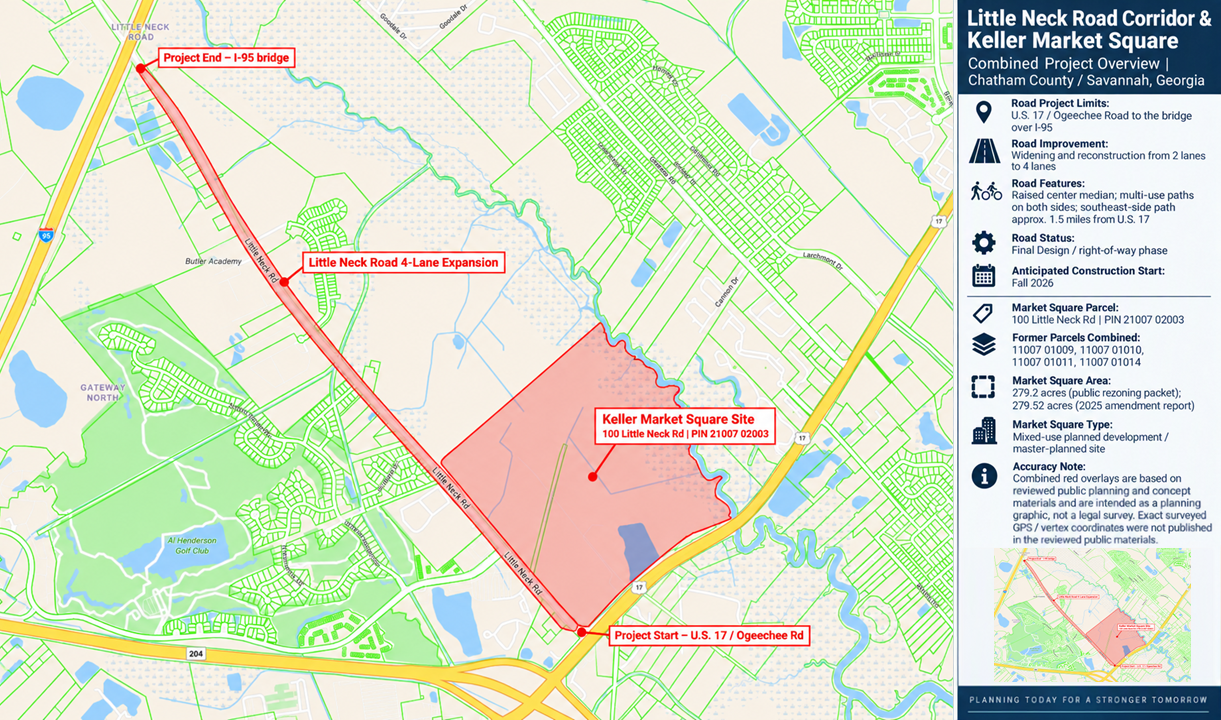
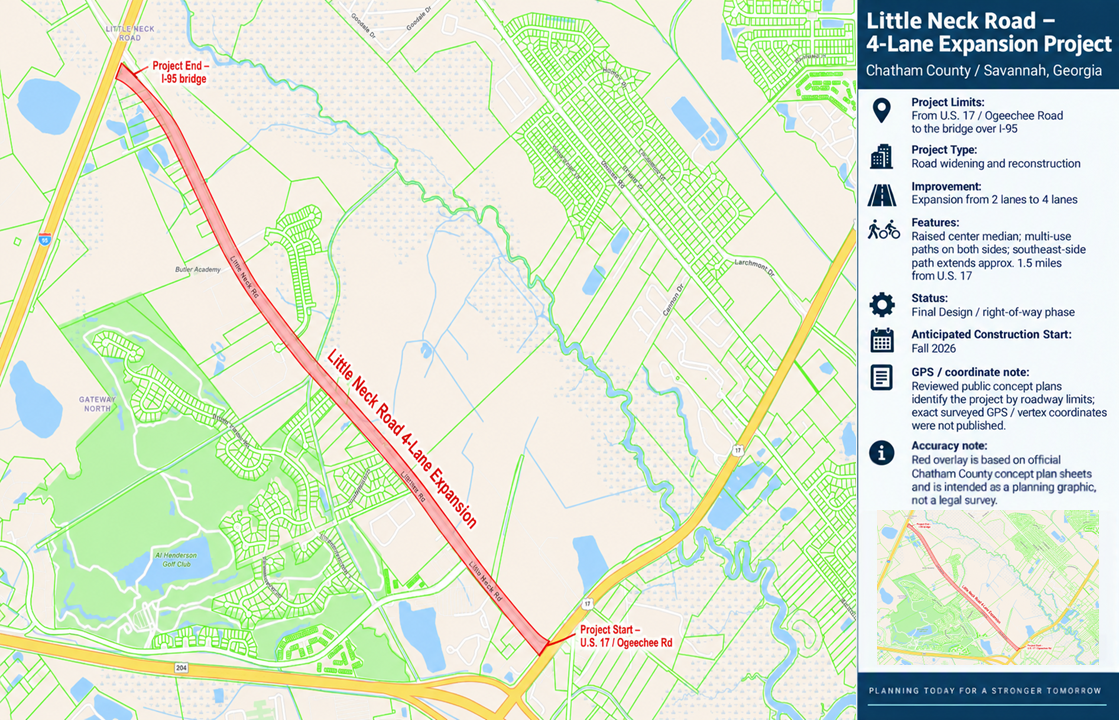
Chatham County currently lists Little Neck Road in Final Design and anticipates construction beginning in Fall 2026 following right of way acquisition.
The current SPLOST 7 listing shows December 27, 2028 as the project completion date. The County’s current public description calls for widening and reconstruction from U.S. 17 to the I 95 bridge from two lanes to four lanes.
This is broader than the road configuration assumed in Keller’s 2024 traffic study, which described four lanes between U.S. 17 and Al Henderson Boulevard and a new two lane section north to I 95.
Phase 1 Construction Detail
Keller’s original Phase 1 included utilities and internal infrastructure, multifamily and senior housing development, and preparation of commercial sites for future purchasers.
The applicant anticipated 6 to 12 months of permitting and site development before residential vertical construction and up to approximately 24 months for that vertical construction thereafter. Commercial timing was expressly tied to market demand.
Traffic Study Detail
Keller’s traffic analysis studied future 2030 conditions and incorporated the planned Little Neck Road improvements into that future roadway network.
At full development the study calculated 28,120 daily trips before reductions and approximately 17,158 new external daily trips after reductions. The PM peak contained approximately 1,451 new external trips.
The study projected Level of Service F and approximately 85.8 seconds of delay for the westbound approach at the southern Keller driveway during the PM peak. That finding applies to the modeled future condition and is not a forecast of road construction delays.
Signals and Access Improvements
The traffic analysis recommended a potential traffic signal at Little Neck Road and Al Henderson Boulevard with Keller Site Driveway 3 if signal warrants are satisfied and approval is granted.
It also identified a potential signal on U.S. 17 at Keller Site Driveway 1 if warrants are met and GDOT approves it. Turn lanes and other driveway improvements are also part of the mitigation recommendations.
What Residents May Experience
During the overlap period, the most noticeable issue may be travel reliability rather than permanent development traffic alone. Construction trucks, traffic shifts, reduced work zone speeds, drainage construction, utility work and intersection work can create significant day to day variation.
The exact effect cannot be quantified until a current Maintenance of Traffic plan and actual construction staging schedule are public.
What Could Change This Forecast
A later road Notice to Proceed would move the congestion peak later. Faster roadway construction could shorten it. Early Keller land disturbance could increase the overlap. Delayed residential construction could reduce the initial impact.
Weather, utility relocation, property acquisition, environmental approvals, construction procurement, signal warrants and market demand can all alter individual dates.
Professional Sourcing
What October 6 Actually Confirms
The official October 6, 2026 MPC Action Minutes record approval of the Major Subdivision for Keller Market Square Phase 1 at 100 Little Neck Road.
The agenda identifies the Phase 1 subdivision material as involving Keller parcels 10, 11, 12, 13, 14 and 15.
What It Means
Phase 1 has progressed beyond the master planning stage into subdivision implementation. That is a material development milestone.
What It Does Not Mean
The vote is not itself a contractor Notice to Proceed, land disturbance permit, building permit or confirmed groundbreaking date. Those are separate milestones that should continue to be monitored.
The Original 2024 Development Sequence
Keller’s May 2024 narrative anticipated approximately 96 months of development and expressly stated that Chatham County anticipated completing the Little Neck Road expansion during 2026.
The residential absorption table projected no new residential units in the first two years, followed by significant additions beginning in later years.
The practical planning assumption was therefore that substantial public roadway capacity would be available before the project approached its heavier residential and commercial traffic stages.
Little Neck Road: Current Schedule and Scope
Chatham County currently identifies the project as Final Design and anticipates construction beginning after right of way acquisition in Fall 2026.
The current County project description says the roadway will be widened and reconstructed from U.S. 17 to the bridge over I 95, expanding the existing two lane roadway to four lanes with a raised center median.
The SPLOST 7 project listing currently shows December 27, 2028 as the completion date.
Scope Has Also Evolved
Keller’s 2024 traffic study described four lane widening between U.S. 17 and Al Henderson Boulevard and a new two lane section between Al Henderson Boulevard and I 95.
More recent County material describes a full four lane section through the overall project limits. That provides greater ultimate capacity but also represents substantial roadway construction during the interim.
Keller Phase 1 Construction Sequence
The original Phase 1 plan called first for utilities and internal infrastructure on the western portion of the site.
Residential areas and senior housing were included in the first phase, while several commercial areas were to be prepared as pad ready sites and marketed to purchasers.
The applicant anticipated 6 to 12 months for permitting and site development before residential vertical construction and expected vertical residential construction to be completed within approximately 24 months thereafter.
Commercial vertical construction was not assigned the same fixed schedule. It was tied to market demand and future purchasers.
What the Keller Traffic Study Does and Does Not Predict
The study evaluated future 2030 traffic conditions and incorporated planned Little Neck Road improvements into those future conditions.
Full Development Estimates
- 28,120 daily trips before study reductions
- Approximately 17,158 new external daily trips after reductions
- Approximately 1,451 new external PM peak trips
These figures represent the modeled full development condition. They are not expected to appear immediately when Phase 1 construction begins.
Important Limitation
The analysis did not model a prolonged scenario in which major Keller site construction occurs at the same time Little Neck Road itself is being widened through an active work zone.
Signals, Turn Lanes and Keller Access
The traffic study identified several mitigation improvements associated with Keller access.
- Potential traffic signal at Little Neck Road and Al Henderson Boulevard with Keller Site Driveway 3 if warrants are met and the signal is approved
- Potential traffic signal on U.S. 17 at Keller Site Driveway 1 if warrants are met and GDOT grants approval
- Left turn and right turn lanes serving Keller access points
- Changes to the U.S. 17 median opening associated with the proposed Keller access
These improvements are important because some of their construction can itself contribute to short term traffic disruption before providing long term operational benefits.
What Residents May Experience During the Overlap
The most immediate issue is likely to be reliability rather than a constant delay of the same length every day.
- Temporary traffic shifts
- Reduced work zone speeds
- Utility and drainage work
- Slow turning construction vehicles
- Material deliveries and concrete trucks
- Median and intersection construction
- New Keller access and turn lane work
Until Chatham County releases a detailed Maintenance of Traffic plan, individual lane closure patterns and construction stages should not be presented as confirmed.
What Could Move the Traffic Timeline
The current forecast should be treated as a planning range rather than a fixed contractor schedule.
Factors That Could Extend the High Pressure Period
- Delayed Little Neck Road construction
- Utility relocation problems
- Weather related delays
- Right of way or construction staging issues
- Keller civil construction beginning earlier than expected
Factors That Could Reduce the Overlap
- Faster completion of the widened road
- Delayed Keller vertical construction
- Effective construction traffic staging
- Early availability of newly constructed road lanes
The next decisive records will be the road construction award or Notice to Proceed, the Maintenance of Traffic plan and Keller land disturbance or site development permits.