
Share this article
Community News · E-Safe News
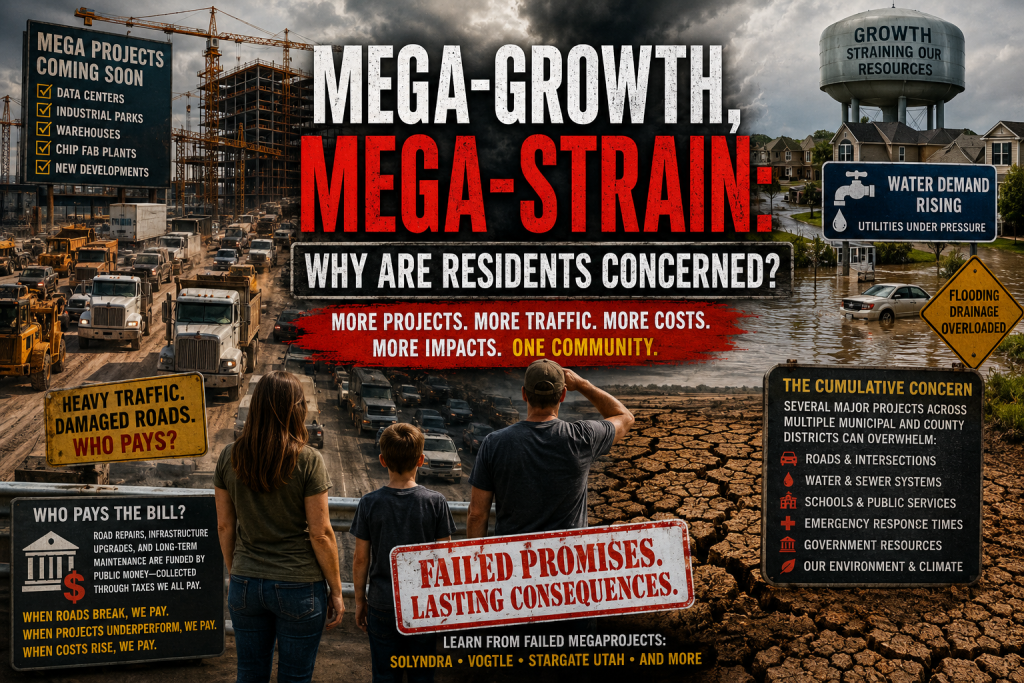
Mega-Growth, Mega-Strain: Why Are Residents Concerned?
Coastal Georgia is absorbing historic industrial and population growth. This report examines water, electricity, traffic, housing, environmental safeguards, and the public demand for transparency now.
Mega-growth, mega-strain: Why are residents concerned?
By: E-Safe, www.e-safe.us
Coastal Georgia is being transformed at a pace few communities experience. The Hyundai Motor Group Metaplant, battery production, supplier plants, expanding logistics districts, Port of Savannah growth, new subdivisions, utility projects, and the proposed Project Camellia data center are all drawing upon the same regional roads, water systems, electrical grid, workforce, housing supply, drainage network, natural resources, and public services.
Residents are not simply asking whether one factory or data center can be permitted. They are asking whether the combined effects of every project are being measured together, whether infrastructure can keep pace, whether public resources will remain reliable, and who will ultimately pay for the roads, utilities, schools, emergency services, environmental protections, and climate resilience these developments require.
Economic growth can create jobs, tax revenue, business opportunities, and new careers. Those benefits should be considered alongside the complete public cost. A project that appears financially beneficial in isolation may look different after tax incentives, road construction, utility expansion, public safety staffing, maintenance, climate protection, and long term infrastructure obligations are included.
These projects must be evaluated as one regional system
The Hyundai Metaplant is not only an automobile factory. Its regional footprint includes battery manufacturing, supplier operations, employee housing, freight movements, warehouses, rail activity, utility extensions, and roadway construction.
Project Camellia is not only a group of data center buildings. Its footprint includes a proposed 3.2 gigawatts of electrical capacity, transmission infrastructure, substations, construction traffic, water service, stormwater management, emergency planning, backup systems, and long term public oversight.
The same regional systems must also support continued port growth, expanding warehouse districts, residential construction, commercial centers, existing industries, farms, schools, neighborhoods, and ordinary household demand.
A development may be located within one municipal or county jurisdiction while creating consequences throughout the surrounding region. Employees and freight carriers may travel through several communities. Water may be withdrawn in one county, treated in another, and consumed by development elsewhere. Electrical generation and transmission projects may be built far from the customer they serve. Housing demand, school enrollment, emergency response, pollution, and stormwater effects can similarly cross jurisdictional boundaries.
This creates a significant planning gap. Local officials may reasonably concentrate on the smaller geographic area they govern, the tax revenue their jurisdiction expects to receive, and the infrastructure located within their boundaries. Neighboring communities may still inherit additional traffic, road wear, utility pressure, housing costs, environmental risk, or public service demand without receiving the same financial benefits or having an equal voice in the approval process.
The regional concern is therefore not only the size of each project. It is the possibility that many local governments are approving separate pieces of development without any one authority calculating the total regional burden.
The cumulative concern: A single project may appear manageable when evaluated only within the municipality or county approving it. Its effects, however, do not stop at city limits or county lines. Freight traffic, road wear, water demand, electrical load, housing pressure, school enrollment, stormwater runoff, air pollution, emergency response demands, and environmental impacts can extend into neighboring communities that had little or no role in approving the development.
Local leaders are understandably focused on the jurisdiction they represent. The larger risk arises when several cities and counties evaluate separate megaprojects independently, with each government seeing only what appears to be a manageable local share. Without a coordinated regional assessment, no single authority may be measuring the combined burden placed on the same highways, water supplies, electrical grid, watersheds, housing market, workforce, public services, and natural resources.
A factory in one county, a data center in another, port related development in a third, and new warehouses and subdivisions across several municipalities may all depend on the same regional infrastructure. Individually approved projects can therefore combine into a much larger problem than any one local review identifies. Regional impacts require regional planning, shared data, coordinated public hearings, and enforceable agreements among every affected city, county, utility, transportation agency, and environmental authority.
Who pays for the roads?
The direct answer is that the public often pays a substantial portion. When a city, county, the Georgia Department of Transportation, or the federal government pays for a road, bridge, interchange, or resurfacing project, public money is being used. That money ultimately comes from taxpayers, public debt, fees, or revenue that could otherwise support another public need.
A newly announced tax increase is not required for the public to assume the cost. Existing motor fuel taxes, federal tax revenue, county property and general fund revenue, sales taxes, transportation sales taxes, and bonds are all public funding sources.
Federal transportation money is still taxpayer money, although the cost is spread across the country. State funding is paid collectively by Georgia taxpayers and road users. Local sales taxes are paid by residents, businesses, and visitors who make taxable purchases. Bonds do not eliminate a cost. They move payment into future budgets and usually require repayment with interest.
When existing funds are redirected toward growth related infrastructure, residents may not see a new tax line. They can still experience the cost when another road, school, park, drainage project, public safety need, or maintenance priority must wait.
| Cost | Who commonly pays | How the public may be affected |
|---|---|---|
| Private roads and internal site circulation | Developer or project company | Usually a direct private project cost. |
| Driveways, entrances, turn lanes, and site access | Often the developer, sometimes shared | The exact obligation depends on permits and development agreements. |
| Major highway widening, interchanges, and bridges | State, federal, or local transportation agencies | Funded through taxes, public programs, or public debt unless a private contribution is required. |
| Routine resurfacing and long term maintenance | The public road owner | Normally paid through future public transportation and maintenance budgets. |
| Transportation impact fees | Qualifying new development | Fees generally cover only a proportionate share of eligible growth related capital improvements. |
| Documented contractor or hauling damage | Potentially the contractor, hauler, developer, or project company | Recovery usually requires evidence and an enforceable contract, permit condition, bond, or legal obligation. |
| Water, sewer, and electrical expansion | Developer payments, utility customers, bonds, grants, or shared arrangements | Residents can be affected through utility rates and fees even when tax revenue is not used. |
| Tax incentives and abatements | Public agencies forgo some anticipated revenue | The public cost appears as revenue the community does not receive rather than as a direct payment. |
Construction crews do not automatically pay for public road wear
Construction crews and subcontractors are paid to perform work. They do not automatically assume responsibility for repairing the wider public road system simply because their vehicles use it.
A contractor may be required to remove debris, repair documented damage, follow designated truck routes, or maintain a construction area when a contract or permit places that obligation on the company. Outside those conditions, the public agency that owns the road generally remains responsible for long term maintenance.
The Hyundai area shows how public funding can support growth
Georgia Department of Transportation materials identify three major projects serving the Hyundai area and the surrounding region. These include the Interstate 16 frontage road at approximately $29.7 million, the United States Route 280 widening at approximately $83 million, and the Old Cuyler Road interchange at approximately $74.6 million.
Their listed contract values total approximately $187.3 million. Georgia DOT describes the transportation projects and the Bryan County Megasite as separate endeavors, while also stating that the projects provide more efficient access to the Metaplant and surrounding area.
These roads benefit more than Hyundai. They can improve regional mobility, safety, and access for other users. They are nevertheless public transportation investments supported by public funding and developed in response to the demands created by major regional growth.
Project Camellia’s public cost must be itemized
OpenAI states that Project Camellia will be entirely privately funded and that the company will pay the electrical infrastructure and service costs required to serve its power demand.
That commitment should not automatically be interpreted as proof that every off site road, bridge, signal, water line, sewer improvement, stormwater project, fire station, emergency vehicle, government employee, or regional power project will be privately funded.
Those responsibilities should be stated in binding development agreements, utility contracts, permits, road use agreements, the proposed Georgia Community Compact, and other enforceable documents. The public should be able to see which expenses are private, which are public, which are shared, and what happens if the project is delayed, reduced, transferred, or abandoned.
Water and electricity promises must be measured against actual use
Hyundai’s water demand
Hyundai has estimated that the Metaplant will require approximately 4 million gallons of water per day at full production. That would equal approximately 1.46 billion gallons during a full year.
The associated groundwater permits allow a combined maximum of approximately 6.625 million gallons per day for the industrial system and related development. Continuous use at the full permit ceiling would equal approximately 2.42 billion gallons annually.
A permit ceiling is not proof that the maximum amount is currently being withdrawn. Public discussion should distinguish permitted capacity, projected future demand, peak demand, construction demand, and measured operating use.
The water is initially expected to come from the Floridan Aquifer through wells connected to Bryan and Bulloch County systems. A settlement involving Ogeechee Riverkeeper shortened the planned transition period for an alternative water supply from 25 years to 15 years and added further water quality testing.
Project Camellia’s current commitments
OpenAI says Project Camellia will use a closed loop cooling system that recirculates water and keeps continuing consumption comparable to an ordinary workplace with a similar number of employees.
The project is also contracting for 3.2 gigawatts of electrical capacity to be delivered in phases between 2028 and 2032. OpenAI says residential electric rates will not increase because of the project and that the campus will reduce demand during periods of grid stress.
Georgia Public Service Commission rules include minimum billing requirements, longer contracts, contract review, and other protections intended to prevent large customers from shifting infrastructure costs to existing customers. Those protections are meaningful, but they must continue to be tested through actual contracts, construction costs, rate proceedings, project performance, and enforcement.
What still needs to be publicly verified
- The amount of water required to fill the cooling system
- Average, peak, and annual water demand during construction and operation
- Water required for maintenance, landscaping, fire protection, and emergency cooling
- The source of the water and its effect during drought conditions
- Wastewater volume and treatment requirements
- Actual electrical consumption compared with contracted capacity
- The generation, transmission, and substation projects required to serve the campus
- The number, fuel type, emissions, noise, and testing schedule of backup generators
- The audit method, reporting schedule, and enforcement process for every public commitment
Other communities show why early estimates are not enough
These examples do not prove that Hyundai or Project Camellia will exceed their stated demands. They demonstrate why construction use, operating use, peak demand, indirect resource use, and cumulative regional demand must be reported separately and verified over time.
Fayette County, Georgia
A QTS data center campus under construction in Fayette County provides a recent Georgia example. County billing records reviewed by Atlanta News First showed approximately 109 million gallons of water billed across 13 connections as the site expanded.
QTS said the construction water was being used for concrete work, dust control, and site preparation. The company also said that its completed closed loop operating system would use approximately 9,000 to 12,000 gallons per month.
The two figures refer to different phases, but that is precisely why full disclosure matters. A low estimate for future operations can leave the public unaware of the much larger temporary demand created during several years of construction.
Earlier scrutiny also uncovered approximately 29 million gallons associated with connections that had not initially been properly billed. Residents had reported low water pressure, although county officials and the company disputed that the campus had been established as the cause.
The Dalles, Oregon
Google resisted public disclosure of water use at its data centers in The Dalles. After the public records dispute ended, released information showed that the facilities consumed approximately 355 million gallons of water during a single year.
The lesson is not that every data center will consume the same amount. It is that communities cannot evaluate resource commitments without timely, facility specific, publicly accessible data.
Western Sydney, Australia
OpenAI and NEXTDC originally planned to use recycled water for a major data center in Western Sydney. The plan was later abandoned because the required pipeline and approvals were not available.
The project shifted to a waterless cooling method that reduces direct water consumption but requires more electricity. This demonstrates the connection between water and power. A change that reduces pressure on one system can increase pressure on another.
Ireland’s cumulative electrical demand
Ireland encouraged rapid data center development and later found that the industry consumed more electricity than all urban households combined. Data centers accounted for approximately 21 percent of national electricity use in 2023, and new connections near Dublin were restricted because of grid reliability concerns.
The lesson for Coastal Georgia is that each project may appear manageable on its own while the combined load becomes a regional planning problem.
Climate change multiplies the infrastructure strain
Climate is not a separate issue that can be considered after development decisions are made. It directly affects water availability, electrical demand, pavement durability, stormwater capacity, public health, insurance costs, emergency response, and the reliability of infrastructure being built today.
Extreme heat and peak electricity demand
Hotter and longer heat events increase household air conditioning demand at the same time that data centers, factories, warehouses, battery facilities, and industrial cooling systems may require more power.
Waterless or dry cooling can reduce direct water consumption but may require more electricity during the hottest periods. Those periods are also when households, hospitals, schools, and businesses most need reliable power.
Older adults, people with disabilities, outdoor workers, lower income households, and residents who depend on medical equipment are especially vulnerable to extended heat and power disruptions.
Drought, evaporation, and water competition
Higher temperatures increase evaporation from ponds, soils, reservoirs, wetlands, and vegetation. Drought can reduce streamflow, lower shallow groundwater, increase irrigation demand, and place additional pressure on public water systems and private wells.
Industrial demand that appears manageable during an average year may become more consequential during extreme heat, drought, or low river flow. Water planning should therefore address peak and drought conditions rather than relying only on annual averages.
Heavy rain, pavement, and flooding
Climate change is also increasing the risk of heavy rainfall. Large roofs, parking lots, roads, warehouses, and compacted construction areas prevent water from soaking naturally into the ground.
More runoff can overwhelm drainage systems, increase erosion, carry pollutants into waterways, damage roads, and worsen neighborhood flooding. Heavy freight traffic can compound pavement damage where heat, standing water, and inadequate drainage have already weakened the roadway.
Sea level rise and coastal drainage
Coastal Georgia must also account for rising seas, higher storm surge, saltwater intrusion, and more frequent coastal flooding. Higher coastal water levels can reduce the ability of stormwater systems to drain during heavy rain.
Roads, utilities, wastewater systems, evacuation routes, and water supplies designed today will remain in service for decades. Planning them around historical conditions alone can create expensive failures later.
Land clearing and local heat
Replacing forests, wetlands, and open ground with pavement and buildings removes shade, reduces natural flood storage, fragments wildlife habitat, and increases local temperatures.
Trees, wetlands, buffers, and green infrastructure are not decorative additions. They are part of the region’s cooling, drainage, flood protection, water quality, and climate resilience systems.
Storms, outages, and emergency operations
Hurricanes and major storms can close roads, damage transmission lines, interrupt water and wastewater systems, disrupt supply chains, and delay emergency response.
Large industrial campuses may rely on extensive backup generation during outages. The public should know how many generators will operate, what fuel they use, how long they can run, and what noise and air emissions surrounding communities could experience.
The compound risk: Extreme heat, drought, population growth, industrial water demand, and peak electrical use can occur at the same time. Heavy rain, saturated drainage systems, road congestion, power outages, and emergency response demands can also occur together. Planning for one risk at a time is no longer sufficient.
What could local communities experience?
Road damage, congestion, and safety
Residents may experience heavier truck traffic, damaged pavement, construction debris, longer commutes, intersection delays, railroad crossing congestion, road closures, noise, vibration, and more difficult emergency access.
Higher public costs
Communities may face higher transportation, drainage, school, fire, emergency medical, police, utility, and maintenance expenses. These costs may appear through taxes, sales taxes, utility bills, service fees, public debt, or the delay of other projects.
Housing and affordability pressure
Incoming workers and investment can increase housing demand. That may benefit some existing property owners while making rents, home prices, insurance, and property tax bills more difficult for renters, younger families, retirees, and lower income residents.
Schools and emergency services
Population and industrial growth can require additional classrooms, buses, teachers, firefighters, emergency medical personnel, law enforcement officers, hazardous materials training, equipment, stations, and medical capacity.
Water reliability and agriculture
Public systems may require larger treatment plants, pumps, storage tanks, pipelines, wastewater capacity, and drought planning. Rural residents, farmers, and property owners with private wells may be especially concerned about groundwater levels, water quality, and competition for available supplies.
Electric reliability and household bills
Large customers may help finance new generating capacity, but the public must verify that contracts, minimum payments, collateral, and long term protections remain adequate if a project uses less power than expected, reduces its plans, or closes early.
Air, noise, light, and quality of life
Residents near freight corridors and industrial sites may experience diesel exhaust, dust, construction noise, backup generator testing, industrial lighting, vibration, and continuous activity.
Flooding and insurance
Additional impervious surfaces and more intense rainfall can increase local flood exposure. Repeated flooding can affect property values, insurance availability, insurance premiums, road access, and household repair costs.
Small businesses and existing employers
Large projects can create new customers and opportunities for local businesses. They can also compete for workers, contractors, housing, electricity, water, warehouse space, and transportation capacity. Small employers may have less financial ability to absorb rising wages, rents, utility costs, insurance premiums, or traffic delays.
Unequal distribution of costs and benefits
Jobs and economic benefits may be regional, while traffic, noise, flooding, displacement, pollution, or utility impacts may be concentrated in particular neighborhoods.
Rural residents, lower income households, renters, older adults, people with disabilities, outdoor workers, small businesses, and communities with limited political influence may have fewer resources to absorb rising costs or challenge harmful decisions.
Communities outside the jurisdiction approving a project may experience substantial effects while receiving little tax revenue from the development and having limited representation in the approval process.
Failed and reduced megaprojects offer important lessons
Large announcements do not always become the projects originally promised. Markets change, financing fails, demand projections weaken, technologies shift, companies reorganize, and construction costs increase.
FREYR Battery in Georgia
FREYR canceled a proposed $2.6 billion Georgia battery factory that was expected to create more than 700 jobs. Georgia had provided a $7 million site grant and later worked to recover the money.
Foxconn in Wisconsin
Foxconn originally proposed a $10 billion investment and 13,000 jobs. The agreement was later reduced to approximately $672 million and 1,454 jobs, and the available public incentives were substantially reduced.
V.C. Summer in South Carolina
The original V.C. Summer nuclear expansion was abandoned after approximately $9 billion had been invested. The planned reactors never generated electricity, while customers had already paid higher utility rates toward the project.
The lesson for Coastal Georgia: These examples do not predict that Hyundai or Project Camellia will fail. They show why public protections must be established before roads, utilities, tax incentives, or other public commitments are made.
Protective agreements should include milestone based incentives, repayment requirements, enforceable clawbacks, road damage bonds, performance guarantees, independent audits, termination protections, and plans for reusing publicly supported infrastructure if a project is reduced, delayed, sold, or abandoned.
Hyundai’s economic development agreement includes investment and employment commitments and repayment requirements when performance falls below specified levels. The public should expect equally clear and enforceable protections for every large publicly supported project.
Safeguards residents should expect
- A regional cumulative impact analysis covering every known and reasonably foreseeable major development
- A complete public accounting of private, public, and shared infrastructure costs
- Baseline pavement, bridge, drainage, groundwater, noise, and air quality measurements
- Approved truck routes and delivery schedules that protect neighborhoods and school traffic
- Road use agreements, repair obligations, performance bonds, and enforceable damage standards
- Separate reporting of construction water, operating water, peak water, drought water, and emergency water use
- Public reporting of actual electrical demand, curtailment, backup generation, and emissions
- Climate stress testing for heat, drought, extreme rainfall, flooding, sea level rise, and storms
- Milestone based incentives and enforceable clawbacks
- Plans for schools, fire protection, emergency medical services, law enforcement, and hazardous materials response
- Independent annual audits using publicly disclosed methods
- A reuse and financial recovery plan if a project is reduced or abandoned
- Regional agreements identifying which jurisdictions receive benefits and which communities may bear surrounding costs
Local initiatives and monitoring resources
Project Camellia regional review
Review the Development of Regional Impact record, submitted materials, regional findings, and future determinations.
Open the Project Camellia DRI record
Effingham County agendas and minutes
Follow Board of Commissioners, Planning Board, transportation, utility, and development discussions.
Review Effingham County meetings
Effingham County transportation sales tax
Review the voter approved sales tax used for roads, bridges, resurfacing, intersections, and other transportation projects.
Review Effingham County TSPLOST
Bryan County transportation impact fee
Review the transportation impact fee program, project lists, fee schedules, and annual reporting.
Review the Bryan County impact fee program
Georgia DOT Hyundai area projects
Follow the United States Route 280 widening, Interstate 16 frontage road, and Old Cuyler Road interchange projects.
Open the Georgia DOT fact sheet
CORE MPO regional freight planning
Review freight forecasts, congestion, road needs, equity concerns, environmental impacts, and regional recommendations across Bryan, Chatham, and Effingham counties.
Review CORE MPO freight planning
Bryan and Bulloch groundwater sustainability program
Review groundwater monitoring, conservation information, and the process for investigating qualifying private well impacts.
Open the groundwater sustainability program
Coastal Georgia regional water plan
Review regional water demand, conservation, supply planning, surface water, groundwater, and long term strategies.
Review the Coastal Georgia water plan
Ogeechee Riverkeeper Megasite monitoring
Review Hyundai Megasite permit documents, settlement information, water quality data, and monitoring updates.
Georgia Public Service Commission data center information
Review large customer billing protections, generation planning, contracts, and rate protections.
Open the data center fact sheet
Project Camellia public information
Review company commitments, project updates, public meetings, and future Community Compact information.
Open Project Camellia information
One Hundred Miles data center resources
Review coastal conservation concerns, public education, local planning resources, and opportunities for residents to participate.
Review coastal data center resources
Savannah area warehouse dashboard
Review regional warehouse development and information intended to help communities understand cumulative industrial impacts.
What can local residents do?
Stay informed through original records
Review permits, transportation studies, utility filings, development agreements, incentive documents, meeting packets, environmental reviews, and annual audits rather than relying only on summaries or social media discussions.
Participate before decisions are final
Attend county commission, city council, planning board, transportation, regional water, and Public Service Commission meetings. Submit comments while routes, agreements, permits, and project conditions can still be changed.
Ask who pays
Request a written explanation of every road, bridge, signal, utility, school, emergency service, and drainage improvement connected to a project. Ask which costs are private, which are public, which are shared, and what repayment applies if the project changes.
Ask for complete resource measurements
Request separate estimates and actual records for construction use, operating use, average use, peak use, drought use, emergency use, and indirect water or energy demand.
Request public records
Request traffic studies, road condition surveys, development agreements, impact fee calculations, tax abatements, bonds, truck route plans, utility contracts, water records, audit reports, and agency correspondence.
Document local conditions
Keep dated photographs and records of pavement damage, construction debris, truck traffic, flooding, water pressure, private well conditions, noise, dust, outages, and emergency access concerns.
Coordinate across municipal and county lines
Traffic, water, electricity, housing, freight, air quality, stormwater, watersheds, and environmental effects do not stop at jurisdictional boundaries. Residents should follow major development decisions in neighboring cities and counties, not only those occurring within their own community.
Local governments should share traffic studies, utility projections, development schedules, environmental data, emergency plans, incentive agreements, and public infrastructure costs before major projects are approved. Regional agencies should evaluate the combined effects of all known and reasonably foreseeable development rather than reviewing each project as though it exists independently.
Residents should ask whether communities outside the approving jurisdiction were notified, consulted, and included in public discussions when they are likely to experience additional traffic, road damage, utility demand, flooding risk, housing pressure, pollution, or public service costs.
They should also ask which jurisdiction receives the project’s tax revenue and economic benefits, which communities bear the surrounding costs, and what regional agreements will prevent those costs from being shifted to neighboring residents.
Remain involved after construction begins
Compare actual traffic, road repairs, water use, electrical demand, jobs, tax revenue, public service costs, and environmental conditions with the projections used during approval.
Growth and accountability must advance together
Coastal Georgia can welcome investment, jobs, and new industries while still requiring fair cost allocation, environmental protection, climate resilience, transparent agreements, and measurable public accountability.
Concern about road damage, water, electricity, taxes, housing, schools, emergency services, flooding, and climate risk is not opposition to economic development. It is a request that growth be evaluated honestly as one connected regional system.
When public agencies pay, the public is paying. When utility systems borrow or expand, customers can be exposed through rates and fees. When tax revenue is abated, the community gives up revenue it might otherwise receive. When roads, drainage systems, schools, or emergency services are overwhelmed, residents experience the consequences directly.
A local government may approve a project and receive its tax benefits while neighboring municipalities or counties absorb portions of the traffic, utility demand, environmental effects, housing pressure, and public service costs. That imbalance must be identified before approval rather than discovered after regional systems are already strained.
The success of this growth should therefore be measured by more than the value of projects announced. It should also be measured by whether Coastal Georgia remains safe, affordable, mobile, environmentally secure, climate resilient, and financially sustainable for the people who already call it home.
Sourcing
Data center and Hyundai plant water use, Google Gemini export, July 26, 2026
Used as a research lead and outline of community concerns. Material claims were reviewed against government records, company disclosures, permits, research, and established reporting.
Georgia Department of Transportation, United States Route 280, Interstate 16 frontage road, and Old Cuyler Road interchange improvements
Georgia Department of Community Affairs, development impact fees and capital improvements planning
Effingham County, transportation special purpose local option sales tax
https://www.effinghamcounty.org/673/TSPLOST
Bryan County, transportation impact fee program
OpenAI, building AI infrastructure with the Effingham County community
https://openai.com/index/building-ai-infrastructure-with-the-effingham-county-community/
Georgia Public Service Commission, data center fact sheet
https://psc.ga.gov/site/downloads/datacenterfactsheet.pdf
The Current, Hyundai quiet on local water use
https://thecurrentga.org/2025/08/05/hyundai-quiet-on-local-water-use/
Georgia Public Broadcasting, Georgia issues water permits for Hyundai plant
https://www.gpb.org/news/2024/10/09/georgia-issues-water-permits-for-hyundai-plant
Ogeechee Riverkeeper, settlement agreement with the Savannah Joint Development Authority
https://www.ogeecheeriverkeeper.org/settlement-agreement-ork-savjda/
Atlanta News First Investigates, records raise questions about Georgia’s largest data center and its water use
Reporters Committee for Freedom of the Press, Oregon city agrees to reveal Google’s local water usage
https://www.rcfp.org/dalles-google-oregonian-settlement/
Data Center Dynamics, Google water consumption in The Dalles
Reuters, OpenAI Australian data center drops water recycling plan
Associated Press, Ireland’s data center electricity demand
https://apnews.com/article/6c0d63cbda3df740cd9bf2829ad62058
Fifth National Climate Assessment, Southeast chapter
https://toolkit.climate.gov/sites/default/files/2025-07/NCA5_Ch22_Southeast.pdf
United States Climate Resilience Toolkit, Tybee Island sea level rise adaptation plan
https://toolkit.climate.gov/action-plan/tybee-island-sea-level-rise-adaptation-plan
CORE MPO regional freight transportation plan
https://www.thempc.org/Core/Fp
Associated Press, FREYR Battery cancels proposed Georgia factory
https://apnews.com/article/5b718f627462bb1d5cc3bf4d835ae879
Reuters, Foxconn Wisconsin project reduction
Associated Press, V.C. Summer nuclear project
https://apnews.com/article/c97cb1aaa33c991020551b2ae5c4dd85
Georgia Department of Economic Development, Hyundai economic development agreement executive summary