
Share this article
Community Safety · E-Safe News
Social Security Scam Alert: Ongoing
A Rincon neighbor reported an unexpected Social Security related visit. Learn the warning signs, what scammers may want, how SSA actually operates, and what to do if your information was shared today.
Recently, one of our neighbors in Rincon, Georgia posted a message after an unexpected visit to her home that raised legitimate concerns about possible Social Security impersonation activity.
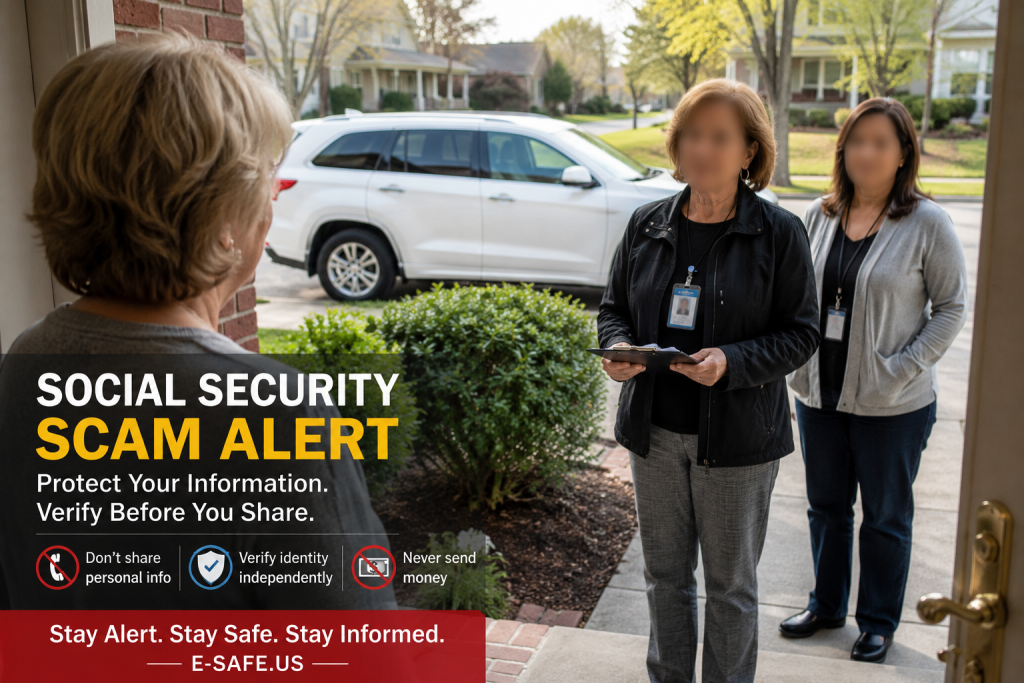
Two women arrived at the residence in a white SUV. The older woman did most of the talking, mentioned a name the resident did not recognize, and presented the visit as connected in some manner to Social Security activity in the neighborhood. The resident became suspicious rather than treating the claim as automatically legitimate.
That caution was appropriate.
E-Safe has not independently identified the visitors, and the information presently available does not establish that either woman committed a crime. However, the circumstances contain several warning signs associated with government impersonation, identity information harvesting, and social engineering.
Official Social Security sources confirm that limited home visits can occur in specific circumstances. That fact does not make a general neighborhood approach legitimate. It means residents should independently verify the claimed purpose rather than rely only on the assumption that Social Security never visits a residence.
The Encounter Reported in Rincon, Georgia
According to the neighbor’s account, two women arrived in a white SUV. The older woman spoke, used a name the resident did not recognize, and presented the visit as Social Security related.
Unexpected doorstep contact
The resident had not requested the visit or expected someone to arrive concerning Social Security.
Use of an unfamiliar name
An incorrect name can be an innocent mistake, but it can also encourage the resident to disclose the correct identity or explain who lives at the address.
General neighborhood explanation
Saying representatives are working throughout the neighborhood can create an appearance of legitimacy without identifying a specific beneficiary, case, appointment, or official purpose.
No independently verified appointment
The encounter was described as unexpected, and no prior letter, telephone notice, or confirmed Social Security case was identified in the account.
The number of visitors, their appearance, and the white SUV are descriptive information, not proof of criminal activity. The warning comes from the nature of the approach and the absence of an independently verified case specific purpose.
None of these details alone proves fraud. Together, they justify ending the conversation and verifying the claimed government activity before providing any personal information.
How the Scam Can Work
Government impersonation scams rely heavily on trust. Social Security is valuable to criminals because the agency is widely recognized and communicates with older adults, people with disabilities, representative payees, survivors, and other beneficiaries.
The scam does not have to begin with a demand for money.
Someone can appear at the door, identify an agency, mention a person’s name, ask whether that person lives there, or say records are being reviewed or updated. The first questions may initially seem harmless.
The visitor may then ask for a full name, date of birth, telephone number, Social Security number, Medicare information, benefit status, marital status, banking information, or confirmation of who else lives in the home.
A criminal does not need to obtain everything during the first encounter.
A name, address, telephone number, approximate age, household relationship, or confirmation that someone receives benefits can be combined with information obtained from public records, social media, previous data breaches, commercial information sources, or earlier scams.
That can make the next contact considerably more convincing.
Federal authorities warned in April 2026 that Social Security impersonators were using the real names of government employees and fabricated credentials to strengthen their stories. The fact that someone knows the name of an actual employee, displays a badge, presents an official looking document, or already possesses some personal information does not establish that the person is legitimate.
The doorstep encounter may therefore be only the first stage.
A later telephone call, email, letter, text message, or social media communication may reference information collected during the original encounter. To the victim, the second contact can appear credible because the caller seems to know details that an ordinary stranger should not know.
In reality, some of those details may have been supplied during the first conversation.
What Are the Scammers After?
The objective can vary, and criminals may pursue more than one goal.
Identity information is extremely valuable. A Social Security number combined with a name, date of birth, address, or other identifying information can facilitate attempts to impersonate the victim, obtain credit, access accounts, or commit other forms of identity fraud.
Financial information is another target. A scammer may claim that direct deposit information needs to be verified, that suspicious activity has affected the victim’s benefits, or that money must be moved to protect it.
Account access can also be valuable. Criminals may attempt to obtain information that helps them compromise an email account, financial account, or personal my Social Security account.
There can also be an information gathering component even when no Social Security number is immediately requested. A doorstep conversation can reveal who lives in the residence, which person answers the door, household relationships, whether an older resident lives there, what vehicles are associated with the property, and how willing the household is to answer questions from an unexpected visitor.
That does not mean every suspicious visitor is attempting another crime. It means residents should recognize that seemingly harmless information can have value to a fraudster.
Some Social Security impersonation schemes ultimately become direct financial theft. Federal warnings describe criminals demanding gift cards, wire transfers, cryptocurrency, cash, precious metals, or other assets. Authorities have also warned about schemes involving supposed in person transfers or pickups of money, gold, or other valuables.
The first request does not have to involve money for the encounter to create risk. Information itself has value.
What to Do if You Encounter These or Other Suspected Scammers
If someone unexpectedly appears at your home claiming to represent Social Security, another government agency, a utility company, financial institution, or benefit program, you are not required to conduct business with that person at your doorway.
- Keep the door closed and secured while speaking with the visitor. A doorbell camera or closed door can provide additional separation.
- Do not confirm your full name, date of birth, Social Security number, Medicare number, banking information, telephone number, email address, benefit information, or who lives in the residence.
- Ask for the visitor’s full name, job title, office or organization, official purpose, and the specific beneficiary, case, review, or appointment connected to the visit.
- Ask whether Social Security previously sent a letter or made a telephone call concerning the visit. Do not accept a document shown at the door as final proof.
- Tell the visitor that you will independently contact Social Security before continuing the conversation. You can decline the visit and request that any legitimate appointment be rescheduled.
- Do not call a telephone number printed on a card, letter, document, or electronic device supplied by the visitor. Do not let the visitor place or transfer the verification call.
- Contact Social Security directly at 1 800 772 1213 and ask the agency to verify the employee, appointment, review, or case. TTY users can call 1 800 325 0778.
- You can also locate the appropriate Social Security office through the official SSA Field Office Locator and independently contact that office.
- A representative payee review may be conducted by a state Protection and Advocacy organization rather than a direct SSA employee. Ask Social Security to confirm that the review is authorized, then independently contact the organization through information listed on an official SSA or state Protection and Advocacy page.
- If the visitor claims to represent the SSA Office of the Inspector General or another law enforcement agency, verify the contact through publicly listed agency information or local law enforcement. Do not rely on a badge image, badge number, business card, caller identification, or telephone transfer.
- If it can be done safely, document the approximate time, physical descriptions, vehicle description, license plate, and direction of travel. Do not confront, follow, or attempt to detain anyone.
- Report suspicious activity to local law enforcement. Rincon residents can contact the Rincon Police Department office at 912 826 5200 or non emergency dispatch at 912 754 8119. Call 911 if someone refuses to leave, attempts to enter the home, threatens a resident, or creates an immediate safety concern.
- Social Security related impersonation attempts can also be reported to the Social Security Administration Office of the Inspector General.
A legitimate representative should have no objection to a resident independently confirming the person’s identity and purpose before providing protected information.
What to Do if You Already Provided Information
Do not assume that no damage can occur simply because no money was taken.
The appropriate response depends upon exactly what information was disclosed.
If you provided only your name, address, or telephone number, remain alert for follow up calls, texts, emails, letters, or additional visits. A second contact may use those details to make a later story appear more credible.
If you provided your Social Security number, date of birth, or other substantial identifying information, consider placing a credit freeze with Equifax, Experian, and TransUnion. A credit freeze is free and can make it substantially more difficult for an identity thief to open new credit accounts using your identity.
A fraud alert can provide another layer of protection. Review your credit reports and watch for accounts, inquiries, or activity you do not recognize.
If you believe your identity has been compromised, use IdentityTheft.gov. The Federal Trade Commission provides a recovery process based upon the type of information exposed and any fraudulent activity that has already occurred.
If you disclosed banking, debit card, or credit card information, contact the financial institution’s fraud department immediately. Ask what accounts, cards, account numbers, passwords, or security credentials should be replaced.
If you disclosed usernames, passwords, or security codes, change them immediately. Do not reuse the compromised password on another account.
If your personal my Social Security account may have been compromised, access Social Security by typing the official SSA address into your browser rather than using a link supplied in a message. Review your account information and contact SSA directly if something appears incorrect.
If money has already been sent, contact the bank, wire service, card provider, payment service, or other financial institution immediately. Some transactions may be reversible if action is taken quickly.
Preserve information about the encounter. Save messages, photographs, telephone numbers, documents, vehicle information, payment receipts, and a written account of what happened while the details are still fresh.
What Social Security Does and Does Not Do
Official Social Security sources confirm that home visits are possible, but they are limited and connected to specific circumstances.
It would be inaccurate to say that Social Security never conducts a home visit. It would also be inaccurate to treat a general neighborhood canvass or an unsolicited request to confirm personal information as routine Social Security activity.
Examples of Legitimate Visits Residents May Encounter
Home assistance because of illness or infirmity
The Social Security Handbook states that a representative from a local office may visit a person’s home when that individual cannot visit an office or contact station because of illness or infirmity.
Scheduled beneficiary interviews
Social Security uses Form SSA L501 to schedule certain residence interviews connected to the Centenarian Project, Gerontology Project, and Medicare Non Utilization Project.
Representative payee reviews
A state Protection and Advocacy organization may conduct a review on behalf of Social Security, including financial record review and a home visit and interview with the beneficiary.
Questionable representative payee follow up
SSA procedures allow personal contact when concerns exist about whether a representative payee is properly serving a beneficiary. A narrow questionable payee situation may involve an unannounced beneficiary home visit.
Law enforcement contact connected to an investigation
SSA Office of the Inspector General special agents conduct field investigations involving suspected fraud or misconduct. They will not ask residents to hand over money or assets.
These examples are tied to a specific beneficiary, application, disability or Medicare review, representative payee matter, accessibility need, or investigation. They are materially different from individuals generally traveling through a neighborhood and asking residents to confirm names or Social Security information.
Prior Notice and the Narrow Exception
SSA public scam guidance states that residents ordinarily receive prior notification by mail or telephone before a personal visit and that Social Security can verify the identity of an employee who has made contact.
There is, however, a narrow exception in SSA’s representative payee procedures. When SSA is following up on a questionable representative payee, the agency may make an unannounced visit to interview the beneficiary.
For most residents, the absence of prior notice is a serious warning sign. It should not be treated as absolute proof of fraud because of that limited representative payee exception.
How to Verify a Claimed Social Security Visitor
- Keep the person outside while verification is completed.
- Ask for the person’s full name, title, office, organization, and specific purpose.
- Ask which beneficiary, case, appointment, representative payee review, or investigation is connected to the visit.
- Check whether you received prior notice by mail or telephone. Compare the stated purpose with the notice, but do not rely only on the telephone number shown in the document.
- Call Social Security independently at 1 800 772 1213 and ask whether the visit, employee, appointment, or review is legitimate.
- Use the official SSA Field Office Locator to identify and contact the appropriate local office.
- For a Protection and Advocacy review, confirm the review through Social Security and independently contact the authorized state organization.
- For a claimed OIG or law enforcement visit, use publicly listed agency contact information or local law enforcement to verify the contact.
- Do not rely on identification alone. Federal warnings confirm that criminals use real employee names, fabricated badges, false credentials, official looking documents, and spoofed telephone numbers.
- Do not provide personal or financial information until verification is complete. A legitimate appointment can be paused and rescheduled.
What Legitimate Social Security Personnel Will Not Do
They will not demand immediate payment to resolve a Social Security problem.
They will not require payment using gift cards, cryptocurrency, gold, wire transfers, or cash.
They will not threaten arrest because you refuse to make an immediate payment.
They will not tell you to move money into a supposedly protected account.
They will not require you to keep the matter secret or confidential.
They will not ask you to hand cash, gift cards, cryptocurrency, gold, or other assets to someone for safekeeping.
They will not send photographs of badges or credentials to prove legitimacy.
They will not object to independent verification through official agency contact information.
The official procedures reviewed for this article do not describe random neighborhood canvassing as a routine method for updating benefit records or identifying who lives at a residence.
When in doubt, end the interaction and independently contact Social Security.
Why This Warning Matters Now
Federal authorities continue issuing warnings because Social Security impersonation tactics are becoming more convincing.
In April 2026, the Social Security Administration Office of the Inspector General warned that criminals were using the names of real SSA employees, fabricated badges, false credentials, spoofed telephone numbers, and information gathered from social media.
The OIG advises residents to ignore unexpected outreach, avoid trusting caller identification, and verify claimed government contact through publicly listed agency information.
Federal authorities have also warned that criminals may attempt to arrange an in person transfer or pickup of cash, gold, gift cards, cryptocurrency, or other assets. SSA OIG agents may work in the field, but they will not ask for money or offer to safeguard a resident’s assets.
There is also relevant local context.
In January 2026, the Effingham County Sheriff’s Office warned residents about a separate door to door impersonation concern after an individual reportedly approached homes offering what were described as benefits through the county. Subsequent reporting indicated that people connected to that separate activity may also have appeared in Rincon.
There is no evidence connecting that earlier incident to the recent Social Security related encounter. It is relevant only as local context demonstrating why residents should verify unexpected government or benefit related claims at the door rather than relying on appearance or presentation alone.
The techniques will continue to change. A telephone scam can become an email scam. An email scam can become a text scam. Online impersonation can be combined with physical contact. Information obtained during one encounter can make the next encounter considerably more persuasive.
That is why suspicious activity should be reported even when the intended victim recognized the warning signs and lost nothing.
One person’s report may prevent the next neighbor from becoming a victim.
Stay Informed With E-Safe
Community awareness remains one of the strongest defenses against scams that depend on surprise, confusion, trust, and isolation.
To stay current on scams affecting our neighborhoods, subscribe to the E-Safe website and remain informed about emerging fraud activity, local warnings, changing scam techniques, and practical steps you can take to protect yourself and your family.
Sharing credible information quickly helps neighbors recognize suspicious activity before criminals have an opportunity to succeed.
E-Safe, www.e-safe.us
Where Community Comes First.
Sourcing
Local neighbor account shared with E-Safe, Rincon, Georgia.
Private community source for the two visitors, white SUV, unfamiliar name, and unexpected residential contact. No public hyperlink is available.
Social Security Administration, Social Security Handbook Section 110, The Function of the Social Security Office.
Confirms that a representative from a local office may make a personal home visit when illness or infirmity prevents a person from visiting an office or contact station.
https://www.ssa.gov/OP_Home/handbook/handbook.01/handbook-0110.html
Social Security Administration Program Operations Manual System, SSA L501 Home Visit Letter.
Confirms the residence interview process for the Centenarian Project, Gerontology Project, and Medicare Non Utilization Project.
https://secure.ssa.gov/apps10/poms.nsf/lnx/0900701135
Social Security Administration Program Operations Manual System, Follow Up on Questionable Representative Payees.
Confirms personal visits and the narrow unannounced beneficiary home visit procedure involving a questionable representative payee.
https://secure.ssa.gov/apps10/poms.nsf/lnx/0200504185
Social Security Administration, Representative Payee Site Reviews Conducted by Protection and Advocacy Systems.
Confirms that authorized state organizations may conduct representative payee interviews, financial record reviews, and beneficiary home visits.
https://www.ssa.gov/payee/reviews_by_Protection_and_Advocacy.htm
Social Security Administration, Information About Scams.
States that residents ordinarily receive prior notification before a personal visit and can call Social Security to verify the identity of an employee.
https://www.ssa.gov/phila/scams.htm
Social Security Administration, Field Office Locator.
Provides the official method for independently locating a Social Security office.
Social Security Administration Office of the Inspector General, New Wave of Imposter Scams: Criminals Using Real SSA Employee Names and Fake Badges.
Supports the warnings concerning real employee names, fabricated credentials, spoofing, payment demands, and independent verification.
Social Security Administration Office of the Inspector General, Do Not Hand Off Cash to Agents.
Confirms that SSA OIG agents may work in the field but will not request money or conduct an asset pickup.
https://oig.ssa.gov/scam-alerts/2025-07-17-don%E2%80%99t-hand-off-cash-to-%E2%80%9Cagents%E2%80%9D/
Federal Trade Commission, Credit Freezes and Fraud Alerts.
https://consumer.ftc.gov/articles/credit-freezes-and-fraud-alerts
Federal Trade Commission, IdentityTheft.gov.
https://www.identitytheft.gov/
City of Rincon, Rincon Police Department.
Official police office, emergency, and non emergency contact information.
https://www.cityofrincon.com/departments/police/
WTOC, Possible Door to Door Impersonators From Guyton May Now Be in Rincon, January 29, 2026.
Provides local context concerning a separate Effingham County warning. No connection to the current encounter has been established.