
Share this article
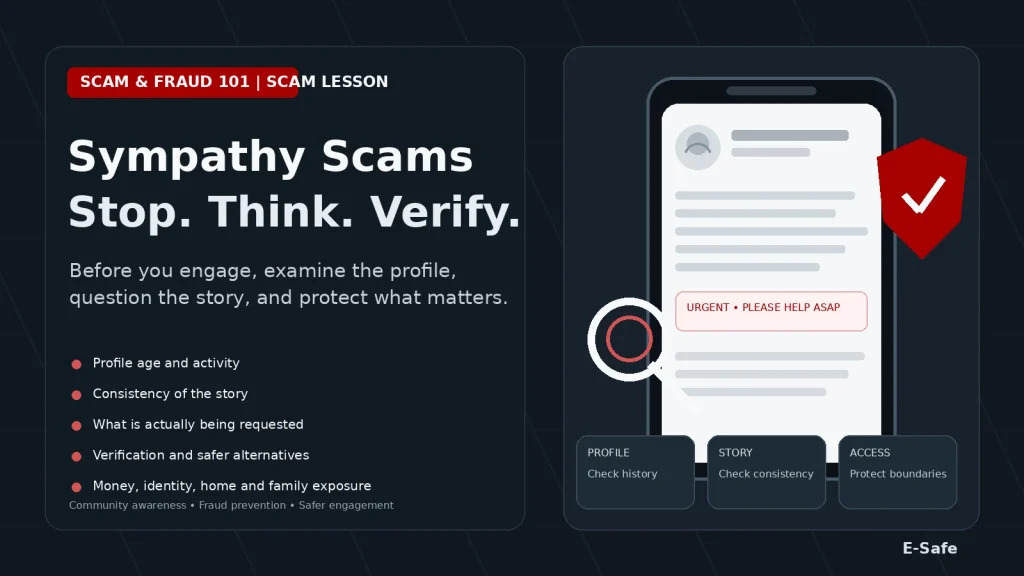
Digital Safety · Fraud Awareness
Sympathy Scams: Stop, Think, Verify Before You Engage
A hardship story may be completely legitimate, but emotion should never replace verification. Learn the questions every community member should ask before giving money, information, employment or access to their home.
Community groups work because neighbors help neighbors. That same trust can also be exploited.
A sympathy scam does not always begin with a request for money. It may begin with a personal hardship story, an urgent need for work, housing trouble, illness, family difficulties, transportation problems, or a request for prayers. The initial post may be completely legitimate. The danger arises when emotion causes us to skip the basic verification we would normally perform before giving a stranger money, personal information, employment, transportation, or access to our home.
The objective is not to assume that someone asking for help is dishonest.
Start With the Profile, Not the Story
Before responding emotionally, take a minute to examine the account itself.
A new account is not proof of fraud, but a recently created or minimally established account deserves additional scrutiny.
Does the person regularly participate in neighborhood discussions, or does nearly every visible post concern the same hardship or immediate need?
Someone may be listed as a neighborhood resident for years while having only a few days of visible activity. There may be an innocent explanation, but it is worth noticing.
Normal community accounts often develop an ordinary digital footprint over time through recommendations, questions, comments, local events, lost pets, traffic, schools, businesses, or other neighborhood topics.
A limited account does not make someone a scammer. It simply means you have less information with which to establish trust.
Read the Story Again, This Time Without the Emotion
Fraudsters frequently rely on urgency because urgency interferes with careful decision-making.
Unusual circumstances happen to legitimate people every day. The concern is not one unusual detail. The concern is a growing collection of inconsistencies that cannot reasonably be explained.
What Is the Person Actually Asking For?
The original public request may not be the eventual request. A post requesting advice, prayers, resources or employment leads can later move into private communications.
Be alert if the request changes to:
- Cash or peer-to-peer payments
- Gift cards
- Transportation
- Temporary lodging
- Access to someone’s home
- Childcare or eldercare employment
- House cleaning or pet sitting
- Personal or banking information
- Depositing or forwarding money
How Does the Person Respond to Verification?
A legitimate person may reasonably protect private information. Nobody should be expected to publicly disclose medical records, Social Security numbers, financial documents or other sensitive information.
Reasonable verification is different.
Repeated avoidance of reasonable verification deserves greater caution.
Think About What You Are Exposing
Helping someone locate a public resource is very different from allowing a stranger into your home.
The greater the access being requested, the greater the verification that should occur first.
Watch for the Financial Pivot
Some fraud attempts become obvious only after contact has already been established.
Be especially cautious if someone asks you to:
- Send money through an unfamiliar or difficult-to-reverse method
- Purchase gift cards
- Deposit a check and return part of the money
- Receive money and forward it elsewhere
- Use your bank account
- Provide account login information
- Share a verification code sent to your telephone
- Purchase equipment for a supposed job
- Send money to an unexplained third party
These are substantially stronger warning indicators than emotional language or a limited social-media history.
Use the Resource Test
One of the safest ways to help someone is to provide legitimate resources first: recognized housing programs, food assistance, employment services, nonprofits, churches with formal assistance programs, government agencies, utility programs or 211.
Rejecting one resource proves nothing. Consistently rejecting reasonable alternatives while insisting on money or unrestricted access deserves closer examination.
The Five Questions Every Neighbor Should Remember
Compassion should encourage us to help. It should never require us to abandon common sense.
Remember
A new profile is not proof of fraud.
An emotional story is not proof of fraud.
Financial hardship is not proof of fraud.
Asking for work is not proof of fraud.
The purpose of fraud prevention is not to accuse people based on suspicion. It is to recognize risk, identify patterns, verify what can reasonably be verified, and protect yourself before providing money, sensitive information, employment, or access to your family or property.
Sources
Federal Trade Commission, consumer guidance concerning employment scams, work-from-home scams, impersonation, payment fraud, gift cards, fake checks and online fraud prevention.
Federal Bureau of Investigation Internet Crime Complaint Center, public fraud-prevention guidance concerning social engineering, identity theft and online financial scams.
U.S. Cybersecurity and Infrastructure Security Agency, public cybersecurity guidance concerning phishing, social engineering and protection of personal information.
E-Safe community fraud-prevention research and review of recurring online sympathy, employment, housing and social-engineering risk patterns.