
Share this article
Community News · Growth and Development
New Hampstead Parkway: Traffic and Construction Outlook
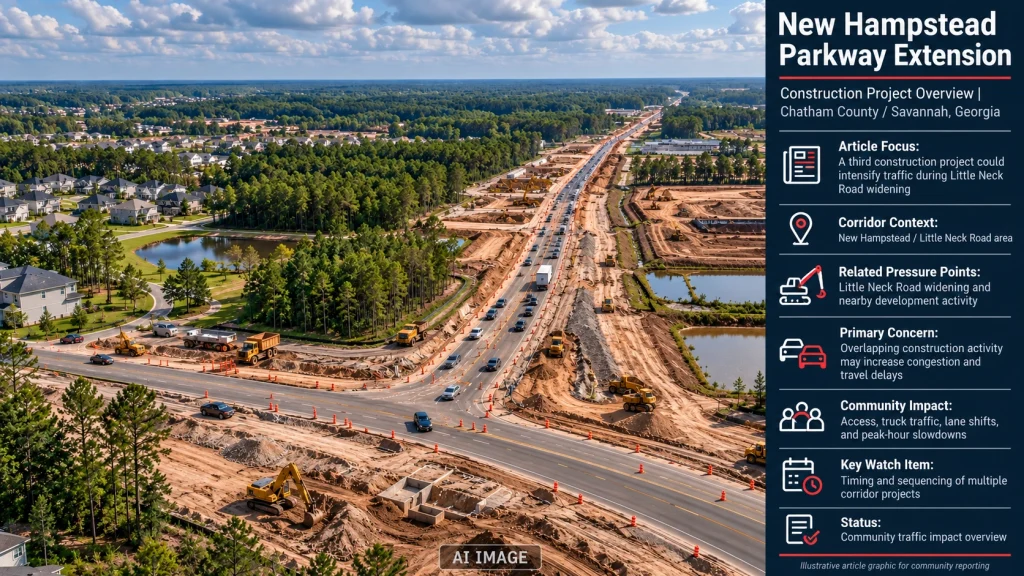
The proposed New Hampstead Parkway development agreement introduces a potential third construction project during the 2027–2028 Little Neck Road widening and Keller Market Square Phase 1 overlap. Examine the projected schedules, traffic…
Savannah’s proposed infrastructure agreement raises new questions about construction overlap, road capacity and the timing of improvements across western Savannah.
October 19, 2026 | Infrastructure and Traffic Update
Three Projects Are Converging on the Same Growth Corridor
The Palms at New Hampstead faces a potentially important new transportation challenge as three separate projects advance: the Little Neck Road four-lane widening, Keller Market Square Phase 1, and the proposed extension of New Hampstead Parkway through Argyle Grove to Fort Argyle Road.
Savannah City Council is scheduled to consider a development agreement on October 22, 2026, with Brookhaven Development, LLC and Forest Lakes Developers, LLC. The agreement would establish responsibilities for the Parkway extension and associated improvements.
Argyle Grove and the proposed roadway connection were previously examined in E-Safe’s September Neighborhood Intelligence Report. The new issue is the formal agreement specifying construction responsibilities, proposed financing and related traffic improvements.
The Central Concern
E-Safe’s October 9 analysis identified 2027 through 2028 as the principal window of potential congestion from Little Neck Road reconstruction and Keller development.
The Parkway agreement introduces a possible third construction operation during that same period. Its actual timing remains unconfirmed.
What the New Agreement Would Establish
Argyle Grove is planned for up to approximately 2,450 residential units by full buildout in 2038. The proposed agreement addresses infrastructure needed to connect the development with the existing New Hampstead transportation network.
The developer’s September 23 estimate totals approximately $12.05 million for a broader infrastructure package incorporating roadway construction, drainage, water, sewer, property and other associated costs.
The proposed City’s reimbursement is capped at $3 million for eligible connector work, not the entire estimated infrastructure package.
The draft agreement permits the roadway to be constructed in phases. It assigns responsibility for a future traffic signal at Fort Argyle Road to the developer, subject to traffic-warrant analysis and GDOT authorization. A separate water and sewer agreement is anticipated.
Current Approval Status
As of October 19, 2026, the proposed development agreement has not been approved. Council consideration is scheduled for October 22. Neither an actual construction start nor a completion date has been confirmed.
Comparing the Construction Schedules
The timing of the three projects is central to understanding their potential combined traffic impact.
| Project | Verified Milestone | Projected Activity |
|---|---|---|
| Little Neck Road Widening | Final Design with Fall 2026 anticipated construction start | Potential construction through December 2028, the current SPLOST completion target |
| Keller Market Square Phase 1 | October 6, 2026 major subdivision approval | Site development in 2027 and possible residential construction through 2029, depending on permits and actual implementation |
| New Hampstead Parkway Extension | October 22, 2026 proposed agreement consideration | Construction timing unknown. A 2027 through 2028 overlap is possible, but not officially scheduled |
The projected periods are planning scenarios rather than confirmed contractor schedules. The Little Neck Road completion date is an official program target, not a guarantee.
Keller Market Square Phase 1
Keller’s original Phase 1 narrative contemplated roughly 6 to 12 months for permitting and site development, followed by up to 24 months of residential vertical construction.
Applying that sequence to its October 2026 approval indicates potential construction activity extending through 2027 to 2029, subject to remaining approvals and market conditions.
New Hampstead Parkway
The proposed Parkway agreement does not provide a comparable confirmed construction timetable. Environmental permitting, utility coordination, roadway phasing and separate governmental approvals could affect when work begins and when the connection opens.
Projected Traffic Impact: Late 2026 Through 2029
Late 2026 Through Early 2027 | Initial Pressure
Little Neck Road mobilization and utility activity could coincide with Keller preparation. Parkway engineering and permitting may proceed without physical roadway construction.
Mid-2027 Through Early 2028 | Escalating Pressure
Road widening and Keller civil work could create simultaneous construction truck movements, temporary work zones, intersection disruptions and changing travel patterns. Parkway construction would add another layer if approved and commenced.
2028 | Potential Highest Pressure
The October 9 baseline assessment identifies 2028 as the period of greatest potential combined Keller and Little Neck Road construction pressure. Parkway activity during this period could increase geographic disruption and variability in travel times.
Late 2028 Through 2029 | Possible Transition
If the widened roadway is completed on target, work-zone restrictions should decline. Keller development and any unfinished Parkway construction could continue, while additional residential occupancy creates permanent traffic demand.
Important Forecast Limitation
No new traffic simulation establishes a measurable increase in congestion from three simultaneous construction operations.
These projections identify potential operational conflicts, not verified travel delays, lane closure schedules or contractor construction dates.
Why Three Construction Projects Could Make Traffic Worse
Reduced Road Capacity During Reconstruction
Temporary traffic shifts, utility relocation, drainage construction and intersection work can reduce reliability on Little Neck Road, even when through lanes remain open.
Additional Construction Truck Traffic
Keller site development could increase heavy vehicle movements near Little Neck Road. Parkway grading, drainage, utility construction and paving could introduce separate contractor movements around Fort Argyle Road and the connecting roadway network.
Disruption Across Multiple Corridors
Little Neck Road and Keller construction would principally affect one set of travel routes. Parkway construction and GA 204 improvements could affect another. Regional traffic redistribution may connect those effects.
The Timing of Opening the Parkway
If the Parkway opens before Little Neck Road widening is complete, drivers could begin using an expanded network while one of its important connections remains under active construction restrictions.
Permanent Traffic After Construction
Road construction eventually ends, but residential and commercial development introduces lasting travel demand.
The longer-term issue is whether new road capacity, turn lanes and intersection improvements keep pace with occupancy and commercial activity.
What the Existing Traffic Studies Actually Say
The Argyle Grove applicant’s traffic study estimated approximately 22,939 daily vehicle trips at projected full buildout in 2038.
Metropolitan Planning Commission staff reported that approximately 45 percent of development traffic could eventually be routed north toward Little Neck Road through the New Hampstead Parkway connection.
The Keller Market Square traffic study separately estimated approximately 17,158 new external daily vehicle trips at full development after the study’s stated reductions.
What These Numbers Do Not Mean
These figures describe future development conditions, not vehicle movements expected when construction begins.
They use different traffic study assumptions and cannot simply be added together to predict congestion at a particular intersection.
Neither study provides a detailed simulation of simultaneous Little Neck Road, Keller Market Square and New Hampstead Parkway construction work zones.
The Signalization and Intersection Timing Problem
The proposed development agreement makes the developer responsible for a future traffic signal at the New Hampstead Parkway and Fort Argyle Road intersection.
Signal construction must follow traffic-warrant analysis and GDOT authorization.
The estimated $1.52 million GA 204 improvement package includes turn-related roadway widening, acceleration and deceleration lanes, signal-related work and associated improvements.
These investments could improve future traffic operations once completed. They may also create temporary disruption while they are being constructed.
Potential Keller traffic signals along Little Neck Road and U.S. 17 are likewise conditional on traffic warrant findings and agency approvals.
The Critical Timing Question
Will new signals, turn lanes and other roadway improvements be completed before significant development traffic begins using the connecting roads?
The answer could substantially affect the severity and duration of traffic problems experienced by residents of nearby communities.
Why The Palms at New Hampstead Should Be Watching
The Palms currently depends on Coconut Drive and Highgate Boulevard for its primary neighborhood access. Regional congestion can therefore matter even when construction activity is not directly beside a resident’s property.
Potential consequences include less predictable commute times, increased construction vehicle movements, delays at connecting intersections and complications for routine or time-sensitive travel.
The concern is especially important when emergency access and travel-time reliability are considered.
Longer term, a completed Parkway could introduce additional travel options and distribute traffic differently across western Savannah.
Its ultimate benefit will depend on when it opens, how surrounding intersections operate and how quickly Argyle Grove and other developments approach their planned occupancy levels.
Decisions and Milestones Residents Should Monitor
- October 22 City Council approval, amendment, deferral or rejection of the proposed development agreement.
- Execution of the final agreement and any changes to reimbursement or roadway construction phasing.
- Parkway land-disturbance permits, applicable federal environmental authorizations and utility agreements.
- Chatham County’s Little Neck Road construction award, Notice to Proceed and Maintenance of Traffic plan.
- Keller Market Square Phase 1 site-development permits, construction mobilization and access improvements.
- GDOT traffic-signal warrant determinations and actual intersection construction schedules.
- Coordination of construction truck routes, temporary lane restrictions and intersection access.
Savannah MOVES: October 26 Public Meeting
Monday, October 26, 2026, from 4:00 PM to 6:00 PM at New Hampstead West Fire Station, 3002 Highgate Boulevard, Savannah, Georgia.
Residents can raise concerns about combined construction schedules, intersection capacity, signalization priorities, truck routes and traffic management throughout the western Savannah growth corridor.
Conclusion: The Risk Is in the Timing
The proposed New Hampstead Parkway agreement strengthens the case for monitoring the three projects together.
It does not yet establish when Parkway construction will occur, and its anticipated traffic should not be counted as a newly discovered source of development demand already addressed in earlier E-Safe reporting.
The existing 2027 through 2028 high-risk construction window remains the working forecast, with 2028 representing the potential peak.
Parkway construction during that period could intensify or extend traffic impacts. Opening the connection after Little Neck Road widening is completed could produce a different outcome.
Future reporting should therefore focus on confirmed construction milestones, coordinated traffic-management plans and the order in which roadway capacity, traffic signals and development occupancy become operational.
Professional Sourcing
City of Savannah | October 22, 2026 City Council Agenda, Item 26
Proposed development agreement and pending City Council consideration.
View Official City Council AgendaCity of Savannah | Draft Fort Argyle Road Development Agreement, October 14, 2026
Roadway construction responsibilities, proposed City reimbursement, traffic-signal provisions and infrastructure estimates.
View Official Development AgreementChatham County Department of Engineering | Little Neck Road
Four-lane widening project description, Final Design status and anticipated Fall 2026 construction start.
View Official Little Neck Road ProjectChatham County | SPLOST 7 Project Schedule
Program schedule identifying December 27, 2028 as the current Little Neck Road project completion target.
View SPLOST 7 Project ScheduleMetropolitan Planning Commission | October 6, 2026 Action Minutes
Official approval of Keller Market Square Phase 1 major subdivision.
View Official MPC Action MinutesMetropolitan Planning Commission | April 17, 2026 Argyle Grove Staff Report
Argyle Grove development scope, full-buildout traffic estimates, anticipated Parkway connection and traffic distribution considerations.
View Official Argyle Grove Staff ReportE-Safe | October 9, 2026 Keller Traffic Analysis
Previous construction-overlap assessment, development phasing, traffic-study findings and underlying planning documents.
View Original Traffic AnalysisEditorial cutoff: October 19, 2026. Construction periods identified as projections are analytical planning scenarios, not confirmed contractor schedules.