
Share this article
Community · Community News
I-16 Widening, New Hampstead Traffic Outlook | E-Safe
I-16 widening, Little Neck Road, Keller Market Square and New Hampstead Parkway could overlap in 2027 and 2028. See the exact highway limits, schedules and potential traffic effects for New Hampstead.
An Updated Look at Traffic Congestion in the Coming Years
Residents across the New Hampstead Neighborhood and the surrounding western Savannah growth corridor face an increasingly complex transportation outlook as major road improvements and private development projects move forward.
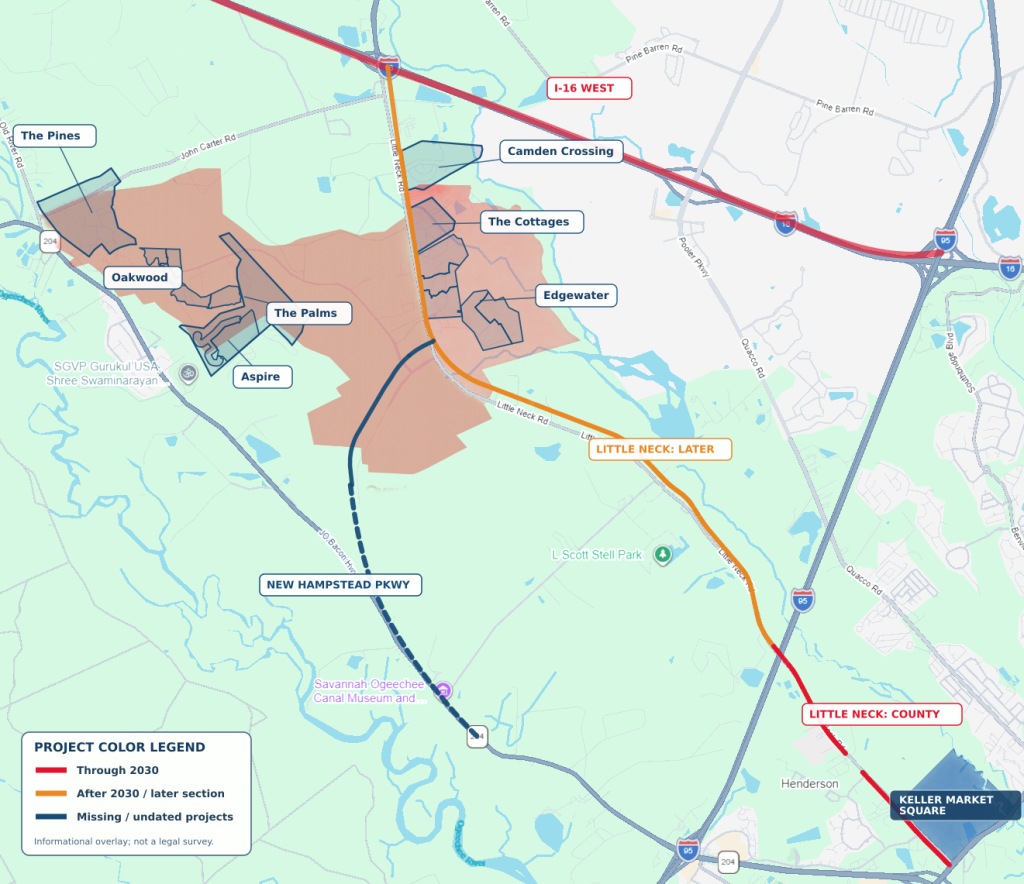
Previous E-Safe investigations examined the overlapping schedules of Little Neck Road widening, Keller Market Square Phase 1, and the New Hampstead Parkway extension toward Fort Argyle Road.
A fourth major project must now be included in that assessment: the widening of Interstate 16.
Exactly where is I-16 being widened? GDOT’s full proposed improvement extends approximately 32.5 miles along Interstate 16, starting at the I-16/I-95 interchange (Exit 157) in Chatham County near Pooler and continuing west to the I-16/Georgia State Route 67 interchange (Exit 127) near Brooklet in Bulloch County. The project crosses Chatham, Effingham, Bryan and Bulloch counties. The first awarded construction phase is shorter: it begins at the I-16/I-95 interchange and ends at I-16 mile marker 139.65 in Bryan County. The section from mile marker 139.65 to the SR 67 interchange is not included in that initial contract.
The Georgia Department of Transportation has awarded a $468.35 million contract for the first 17.77 miles of I-16 widening, with construction anticipated to begin in early 2027. This could coincide with the most active periods of construction along Little Neck Road and nearby development sites.
For residents, the central concern is how the combined construction schedules may affect commuting, access to I-16, local intersections, delivery traffic, school transportation and emergency travel.
The previously identified 2027 and 2028 period remains a potential peak for overlapping local construction. I-16 widening adds the possibility of regional traffic disruptions continuing into 2030 or beyond.
This is a qualified planning projection. Actual congestion, road restrictions and completion dates will depend on published construction schedules and traffic management plans.
I-16 Widening: Scope and Construction Schedule
GDOT’s overall plan would widen approximately 32.5 miles of I-16 between the I-16/I-95 interchange at Exit 157 near Pooler, Chatham County, and the I-16/SR 67 interchange at Exit 127 near Brooklet, Bulloch County, increasing the existing four lane interstate to six lanes.
The July 2026 contract award covers the first 17.77 miles, from I-95 westward to mile marker 139.65 in Bryan County. The remaining proposed corridor will require subsequent construction phases.
Graphic 1. I-16 Widening Project Scope
Full Proposed Corridor: 32.5 Miles 17.77 miles awarded 14.73 miles remaining I-95 / Exit 157 Mile Marker 139.65 SR 67 / Exit 127 First phase: approximately 55% of proposed corridorThe project includes additional travel lanes, pavement improvements, shoulder work and bridge replacements or widening.
Approximately 55% of the proposed corridor is covered by the first contract. Later phases will be necessary to complete the entire I-95 to SR 67 widening concept.
When Will I-16 Construction Begin?
GDOT’s September 2025 project fact sheet identified 2027 as the anticipated construction start. The later contract award announcement specified an anticipated start in early 2027.
The construction contract was awarded in July 2026 to the Matthews-McClendon Joint Venture in partnership with Infrastructure Consulting & Engineering.
When Will I-16 Widening Be Completed?
An official completion date has not been confirmed. A GDOT spokesperson previously discussed an approximately three to four year preliminary construction period, suggesting work could continue into 2030 or later.
That estimate preceded the final contract award. It should not be interpreted as an approved completion date for the first phase or the entire 32.5 mile corridor.
Official construction start target: Early 2027.
Confirmed completion date: Not established.
Potential extended construction period: 2030 or beyond, subject to contract milestones, project phasing and future corridor awards.
GDOT’s project database currently displays an administrative status of “Under Construction” with 0% construction completion and no populated Notice to Proceed or completion date. That database status is not sufficient to establish that physical widening work has begun.
Four Major Projects: Construction and Development Comparison
The New Hampstead Neighborhood traffic outlook must now consider four projects that may affect connected sections of the western Savannah transportation network.
| Project | Confirmed Status | Schedule Assessment |
|---|---|---|
| I-16 Widening | First phase contract awarded July 2026 for 17.77 miles. | Early 2027 construction target. Completion date unconfirmed. |
| Little Neck Road Widening | Chatham County lists the project in Final Design. | Fall 2026 anticipated start after right of way acquisition; December 27, 2028 SPLOST program completion target. |
| Keller Market Square Phase 1 | Major subdivision approved October 6, 2026. | Possible 2027 through 2029 development activity, conditional on permits, financing and actual phasing. |
| New Hampstead Parkway Extension | Development agreement approved unanimously by Savannah City Council on October 22, 2026. | Construction start and completion dates remain unconfirmed. |
Important New Hampstead Parkway Update
Savannah City Council approved the development agreement with Brookhaven Development, LLC and Forest Lakes Developers, LLC on October 22, 2026, by a 9 to 0 vote.
The agreement relates to the extension of New Hampstead Parkway toward Fort Argyle Road and the larger Argyle Grove development proposal. The City agenda describes up to 2,450 residential units and approximately 24,000 square feet of commercial space at full buildout.
This approval is an important advancement since the October 19 E-Safe report. However, approval of a development agreement does not confirm that roadway construction has commenced or establish a completion date.
Projected Construction Overlap, 2026 Through 2031
The following graphic combines official project targets with clearly distinguished planning scenarios for the projects that do not yet have confirmed construction schedules.
Graphic 2. Illustrative Four-Project Timeline
2026 2027 2028 2029 2030 2031 Little Neck Road Keller Phase 1 New Hampstead Parkway I-16 Phase 1 Blue: current county program target Green: conditional Keller development window Dashed bars: illustrative, unconfirmed schedulesIf current targets hold, 2027 and 2028 could bring the greatest overlap among local roadway construction, private development activity and the beginning of interstate widening.
That does not mean every project will operate at maximum intensity simultaneously. Actual conditions will depend on the sequencing of roadway reconstruction, utility relocation, bridge work, subdivision infrastructure and traffic control measures.
How the Combined Projects Could Affect Traffic
The overlap of these projects may produce traffic conditions that are more complicated than those associated with any individual construction site.
Construction activity can change travel patterns by creating temporary lane restrictions, shifting available routes or increasing the variability of travel times. These effects could interact when separate work zones affect the same regional travel network.
Graphic 3. Potential Combined Traffic Effects
2027: Potential Beginning of Overlapping Construction
I-16 work may begin while Little Neck Road reconstruction and Keller development activity are underway.
If those schedules coincide, residents who commute toward Pooler, Bloomingdale, Savannah or other employment areas may experience less predictable travel times.
Impacts will depend on which sections of I-16 and Little Neck Road are active, whether travel lanes remain available and how construction traffic is managed.
2028: A Potentially Difficult Year for Local Circulation
Little Neck Road’s current SPLOST program target extends through December 2028. Keller development could also remain active during that period.
If interstate work and New Hampstead Parkway construction overlap with those activities, the combined effect could include more frequent route changes and additional pressure on selected intersections.
The available records do not demonstrate that 2028 will definitively be the worst traffic year. It remains a reasonable year to monitor closely because of the potential schedule overlap.
2029: Some Local Conditions May Improve
If Little Neck Road reaches its December 2028 program target, the completed widening may provide greater local capacity and reduce some construction related disruptions.
Nevertheless, private development traffic, remaining roadway work and ongoing I-16 construction could still affect the broader transportation network.
2030 and Beyond: Regional Construction May Continue
The preliminary multiyear construction estimate for I-16 suggests that interstate work could continue beyond the local Little Neck Road completion target.
The timing of the remaining proposed I-16 corridor is a separate uncertainty because the July 2026 first phase contract does not cover the entire 32.5 mile plan.
What This Means for the New Hampstead Neighborhood
The impacts will not be identical across every community.
Residents living closer to Little Neck Road may be more directly exposed to local roadwork, temporary traffic controls and construction access activity.
Residents who regularly use I-16 may experience more of the regional travel effects associated with interstate widening.
Edgewater, Keller area developments, New Hampstead subdivisions and nearby residential communities may encounter different traffic patterns depending on construction sequencing, road access and daily travel routes.
Potential consequences include less predictable commutes, construction vehicle activity, temporary intersection restrictions, school transportation adjustments and possible delays on trips to medical services or employment.
However, current evidence does not establish how many additional vehicles would travel through any specific neighborhood or how many minutes of delay residents might experience.
Long Term Growth and Traffic Demand
The importance of these projects extends beyond their construction schedules. Western Savannah continues to accommodate substantial residential and commercial development.
Earlier E-Safe reporting examined two development traffic forecasts:
These are long term development forecasts, not construction period traffic counts. They should not be added together to calculate 2027 or 2028 congestion because of differences in methodology, timing, roadway assignment and potential overlap among vehicle trips.
GDOT’s June 2025 public information materials also estimated existing I-16 daily traffic volumes across the study corridor ranging approximately from 31,000 to 50,000 vehicles.
The combined road investments may eventually support more reliable movement of residents, freight and commercial traffic. However, long term capacity improvements and temporary construction disruptions should be evaluated separately.
Updated Neighborhood Traffic Assessment
| Assessment | Finding |
|---|---|
| 2027 and 2028 construction overlap | Plausible under current planning targets |
| 2028 local congestion pressure | Potentially elevated, but not quantified |
| Construction impacts beyond 2028 | Possible, particularly on I-16 |
| Additional commute delay | Not established by a coordinated model |
| Neighborhood traffic diversion | No verified route specific forecast |
| New Hampstead Parkway completion | Unconfirmed |
| Full I-16 corridor completion | No confirmed date |
The principal uncertainty is not whether these projects are significant. It is how their individual construction stages will interact across the regional transportation network.
What Residents Should Watch Next
GDOT’s future construction authorization, work zone phasing and bridge replacement schedule will determine where interstate restrictions are likely to occur first.
Chatham County’s Little Neck Road project should be monitored for an actual contractor start date, traffic management plan and updates to its current completion target.
Keller Market Square should be monitored for land disturbance authorizations, subdivision infrastructure activity and subsequent phases of development.
The New Hampstead Parkway project should be monitored for engineering approvals, construction permits and implementation milestones following Savannah City Council’s October 22 development agreement approval.
A coordinated construction schedule and traffic management assessment covering all four projects would provide the strongest basis for evaluating possible cumulative impacts on the New Hampstead Neighborhood.
Conclusion: Planning for Several Years of Transportation Changes
I-16 widening could create long term improvements in regional travel capacity and reliability. But construction must be considered alongside significant local roadwork and continuing residential and commercial growth.
For New Hampstead Neighborhood residents, the principal period of concern remains 2027 and 2028, with the possibility of broader regional construction impacts continuing into 2030 and beyond.
The severity of congestion cannot yet be calculated reliably. A coordinated construction schedule and traffic management assessment covering all four projects would provide a more defensible basis for future forecasts.
The question is no longer simply when individual roads will be widened. It is whether the construction schedules for four connected projects will overlap in ways that reduce access and travel reliability across the New Hampstead Neighborhood and western Savannah.
Related E-Safe Intelligence Reports
Professional Sourcing
The following references document the project scope, procurement history, construction planning targets, development approvals and supporting traffic analysis. Government records, agency statements, independent reporting and prior E-Safe assessments are identified separately.
Official Government and Transportation Sources
P.I. 0020739 | Dynamic government database | Reviewed November 1, 2026
Primary record for the proposed I-16 widening corridor, project scope, administrative status and construction completion fields.
Official GDOT I-16 Project Record2026 | Official GDOT agency statement
Documents the 17.77 mile first phase from I-95 to mile marker 139.65 and an anticipated early 2027 construction start.
GDOT Official Project AnnouncementSeptember 17, 2025 | Official PDF
Documents proposed full corridor limits, roadway widening and the anticipated construction start.
Official I-16 Widening Fact SheetJune 11 and 12, 2025 | Technical project handout
Project scope and existing and projected interstate traffic volumes.
GDOT Public Information HandoutOctober 22, 2026 | Agenda Item 26
Confirms 9 to 0 approval of the New Hampstead Parkway extension development agreement.
Savannah Council Action MinutesOctober 22, 2026 | City Council agenda
Development agreement, roadway responsibilities and Argyle Grove growth details.
City Council Agenda and AgreementOfficial county project record | Reviewed November 1, 2026
Documents the U.S. 17 to I-95 bridge widening limits and Final Design status.
Little Neck Road Project DetailsOfficial county program dashboard | Reviewed November 1, 2026
Lists the December 27, 2028 Little Neck Road program completion target.
SPLOST 7 Project ScheduleOctober 6, 2026 | Case 26-002790-SUBP
Confirms Keller Market Square Phase 1 subdivision approval at 100 Little Neck Road.
MPC Keller Action MinutesApril 17, 2026 | MPC staff report
Documents the proposed development and transportation context.
Argyle Grove Staff ReportIndependent News Reporting
July 2, 2026
Reports the award, contractor, project length and anticipated start.
WTOC Contract Award Report2025 | GDOT spokesperson reporting
Reports a preliminary construction duration estimate that does not constitute a confirmed contract deadline.
Bryan County News ReportPreviously Published E-Safe Research
October 19, 2026
Earlier three project comparison and Parkway traffic analysis.
E-Safe Parkway InvestigationOctober 9, 2026
Previous Keller development and Little Neck Road assessment.
E-Safe Keller InvestigationGovernment documents establish project scope, approvals and published planning milestones. Preliminary schedule estimates are not contractual deadlines. Future development traffic forecasts do not represent construction period traffic volumes. No quantitative neighborhood delay or traffic diversion is asserted without a coordinated model.
Research cutoff: November 1, 2026.
E-Safe, www.e-safe.us
Where Community Comes First!