
Share this article
Community News · E-Safe News
Guyton-Effingham County, GA water quality concerns
Guyton and Effingham County neighbors have raised water quality concerns for years. This report reviews the symptoms, likely causes, practical steps, and complaint contacts residents can use now.
Support your community
Please, take a moment to read this article, and if you live in the affected community, take a moment to answer the community poll associated with this article on this box.
Guyton-Effingham County, GA water quality Poll
The goal of this survey is to compile documented evidence of how many households are affected and for how long. This Poll will be collecting data, for only 15 days, so do feel free to share it with others as wide as you can (do your part to address the issue). Once the poll closes, those neighbors affected, are encourage to use the collected data in a wider community complaint to the proper authorities.
Water should be one of the quiet basics of home life. It should run clear, smell normal, and be dependable enough for drinking, cooking, bathing, cleaning, and laundry. In Guyton and nearby parts of Effingham County, many residents say that has not been their experience.
This concern is not built around one bad day. It is built around years of repeated complaints from neighbors who say the water has left black residue, smelled like sulfur, turned cloudy, tasted off, or seemed unreliable in pressure and quality. For many households, the issue is no longer just what the water looks or smells like. It is the loss of confidence that comes when the same problem keeps returning.
What neighbors say they are seeing
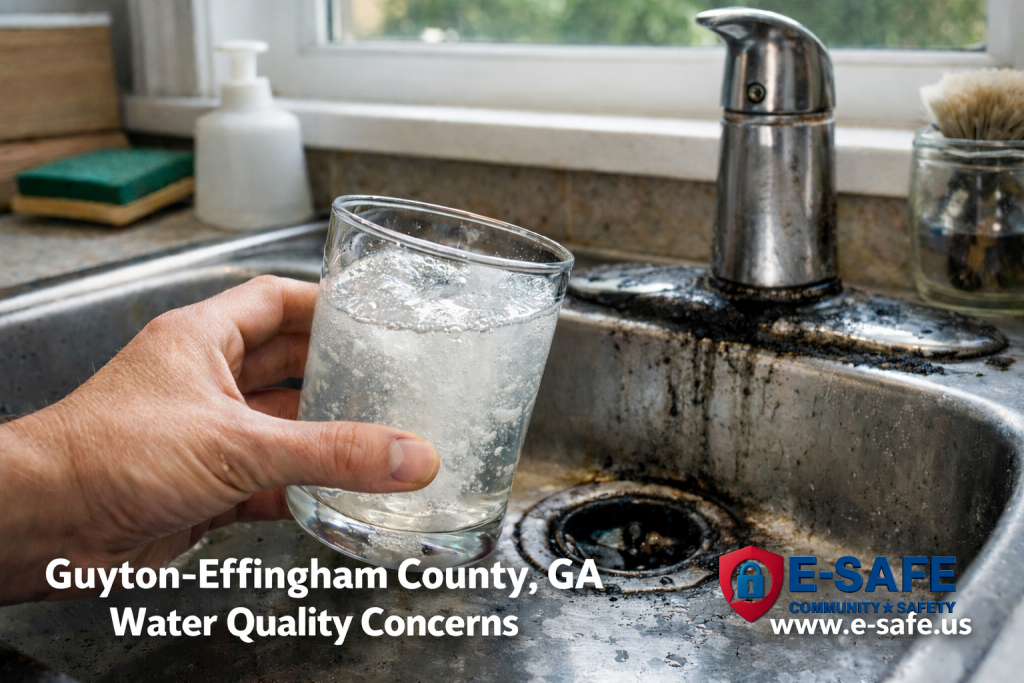
Residents have described black residue left on sinks, tubs, toilets, drains, and other fixtures. Some describe dark specks, black slime, or buildup that keeps coming back even after cleaning. Others report sulfur or rotten egg odor, cloudy water, odd taste, and periods when the water seems wrong even if it later clears.
One of the strongest frustrations is that many residents have already tried the usual in home fixes. In the neighborhood discussion reviewed for this article, one resident said the problem had been present for five years and still left black residue behind even after cleaning out the hot water heater, replacing the elements, and changing faucet aerators. Another nearby resident said the same issue had affected the home for ten years and that the household buys bulk water.
That matters because it points away from a simple dirty faucet problem and toward a broader source or system issue.
The symptom pattern the community keeps describing
The broader open source pattern in Guyton and Guyton area systems includes several recurring complaints. Residents have reported black residue, black sediment, sulfur odor, cloudy water, chemical or unusual taste, and low pressure. Some complaints appear to improve for a time, then return. Others seem tied to certain neighborhoods or systems rather than the entire city all at once.
Not every complaint points to the exact same cause. But taken together, the pattern is too consistent to dismiss as random household inconvenience.
What the symptoms most likely point to
The symptom pattern points most strongly to nuisance contaminants and system conditions rather than one single dramatic contamination event.
Black residue often points to manganese, iron, or bacteria associated with those minerals. Those materials are known to create dark staining, black or brown deposits, and recurring particles or sludge in plumbing and fixtures.
A sulfur or rotten egg smell often points to hydrogen sulfide, sulfur bacteria, or sulfur related groundwater conditions. In some homes, a water heater can make that smell worse. But when multiple homes report similar odor problems, attention naturally shifts toward the source water, the treatment process, the distribution system, or a shared groundwater issue.
Cloudy water, discoloration, and intermittent quality changes can point to disturbed sediment, poor flushing, weak disinfectant residual, stagnation in parts of a system, pressure related disturbances, or some combination of those conditions.
The most careful conclusion is that the complaints fit a recurring water quality pattern, but the exact cause may vary by neighborhood, provider, line condition, and whether a home is on city water or a private well.
Why official reports and daily experience can both be true
One of the hardest parts of this issue is that official compliance documents and daily household experience do not always sound the same.
A water system can appear compliant on the main health based measures shown in its annual report while residents still deal with black staining, odor, cloudiness, recurring buildup, or poor pressure. That is because some of the most frustrating water problems are nuisance or operational problems. They can seriously affect daily living without always appearing as a current declared health based violation.
That does not make the complaints minor. It means the real burden on households can be much larger than the formal violation record alone.
How long these problems appear to have been around
The open source record suggests this is not new.
In this review, public Georgia complaint pages tied to Guyton or Guyton area water issues were directly identifiable from 1998, 2000, 2001, 2004, 2006, 2016, 2017, 2020, and 2021. Those records include bleach like smell and ruined clothes, sulfur odor, cloudy water, black sediments, no chlorine concerns, a campground water supply issue, and low pressure with smelly or cloudy water.
That does not mean there were only nine real complaints. It means at least nine public state complaint records were identifiable in open sources during this review. The actual community complaint total is almost certainly higher because many residents complain locally, directly to utilities, or on neighborhood platforms without ever filing a formal state complaint.
The neighborhood discussion reviewed for this article pushes the lived timeline into the present. One resident described the issue as lasting five years. Another nearby resident described ten years of the same problem.
The broadest safe conclusion is this: Guyton area water complaints have been publicly visible since at least 1998, and the black residue plus sulfur type complaint pattern is visible in the public record by 2004.
What residents can do now
Start by documenting the pattern carefully. Save photos and short videos. Write down dates, times, odors, color, whether the issue affects hot water, cold water, or both, and whether nearby neighbors are seeing the same thing.
Check whether the problem is isolated or shared. If it happens at several fixtures and in several nearby homes, the pattern points more strongly to a shared system issue. If it appears only in one fixture or only in hot water, a local plumbing or water heater issue may also be involved.
For daily living, households dealing with visible residue, repeated cloudiness, or strong odor should consider using bottled water or properly certified filtered water for drinking and cooking until testing clarifies the issue. Cleaning aerators and flushing lines may help temporarily, but those are coping steps, not a permanent solution.
Testing matters. A utility sample can be useful, but an independent certified laboratory test usually creates the strongest paper trail. Residents on private wells should not delay well testing. Residents on public water should still consider independent testing when visible symptoms and household impacts keep recurring.
Who residents can complain to, and how to do it
City of Guyton
Residents on city water should start by creating a written record with the City of Guyton. The city water pages list Jenna McVey, Water Clerk, at 912-772-3353 and jenna.mcvey@cityofguyton.com. City Hall is at 310 Central Boulevard, Guyton, GA 31312. Water and sewer emergencies are listed at 912-445-0773.
When you complain, do it in writing if possible. Include photos, dates, odor description, color description, and whether nearby homes are reporting the same issue. If the problem keeps recurring, raise it publicly at a City Council meeting and ask for a written response.
Effingham County
If you are in a county served area, outside city service, or need county operations involved, use the county water contacts. The county lists water and sewer operations at 805 Low Ground Road, Guyton, GA 31312, phone 912-754-2141. Billing and customer support are listed at 804 South Laurel Street, Springfield, GA 31329, phone 912-754-8080.
If you are on a private well, or you need help with well water testing pathways, contact the local health and environmental health office and ask what testing options are currently available.
Georgia Environmental Protection Division
If the issue is not being resolved locally, if it appears to involve a public water system problem, or if the complaint keeps recurring, escalate it to the state. Georgia EPD’s public complaint tracking system explains how complaints are logged and allows the public to review concluded complaints dating back to January 1, 1998.
For general questions or complaints, Georgia EPD lists askEPD@gaepd.org. For this region, EPD lists the Coastal District Office at 1050 Canal Road, Brunswick, GA 31525, phone 912-264-7284. For an environmental emergency requiring immediate attention, EPD lists 1-800-241-4113.
When filing with EPD, include the full address, the utility name if known, dates and times, whether the issue is color, odor, pressure, visible residue, or possible health concern, whether multiple homes are affected, and whether local authorities have already been contacted.
U.S. Environmental Protection Agency
If residents believe the issue is not being handled properly through local and state channels, federal contacts are also available. EPA Region 4 lists the Sam Nunn Atlanta Federal Center, 61 Forsyth Street SW, Atlanta, GA 30303-8960, with main phone 404-562-9900 and toll free number 1-800-241-1754.
For general drinking water standards, testing questions, and consumer guidance, residents can also use the federal Safe Drinking Water Hotline at 1-800-426-4791.
The bottom line
Guyton and Effingham County residents are not describing a concern that came out of nowhere. The public record and neighborhood discussion together show repeated water related complaints over many years. The pattern is consistent enough to take seriously even if every case does not point to the exact same source.
The most likely explanation is a mix of groundwater related nuisance contaminants and system conditions that can make the problem show up differently from place to place. What residents need now is not more guesswork. They need testing, documentation, transparency, and a response that treats repeated community complaints as a public concern worth solving.
Reporting Notes
The uploaded neighborhood discussion states that one Guyton resident has dealt with the issue for five years, with black residue remaining even after water heater cleaning, element replacement, and faucet aerator changes, and a nearby commenter says the same issue has existed for ten years.
The city’s water quality page currently publishes Consumer Confidence Reports from 2019 through 2024, and the city’s water clerk page lists Jenna McVey as Water Clerk, along with the main city phone number, City Hall address, and water or sewer emergency number.
This review directly verified public Georgia EPD complaint pages tied to Guyton or Guyton area water concerns from 1998, 2000, 2001, 2004, 2006, 2016, 2017, 2020, and 2021. Those records include bleach smell and ruined clothes, sulfur odor, cloudy water, black sediments, no chlorine complaints, a nonpermitted campground water system issue later tied to connection with City of Guyton water, and a 2020 low pressure complaint involving smelly or cloudy water.
Effingham County currently lists county water and sewer operations at 805 Low Ground Road in Guyton and customer support and water billing at 804 South Laurel Street in Springfield. Georgia EPD lists askEPD@gaepd.org for general questions or complaints, the Coastal District Office in Brunswick, and 1-800-241-4113 for environmental emergencies. Georgia DPH recommends annual bacteria testing for private wells and chemical screening every three years. EPA Region 4 lists its Atlanta office and phone contacts, and EPA’s Safe Drinking Water Hotline remains 1-800-426-4791.
Sourcing
- Nextdoor neighborhood discussion
- City of Guyton, Water Quality Report and posted CCR archive.
- City of Guyton, Water Clerk and city contact information.
- Effingham County, Water & Waste Water.
- Effingham County, Water & Sewer Billing.
- Georgia EPD, Contact Us and Complaint Tracking System guidance.
- Georgia EPD, District Offices, Coastal District.
- Georgia EPD Complaint ID 531, 1998 bleach smell and ruined clothes.
- Georgia EPD Complaint ID 3500, 2000 sulfur odor and bleached clothes.
- Georgia EPD Complaint ID 12743, 2001 cloudy water complaint.
- Georgia EPD Complaint ID 28998, 2004 sulfur odor and black sediments.
- Georgia EPD Complaint ID 39390, 2006 rotten egg or sulfur smell complaint.
- Georgia EPD Complaint ID 80921, 2016 no chlorine and black growth complaint.
- Georgia EPD Complaint ID 84208, 2017 campground water system complaint and later connection to City of Guyton water.
- Georgia EPD Complaint ID 94162, 2020 low pressure with smell or cloudiness complaint.
- Georgia EPD Complaint ID 98381, 2021 Lee Village odor and chlorine concern.
- Georgia Department of Public Health, Well Water guidance.
- U.S. EPA, Contacting EPA Region 4.
- U.S. EPA, Safe Drinking Water Hotline information.