
Share this article
Community News · Community Safety
Bone Marrow Donor List Scams Are Not Just Fraud, They Are a Death Sentence
Families fighting cancer are discovering that stolen or sold donor lists can destroy more than privacy—they can cost lives. E-Safe investigates how organ and bone marrow donor scams exploit desperate families, steal…
A bone marrow match is one of the rarest, most lifesaving medical miracles a family can receive. The odds of finding one range from 1 in 100 to 1 in more than 1 million, depending on ancestry and genetics. When a match is found, there is celebration, relief, cautious hope.
When that match cannot be reached because donor records were stolen, sold, or manipulated through scams, it becomes something far darker. A tragedy amplified by crime.
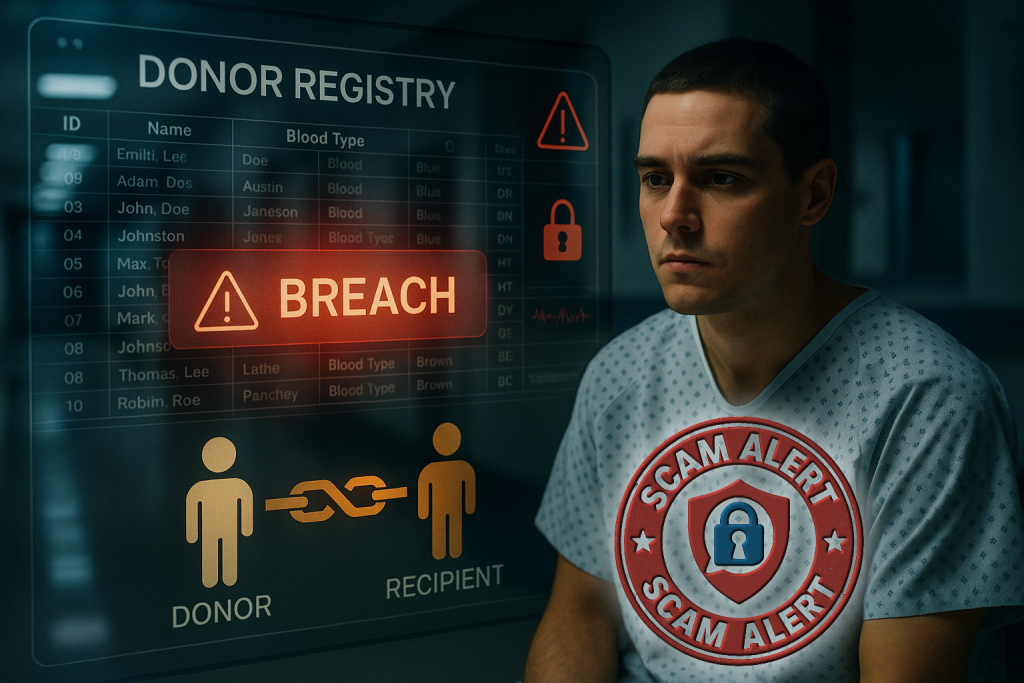
This is not hypothetical. Families across the country, including one currently fighting to save a young daughter battling cancer, are witnessing the consequences in real time. A perfect donor was identified, but the hospital can no longer reach them. Somewhere between goodwill and greed, the chain of custody broke. And a life now hangs in that fracture.
Donor list fraud is not merely financial crime. It is a threat to national health systems, medical trust, and human survival.
Organ and Bone Marrow Broker Scams
In these schemes, criminals pose as facilitators who can locate donors faster than hospitals. They target families in crisis, offering shortcuts, international donor networks, or priority access. The fraudster demands high fees, medical documents, insurance records, or travel payments, then disappears.
What they gain: money, medical identities, insurance fraud material, passport scans, and personal data that can be resold indefinitely.
Consequences: families drain savings, expose medical profiles, and lose critical time attempting to reach real medical help. Children and adults have died waiting while brokers play middleman to nowhere.
Fake Charity and Health Network Impersonation Scams
Scammers clone real charity pages, medical foundation sites, and donor registry portals. These fake platforms collect donor sign ups, donation payments, or recipient inquiries under the illusion of legitimacy. Some even mimic real cancer organizations down to logos, phrasing, and website structure.
What they gain: credit card information, personal addresses, birth dates, email lists, and full medical family histories.
Consequences: families believe they are speaking with advocates or registries while criminals quietly build profiles they can resell or weaponize for identity theft. Legitimate donors unknowingly register where no doctor can ever find them.
Donor List Theft, Resale, and Misuse
This is the scam most directly tied to the tragedy now facing families and hospitals. Donor lists, including bone marrow registries, contain priceless human data. Names, DNA compatibility markers, ethnic lineage data, physical health histories, and direct contact information.
Criminals obtain these lists through phishing attacks on nonprofits, corrupt insiders, fake “data cleaning” services, breached medical platforms, or fraudulent partnership requests. Lists are then resold, harvested for profit, or used to build scam outreach campaigns.
What they gain: targeted access to compassionate, medically trackable, decision ready individuals. A single donor list can generate millions when repurposed for medical identity theft rings or predatory scams.
Consequences: real matches become unreachable, contact details get replaced with scam controlled emails or phone numbers, and registries become polluted with unusable records. Lives are literally lost inside spreadsheets handled like merchandise.
The Refund, Overpayment, and Fake Donor Engagement Scam
This fraud targets service organizations, not patients. Criminals pose as donors pledging funds or offering to sponsor matching drives. They send fake checks or stolen payments, then request a refund before the transaction clears, draining real money from the organization.
What they gain: immediate funds wired back before the fraud is detected.
Consequences: organizations lose resources, credibility, and sometimes entire donor programs. When nonprofits collapse under financial fraud, medical support programs collapse with them, including donor coordination efforts.
Social Media Medical Match Scams
Families pleading for donors online are met with fake matches, fake nurses, fake lab confirmations, and scripted “success stories.” Scammers request shipping fees for fake test kits, DNA processing fees, or “expedited match verification” payments.
What they gain: emotional desperation converts into fast payments, personal medical disclosure, and shared identity data.
Consequences: families lose funds, but more critically, they lose time. In cancer treatment, time is not just money. It is survival.
The Real Cost of Donor List Corruption
The consequences are not abstract. They are measured in:
Missed transplant windows
Compromised patient data
Unreachable medical matches
Destroyed trust in donor systems
Financial devastation for families
And in the worst cases, loss of life
A donor list is not a call center roster or marketing tool. It is a lifeline registry. When it is stolen or corrupted, the crime becomes biological, not digital.
A Call for Reform, Protection, and Vigilance
Donor registries, hospitals, nonprofits, and families must demand stronger protective measures, including:
Encrypted donor databases with restricted access
Independent third party audits of registry integrity
Ban enforcement on data reselling of any medical donor information
Stricter criminal penalties equal to those for medical harm or negligence
Public awareness campaigns so families can identify fraud before they are targeted
Most importantly: every donor registry must be treated with the same security protocols as a national blood bank or organ transplant database, because the stakes are identical.
E-Safe stands with every family fighting for life, not just against disease, but against a system that too often lets predators circle the most vulnerable. Bone marrow donors are not data. They are not assets. They are not profit margins. They are human beings who once raised their hand and said, “I will save someone if I can.”
They deserve a system worthy of that promise. So do the families still waiting for that call to connect.