
Share this article
E-Safe News · Fraud Awareness
Spring Repairs and Contractor Red Flags
Spring repair season can also bring contractor risk. This Chatham County focused article explains how homeowners can verify contractors, spot red flags, and respond when problems begin.
As spring settles into Chatham County, many homeowners begin thinking about the projects they put off through the colder months. A leaking roof, aging siding, cracked concrete, worn flooring, storm related repairs, an overdue bathroom refresh, or the backyard improvement that has been on the wish list for months. Spring often feels like the right time to move forward.
It is also a time when homeowners need to slow down and pay attention.
Most contractors serving Chatham County are legitimate professionals who work hard, take pride in their craft, and depend on satisfied customers to keep their businesses growing. They show up, communicate clearly, perform quality work, and stand behind what they do. But the few who do not can leave a homeowner facing unfinished work, damaged property, permit problems, surprise costs, and a long, frustrating effort to recover money.
That is why hiring a contractor should never begin with the price alone. It should begin with verification.
Why homeowners get caught off guard
Contractor problems do not always begin with obvious fraud. Sometimes the warning signs seem small at first. A person rushes you to sign. A quote feels vague. A promise is made verbally, but never added to the paperwork. Insurance is mentioned, but no proof is provided. The business name seems to change from one document to another. Payment is requested quickly, before materials arrive or before a clear schedule is established.
When homeowners are eager to start a project, especially one tied to weather, safety, or family needs, it becomes easy to mistake speed for professionalism. That is often where expensive mistakes begin.
In Chatham County, that can become even more painful when a homeowner later discovers that the work should have involved proper permits, inspections, or better documentation from the start. Problems that may have seemed manageable at the beginning can quickly grow into delays, rework, denied claims, additional expense, or disputes over responsibility.
What reliable contractors usually do
A reliable contractor generally does not resist basic questions. They understand why a homeowner wants to verify licensing, insurance, references, business details, and prior work. In fact, a reputable contractor usually expects it.
They are more likely to provide a written estimate that clearly describes the scope of work, materials, timing, and payment structure. They are more likely to explain whether permits are needed, who will obtain them, and how inspections will be handled. They are more likely to communicate in a way that is clear, organized, and consistent.
Trustworthy contractors do not usually rely on pressure. They rely on documentation, transparency, and results.
How to identify and verify a contractor before signing anything
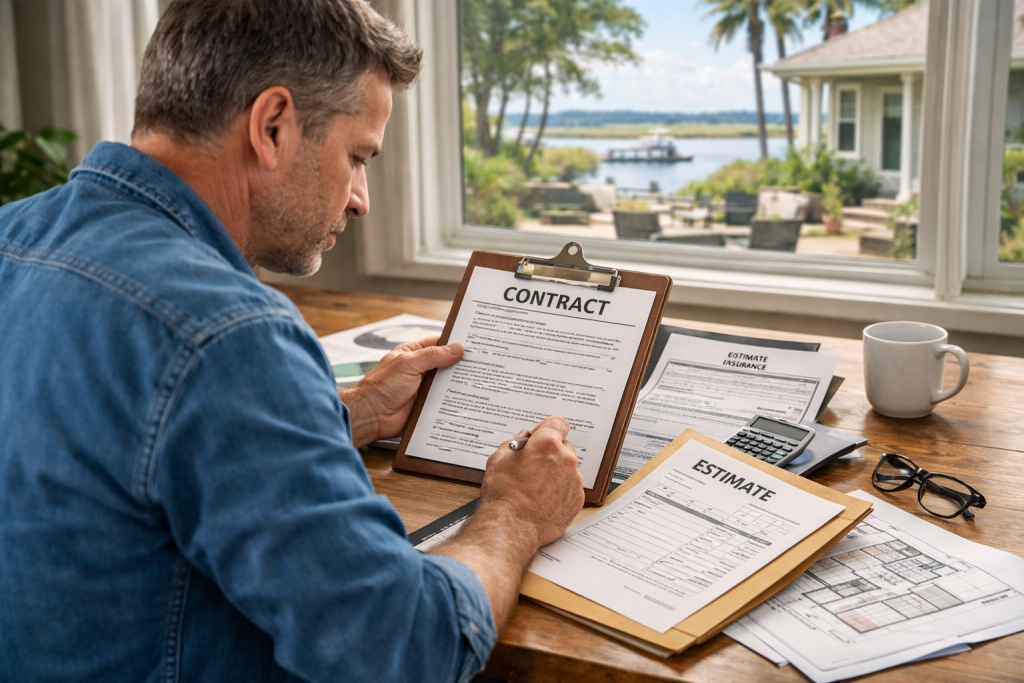
Before agreeing to any project, get the contractor’s full legal business name, physical business address, phone number, email address, and the name of the person who will be responsible for the work. Ask whether the business is operating under its registered name or a trade name. Make sure the name on the estimate, contract, invoice, and insurance paperwork all match.
Ask whether the work requires a professional license, permit, or both. Then verify that information yourself. Do not rely only on what you are told. Verification should come from the appropriate state or local authority, not from a screenshot, a business card, or a social media page.
Also ask for proof of general liability insurance and, when applicable, workers’ compensation coverage. A homeowner should not assume these protections are in place simply because a contractor says they are insured. Request documentation and review it carefully.
Then move to references. Ask for recent customers with projects similar in size and type to yours. Speak with them directly. Ask whether the job started on time, stayed on budget, finished properly, and whether problems were addressed without excuses or delay.
If possible, look beyond the reference list the contractor provides. Search the business name and the owner’s name across multiple sources. Look for patterns, not isolated complaints. A single negative comment may not mean much. Repeated concerns about deposits, delays, workmanship, damage, disappearance, or refusal to correct problems deserve serious attention.
Why online ratings alone should never be the deciding factor
Online ratings can be useful, but they should never stand alone as the basis for trust.
A polished profile can look impressive while still revealing very little about how a contractor handles change orders, warranty issues, missed deadlines, cleanup problems, or disputes after payment. Some ratings are based on only a small number of reviews. Some customers leave a quick score without explaining what actually happened. Some platforms do not show the full picture of complaints, and not every unhappy customer posts publicly.
That is why reviews should be treated as one checkpoint, not the whole investigation.
A stronger approach is to combine online research with direct references, license verification, insurance verification, a written contract, and a close reading of the company’s communication habits. When several of those pieces line up, confidence increases. When they do not, the homeowner should pause.
What the written contract should do
A written contract should remove uncertainty, not create more of it.
It should clearly identify the parties, the property address, the exact work to be done, the materials to be used, who is responsible for permits, the estimated start date, the expected completion date, the payment schedule, cleanup expectations, warranty information, and how changes will be approved. Verbal promises should be added in writing. If something matters, it belongs in the contract.
A smart payment structure also matters. Payments tied to completed stages of work are generally safer than large upfront payments disconnected from actual progress. Homeowners should be cautious when asked to pay in cash, pay everything early, or send money before documentation is in place.
What to do if problems start
If a project begins to go sideways, act quickly and document everything.
Keep the contract, estimate, receipts, proof of payment, photos, videos, inspection records, text messages, emails, and notes from phone calls. If the issue involves defective work, incomplete work, property damage, or a sudden demand for more money, put your concerns in writing immediately and send them in a way that creates a record.
Do not let frustration replace documentation. A clear paper trail can matter far more than memory later.
For homeowners in Chatham County, the right next step often depends on the nature of the problem. Permit or inspection concerns may need to be directed to the county office responsible for building safety and regulatory matters. Licensing questions should be independently checked through the state. Suspected deceptive practices or consumer harm may need to be reported to Georgia’s consumer protection authorities. If money is taken under false pretenses, or there is evidence of theft or intentional fraud, law enforcement may also need to be contacted.
If the financial loss is significant, or the work creates a safety risk, legal advice may also be appropriate.
The bottom line
Spring home projects can add value, comfort, and peace of mind. But the wrong contractor can do the opposite.
A little extra homework at the beginning can prevent a great deal of stress later. Check credentials. Verify insurance. Read the contract carefully. Research prior customer experiences. Compare estimates. Slow down when a contractor tries to rush you. And remember that the best looking online profile is never a substitute for real verification.
Most contractors deserve respect for the work they do. The goal is not to distrust everyone. It is to protect your home from the small number of people who make that caution necessary.
Information Sources
Chatham County Building Safety and Regulatory Services: For Chatham County homeowners, this is the most relevant local office for permit and inspection questions tied to home repair and improvement work. Chatham County states that a building permit is required for most major changes to a structure, and its Building Safety and Regulatory Services office provides permit and inspection functions from 1117 Eisenhower Drive, Savannah, Georgia 31406, with department contact information listed publicly.
Georgia Attorney General Consumer Protection Division: Georgia advises consumers to use written estimates and contracts, verify licensing where required, check references, and be cautious about payment practices. The Attorney General’s office also provides a complaint process for consumer disputes and notes that many contractor related concerns can first be documented and raised with the business before escalating the complaint. Georgia also specifically directs consumers who believe they may be victims of home repair fraud to contact the Consumer Protection Division.
Georgia Secretary of State licensing and business verification: Georgia’s Secretary of State provides the official licensee search for regulated trades and the official business entity search for registered companies. Georgia also states that general contractors, electricians, plumbers, and heating and air conditioning contractors must be licensed through the Secretary of State, while some trades such as roofers, painters, drywall contractors, and repair handymen are not state licensed, making business verification and documentation even more important.
Georgia workers’ compensation coverage verification: Georgia’s State Board of Workers’ Compensation offers an online employer coverage verification tool so consumers can check whether a business has workers’ compensation coverage on file. The Board also states that its Enforcement Division investigates noncompliance and allegations of fraud relating to coverage.
Georgia Right to Repair guidance: Georgia’s consumer guidance explains that the Right to Repair Act provides a notification process for claims involving defective construction or remodeling, and the Attorney General’s consumer page notes that homeowners pursuing certain construction defect claims must follow the Act’s requirements. This can matter when a dispute moves beyond a routine complaint and into possible legal action.
Frequently Asked Questions (FAQs)
Find clear answers about this E-Safe page, its available features, community resources, responsible use, and related services for Coastal Georgia residents. Use the source links and official contacts when making local decisions.
Should homeowners check whether a contractor is pulling permits in their own name or in the homeowner’s name?
Yes. Homeowners should ask exactly who will apply for the permit and whose name will appear on it. A legitimate contractor should be clear about that process. If the contractor tells the homeowner to pull the permit personally for contractor controlled work, that can be a warning sign. It may shift responsibility in ways the homeowner does not fully understand.
What is a change order, and why does it matter during a repair project?
A change order is a written update to the original agreement when work, materials, pricing, or timing changes after the job begins. It matters because many contractor disputes start when extra work is discussed casually but never documented. A written change order helps prevent misunderstandings about what was added, what it costs, and whether the homeowner approved it.
Can a very low estimate be a warning sign instead of a good deal?
Yes. A quote that comes in far below others may mean the contractor is leaving out important parts of the job, using lower quality materials, underpricing to get the contract, or planning to raise costs later. A low estimate is not automatically a scam, but it should be reviewed carefully against the scope of work, materials, timeline, and payment schedule.
Why should homeowners keep a project file from the start of the job?
A project file creates a clear record of what was promised, what was paid, and what actually happened. It should include the contract, estimates, receipts, permit records, insurance documents, photos, videos, emails, text messages, and notes from conversations. This can be extremely helpful if the project goes off track or if the homeowner later needs to file a complaint, make an insurance claim, or seek legal guidance.
What should homeowners do before making the final payment?
Before making the final payment, homeowners should inspect the completed work carefully, confirm that agreed items were finished, and make sure any required inspections have been completed. They should also review whether cleanup was done properly, whether damage was left behind, and whether any warranty information or final paperwork was promised. Final payment should usually come only after the homeowner is satisfied that the contracted work has actually been completed.