
Share this article
E-Safe News · Fraud Awareness
Georgia Crypto Kiosk Safe Haven Scams
Georgia crypto kiosk Safe Haven scams are hitting older adults hard. This report explains how the fraud works, why Georgia is exposed, how the pressure tactics unfold, and what residents should do…
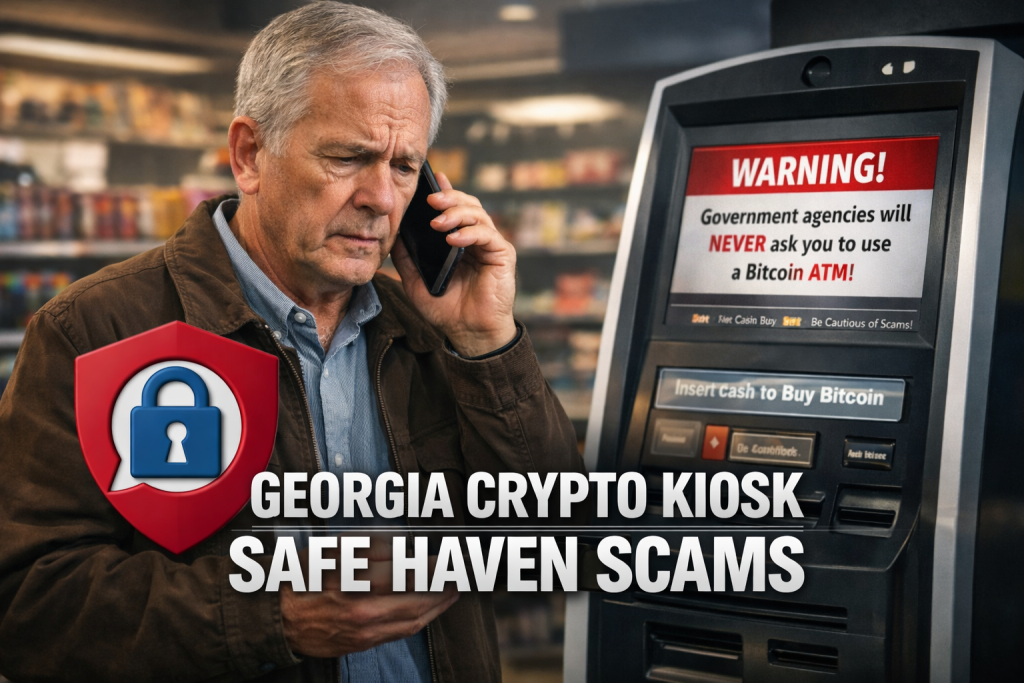
Georgia is becoming one of the states receiving increased attention in the growing wave of cryptocurrency kiosk fraud. The scam is simple in structure, but highly effective in practice. A caller creates fear, claims a bank account or retirement fund is at risk, and then directs the victim to move cash into a cryptocurrency kiosk. The machine is falsely presented as a safe place to protect money. In reality, it is the point where the theft is completed.
Federal consumer warnings now make clear that this tactic is not rare, and it is not misunderstood. It is fraud. The victim is often told that their account has been hacked, that their identity has been tied to criminal activity, or that investigators need them to secure their money immediately. The caller may pretend to be from a bank fraud department, a government office, law enforcement, a court, or another trusted institution. The person on the line sounds calm, official, and urgent. That combination is what makes the scam work.
How the Safe Haven Claim Works
The Safe Haven version of the fraud is especially dangerous because it pretends to be protective. The victim is not told they are sending money to a stranger. They are told they are saving it. Scammers have used phrases suggesting that the kiosk functions like a secure digital locker or government protected holding place. That is false. Once the cash is fed into the machine and transferred by scanning the code provided by the scammer, the money is typically converted and sent to a wallet the scammer controls.
This is why the fraud moves so quickly. The caller creates the panic, controls the conversation, and keeps the victim isolated. Many victims are told not to speak to family members, not to tell bank staff what is happening, and not to hang up the phone. Some are walked from the bank directly to a nearby kiosk. Others are sent to a specific machine chosen by the scammer. The goal is always the same: speed, secrecy, and irreversible payment.
The Impact in Georgia
National losses show how serious the problem has become. Federal reporting shows that cryptocurrency ATMs and kiosks were tied to tens of thousands of complaints and hundreds of millions of dollars in losses. Older adults have been hit hardest. That does not mean younger adults are safe. It means this scam is particularly effective against people with savings, retirement funds, and a stronger instinct to comply when someone sounds official.
Georgia has emerged as a major state to watch because of the number of kiosks already operating here and the level of reported harm. Public reporting has described Georgia as a hotspot for kiosk related fraud, with more than 1,100 cryptocurrency kiosks across the state and more than $5.3 million in reported resident losses tied to kiosk complaints in 2024 alone. That matters because access is part of the threat. When these machines sit in convenience stores, gas stations, and other ordinary locations, the scam can move from a phone call to a cash loss in a very short time.
For Coastal Georgia, the issue is especially important as communities continue to grow in and around Savannah, Pooler, Bloomingdale, and nearby areas. Scammers do not need to know a victim personally. They only need a convincing script, a working phone number, and a target who is caught off guard. In fast growing communities with new residents, retirees, and people handling utility setups, bank changes, and new accounts, the opportunity for a well timed fraud pitch increases.
The pressure tactics are becoming more sophisticated. Consumer advocates in Georgia have also warned that criminals are increasingly using AI generated images and cloned voices to make scam calls sound more believable. That does not change the core rule. No legitimate government agency, bank, court, or law enforcement office will tell someone to protect money by putting cash into a cryptocurrency kiosk.
That is the most important fact in this entire issue.
Recognizing the Payment Trap
If anyone tells you to move money to protect it, to clear your name, to stop an investigation, or to prevent a hacker from draining your account, it is a scam. If they tell you to go to a Bitcoin ATM or cryptocurrency kiosk, it is a scam. If they send a QR code and say it will keep your money safe, it is a scam. The machine is not a vault. It is the handoff.
Consumer Protection and Community Awareness
Georgia lawmakers did respond in March 2026 by passing HB 945, which includes new kiosk related consumer protections and stronger oversight provisions. That matters, but it should not distract from the central issue. The real story is the fraud itself: the false emergency, the impersonation, the isolation, the cash withdrawal, and the final transfer into a system that is extremely hard to unwind once the money is gone.
For residents, the safest response is to slow everything down. End the call. Use a verified phone number to contact the bank or agency yourself. Speak to a trusted family member. Tell bank staff the real reason for the withdrawal if you are already at the counter. If cash has not yet been sent through the machine, stop immediately. If money was already sent, report it as fast as possible to the kiosk operator, your bank, the FTC, and the FBI Internet Crime Complaint Center.
The Safe Haven scam succeeds by making fear sound like protection. The best defense is to recognize that no real protection ever begins with a stranger telling you to put your life savings into a cryptocurrency kiosk.
Sourcing
Federal Trade Commission. Did someone send you to a Bitcoin ATM? It’s a scam. Published March 7, 2024. This consumer alert directly states that there are no Bitcoin federal safety lockers and warns that scammers use fear to push people into sending life savings through a Bitcoin ATM. Accessed March 30, 2026.
Federal Trade Commission. Bitcoin ATMs: A payment portal for scammers. Published September 3, 2024. This FTC analysis explains the mechanics of the scam, including false claims that the kiosk will protect money, directions to withdraw cash from a bank, and the use of QR codes that route funds to the scammer’s wallet. Accessed March 30, 2026.
Federal Trade Commission. Federal Trade Commission Warns of Scammers Pretending to be Agency Staff. Published March 19, 2024. This release confirms that the FTC will never tell consumers to move money to protect it, never send them to a Bitcoin ATM, and never demand cash movement in response to a supposed threat. Accessed March 30, 2026.
Federal Trade Commission. Did someone tell you to move or transfer your money? It could be a scam. Published January 19, 2024. This source explains the broader impersonation structure behind these schemes, including false claims about seized savings, instructions to go to a bank while staying on the phone, and demands to hide the real reason for the withdrawal. Accessed March 30, 2026.
Federal Bureau of Investigation, Internet Crime Complaint Center. 2024 IC3 Annual Report. Published December 3, 2024. The report documents 10,956 complaints involving cryptocurrency ATMs and kiosks, $246.7 million in losses, and $107.2 million in losses among victims over age 60. It also identifies government impersonation, tech support, extortion, and investment schemes as major fraud types associated with crypto ATM use. Accessed March 30, 2026.
AARP Georgia. Report Warns Digital Fraud Crimes Are Harming Georgians at Alarming Rates. Published March 2026. This Georgia focused report describes the state as a hotspot for kiosk related scams, notes more than 1,100 cryptocurrency kiosks in Georgia, reports 298 related complaints and more than $5.3 million in resident losses, and warns of rising use of AI generated images and cloned voices. Accessed March 30, 2026.
Georgia Bankers Association. 2026 State Banking Issues. Accessed March 30, 2026. This legislative tracker describes HB 945 as creating a comprehensive regulatory framework for virtual currency kiosks, including disclosures, fee caps, transaction limits, refund rights for fraud victims, identification requirements, monitoring obligations, and live support duties.