
Share this article
Community News · E-Safe News
Why Retirement is Becoming a Dangerous Trap for Men
A growing number of retired men face identity loss, isolation, and increased health risks after leaving the workforce.
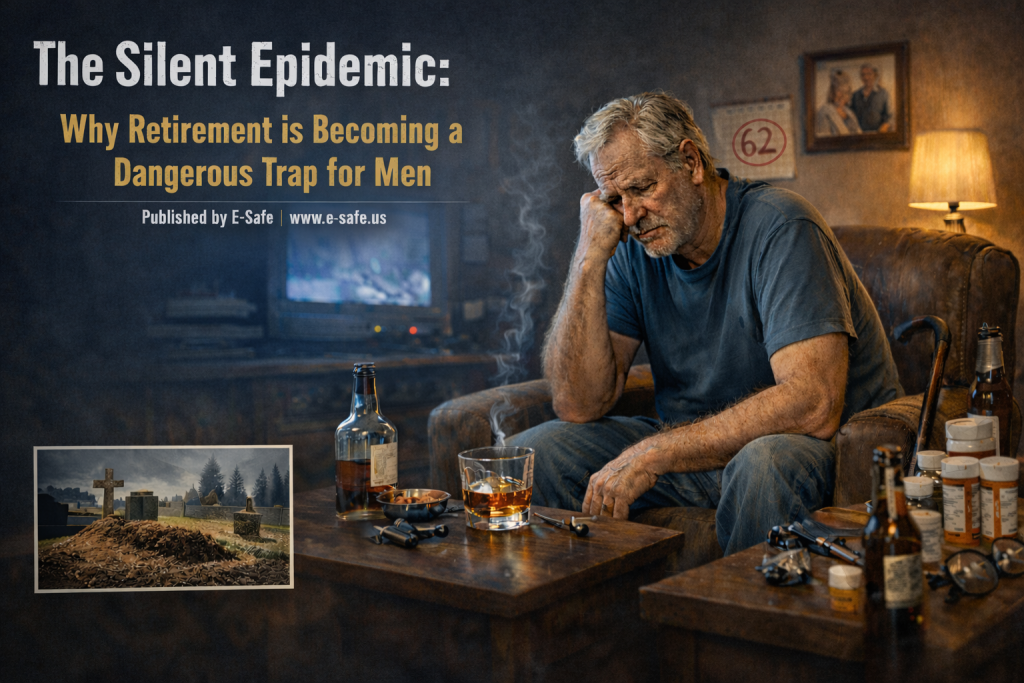
The classic American dream paints retirement as a golden era of relaxation. We picture the retired man sitting peacefully in his favorite armchair with the television murmuring in the background. When his family asks how he is doing, he simply says he is fine. However, recent psychological studies and mortality data suggest a much darker reality. That silence is not always relaxation. Often, it is the sound of a man who has lost the only identity society ever valued him for.
For generations, men were conditioned to view themselves as providers and producers. Their entire architecture of selfhood was built around their careers. But what happens when that framework is suddenly removed? As a website dedicated to community safety and awareness, E-Safe is highlighting this hidden crisis. Understanding it could be the key to protecting the physical and mental well being of our fathers, husbands, and neighbors.
The Psychological Vacuum
Society spends 40 years teaching men to be human doings rather than human beings. When retirement arrives, it strips away their daily structure, their sense of purpose, and their primary source of social connection.
Currently, the psychiatric community lacks a specific diagnostic term for this profound transition. The Diagnostic and Statistical Manual of Mental Disorders does not officially recognize Retirement Syndrome or Post Retirement Identity Loss. Consequently, when older men do seek help, they are often misdiagnosed with general depression. Standard treatments frequently fail because they attempt to medicate what is fundamentally an existential crisis. Furthermore, because older men are socialized to equate silence with strength, they rarely use the clinical language of depression. They mask their symptoms and fade quietly into the background.
The Startling Reality in the Numbers
The physical and mental toll of this identity loss is staggering. It is a common societal rumor that people die shortly after retiring. While the old myth that early retirees automatically pass away within 18 months is false, actuarial data reveals a very real and dangerous spike in male mortality.
-
The Age 62 Mortality Spike: Studies analyzing federal social security data show a robust 2 percent increase in male mortality in the exact month men turn 62, which is the earliest age to claim benefits. Female mortality does not see this same significant jump.
-
The Root Causes: This spike is not driven by natural aging diseases. It is driven by traffic accidents, lung conditions, and other issues tied to an increase in unhealthy behaviors. Without the structure of work, self medicating habits like drinking and a sedentary lifestyle often increase.
-
The Highest Suicide Rates: Federal health statistics reveal the highest suicide rate of any demographic in the United States belongs to men aged 85 and older. The rate sits at an alarming 55.7 deaths per 100,000 people.
-
The Deadly Convergence: Geriatric psychiatry experts identify five factors that tragically converge on older retired men: Depression, Disease, Disability, Disconnection, and Deadly means.
Debunking the Myths
To protect the men in our lives, we must stop believing the misconceptions surrounding retirement.
-
Myth: He is just enjoying the quiet. Reality: The passive retiree in the armchair is frequently experiencing severe internal distress and a loss of external validation.
-
Myth: Hobbies are the cure. Reality: Handing a depressed retired man a golf club does not fix an existential void. The solution requires transitioning from asking what a man does to asking who a man is.
-
Myth: Retirement is equally hard for everyone. Reality: Women historically maintain a portfolio of identities throughout their lives, acting as caregivers, friends, and professionals. Men are often pushed to go all in on a single professional identity, making their fall much harder when work ends.
Redefining Worth Beyond the Workplace
Retirement should not be a trap. It should be a transition. For those approaching this milestone, preparation must begin years in advance. It is vital to build social networks outside of the office and cultivate passions that provide meaning rather than just distraction.
For the families watching a retired loved one slip into silent isolation, the fix starts with asking different questions. Do not ask what they are doing with their time. Ask them what matters to them now. Remind them that they have always been more than their job title, even if society never took the time to tell them.
Sourcing
-
Global English Editing: “Psychology says the reason retired men sit in silence isn’t because they have nothing to say, it’s because they’ve lost the only identity anyone ever valued them for.” https://geediting.com/gen-psychology-says-the-reason-retired-men-sit-in-silence-isnt-because-they-have-nothing-to-say-its-because-theyve-lost-the-only-identity-anyone-ever-valued-them-for/
-
National Bureau of Economic Research (NBER): “The Mortality Effects of Retirement: Evidence from Social Security Eligibility at Age 62” (Working Paper No. 24337). https://www.nber.org/papers/w24337
-
Centers for Disease Control and Prevention (CDC): National Center for Health Statistics (NCHS) Data Brief on Suicide Rates by Age and Sex. https://www.cdc.gov/nchs/products/databriefs/db448.htm
-
University of Rochester Medical Center: Research Profile on Dr. Yeates Conwell regarding geriatric suicide risk factors. https://www.urmc.rochester.edu/people/20349890-yeates-conwell
-
National Center for Biotechnology Information (NCBI): “Psychological Distress and Retirement: A Study on Male Mortality and Health Behaviors.” https://www.ncbi.nlm.nih.gov/pmc/articles/PMC8304918/
Frequently Asked Questions (FAQs)
Find clear answers about this E-Safe page, its available features, community resources, responsible use, and related services for Coastal Georgia residents. Use the source links and official contacts when making local decisions.
Why does retirement affect men differently than women?
Many men are socialized to tie their identity, self‑worth, and social connection primarily to their careers. When work ends, that structure often disappears all at once. Women, historically, tend to maintain multiple identities throughout life, such as caregiver, friend, professional, and community member, which can provide greater resilience during retirement.
Is this issue officially recognized as a medical or psychological condition?
Currently, there is no formal diagnostic category for retirement‑related identity loss in standard psychiatric manuals. As a result, men experiencing this transition are often diagnosed with general depression, even when the underlying issue is a loss of purpose and identity rather than a chemical imbalance.
Why do many retired men struggle in silence instead of asking for help?
Older men are often taught that strength means self‑reliance and emotional restraint. Many do not use clinical language to describe their distress and may not recognize their experience as depression. This can lead to symptoms being hidden or minimized until they become severe.
What warning signs should families watch for after a loved one retires?
Common signs include social withdrawal, loss of interest in previously meaningful activities, increased alcohol use, declining physical activity, irritability, and a lack of future‑oriented goals. Sudden changes in routine or personality after retirement should be taken seriously.
What can help reduce the risks associated with retirement identity loss?
Preparation before retirement is key. Building strong social networks outside of work, developing purpose‑driven roles, and having honest conversations about identity and meaning can reduce risk. After retirement, families should focus on asking what matters to the individual now, rather than how they are filling their time.