
Share this article
Crime Awareness · E-Safe News
Cargo Theft Rings Expose Coastal Car Haulers to Higher Risk
E-Safe public safety, and crime awareness article explaining organized cargo theft, open haulers, rest area risks and port linked freight routes increasing exposure for Coastal Georgia car haulers and driver safety.
This article examines the growing risk that organized cargo theft rings pose to coastal car haulers, especially drivers moving visible vehicle loads through port linked routes, interstate corridors, rest areas, and late night parking locations. It is written as a safety and awareness article for Coastal Georgia readers, commercial drivers, dispatchers, and residents who may observe suspicious activity near freight movement areas.
The investigation into the death of truck driver Alejandro Jacomino Gonzalez remains an important public safety matter. As of June 4, 2026, E-Safe found no significant publicly available update from State Law enforcement nor from the FBI identifying an arrest, suspect description, reward, cause of death, or major investigative break in the case.
The known facts are still serious. Gonzalez was transporting vehicles from the Port of Brunswick to Miami. He was last seen during the early morning hours at a rest area along Interstate 95 in Brevard County, Florida. His truck was later found in Port Wentworth, Georgia, with several vehicles missing from the hauler. His body was found in coastal Georgia, and the FBI continues to lead the investigation.
This article focuses on the larger public safety issue the case brings into view. Across the transportation industry, cargo theft has become more organized, more selective, and more technologically enabled. For open car haulers, the risk profile is especially visible because the cargo is displayed in plain sight.
Visible Cargo
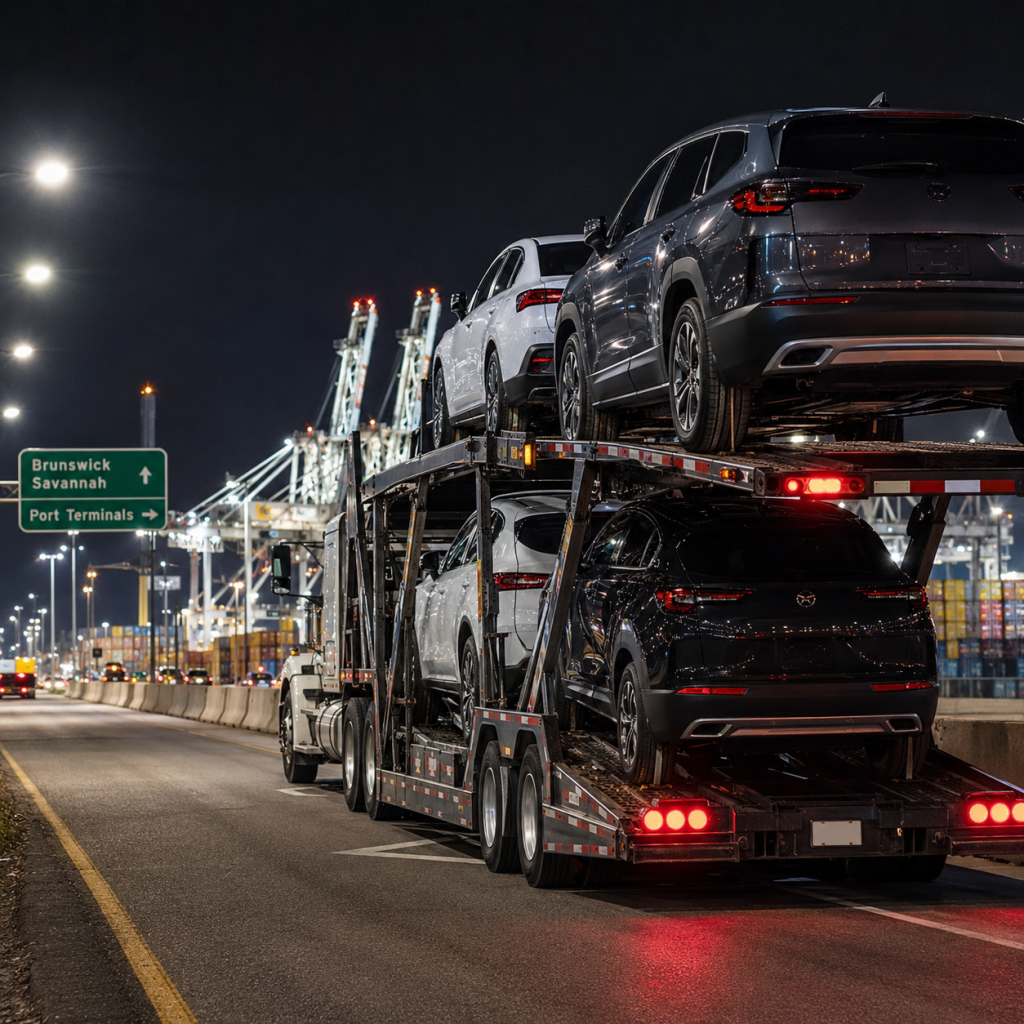
Open car haulers display vehicle type, quantity and estimated value in plain view.
Late Night Exposure
Rest periods, delivery windows and parking shortages can push drivers into vulnerable locations.
Organized Methods
Modern cargo theft can involve physical theft, fraud, account misuse and technology enabled diversion.
A Visible Load Can Become a Visible Target
Most freight theft happens because criminals identify opportunity. With a sealed trailer, the cargo is often hidden. With an open car hauler, the cargo can be seen immediately.
A person driving behind or beside a vehicle hauler can often identify the number of vehicles, vehicle type, estimated value, and whether the load appears to include desirable models. That visibility does not mean every car hauler is targeted. It does mean the driver and cargo operate with a different kind of exposure.
Car haulers are also highly recognizable. They move slowly in traffic, require larger turning space, and are harder to hide in public parking areas. A loaded hauler parked at night can draw attention from people who understand how valuable each vehicle may be.
For independent operators and smaller transport companies, that exposure matters. A single vehicle load can represent hundreds of thousands of dollars in cargo value. If a driver is alone, far from the delivery point, parked overnight, and operating under time pressure, the safety concern extends beyond property loss.
It becomes a driver safety issue.
Cargo Theft Is No Longer Just a Parking Lot Crime
Older public perception often treats cargo theft as a simple theft from an unattended truck. That still happens, but the modern threat is broader.
Federal, State and industry reporting now describe cargo theft as a mix of physical theft, organized theft rings, fraudulent pickups, broker impersonation, compromised accounts, fictitious carriers, and technology enabled diversion. In some cases, criminals do not need to break into a trailer at all. They may deceive a broker, impersonate a carrier, redirect a shipment, or obtain real shipping information through compromised systems.
That matters for the public because transportation crimes do not always look dramatic from the outside. A truck may appear to be moving normally. A load may appear to be assigned properly. A driver may appear to be following instructions. The problem may not become clear until the shipment is missing, the route does not make sense, or communication stops.
For car haulers, the risk includes both worlds. The cargo is physically visible, but the logistics information behind the movement may also be valuable. Route information, delivery timing, pickup paperwork, vehicle descriptions, tracking data, and driver communications can all become points of vulnerability.
Why Coastal Georgia Belongs in This Conversation
Coastal Georgia is a major freight region. Brunswick is one of the nation’s most important automotive ports, and Savannah is one of the nation’s busiest container gateways. Those facts are a point of economic strength for Georgia, not a criticism of the ports.
However, freight volume creates movement. Movement creates predictable routes. Predictable routes create risk points.
Vehicle haulers and freight carriers moving between port facilities, interstate corridors, distribution points, and delivery destinations often rely on major highways, truck stops, rest areas, fuel locations, and staging areas. In Coastal Georgia and the broader Southeast, Interstate 95, Interstate 16, Interstate 75, and related connecting roads form a major transportation network for freight moving north, south, east, and west.
That does not mean any specific road, port, or rest area is unsafe by itself. It means the region sits inside a high volume freight environment where cargo security, driver safety, and public awareness deserve attention.
The Late Night Parking Problem
Commercial drivers have to rest. They also have to comply with delivery windows, hours of service limits, dispatch instructions, traffic conditions, and parking availability. Those pressures often collide late at night.
Truck parking shortages are a nationally recognized safety issue. When safe parking is not available, drivers may be pushed toward less secure options. That can include crowded rest areas, overflow parking, shoulders, ramps, vacant lots, or isolated locations.
The early morning window is especially important. Between 1:00 a.m. and 5:00 a.m., many commercial drivers are parked, sleeping, waiting for a delivery window, or trying to comply with required rest periods. At the same time, public traffic is lower, visibility is reduced, and fewer witnesses may be present.
For car haulers, those conditions can increase vulnerability. A loaded vehicle hauler is difficult to secure in the same way as a closed trailer. The driver cannot make the vehicles invisible. If the location is poorly lit, isolated, or predictable, the risk rises.
What Residents Should Understand
Cargo theft is not only a trucking industry problem. It affects consumers, insurers, businesses, workers, law enforcement, and local communities.
When cargo is stolen, costs can spread across the supply chain. Insurance claims increase. Delivery schedules are disrupted. Businesses lose inventory. Drivers may lose work. Consumers may eventually face higher prices. In more serious cases, stolen goods can support broader criminal activity.
Residents also matter because many cargo crimes intersect with public spaces. Rest areas, fuel stations, hotel lots, industrial roads, warehouse areas, port access roads, and interstate corridors are all places where local residents, commuters, workers, and travelers may notice something suspicious.
The public should not intervene in suspected cargo theft. The safest action is to observe from a safe distance and report credible information to law enforcement.
Warning Signs Worth Reporting
Possible indicators near freight routes, rest areas or truck parking locations
- A person tampering with vehicles on a hauler.
- A vehicle circling or watching a loaded commercial truck for an extended period.
- A driver appearing distressed or separated from the vehicle.
- A truck or hauler being moved in a suspicious manner.
- People unloading vehicles from a hauler in an unusual location.
- A commercial vehicle parked in an isolated place while others appear to be accessing the load.
These observations do not prove a crime. They are indicators that may justify a call to law enforcement, especially when the situation involves danger, forced movement, unusual unloading, or a driver who may need help.
Practical Safety Points for Drivers and Dispatchers
Car hauler drivers and dispatchers should treat route planning as part of cargo security.
Secure parking should be planned before departure, not improvised at the end of a shift. Dispatchers should verify changes in route, pickup, or delivery instructions through known contact methods. Drivers should be careful about sharing cargo details, route plans, delivery times, or parking locations with unknown parties.
When possible, operators should avoid predictable overnight stops with high value loads. Drivers should park in well lit areas with visibility, cameras, and regular activity. If a route change appears unusual or comes from an unfamiliar source, it should be confirmed before the driver acts on it.
Tracking tools can help, but they are not enough by themselves. Technology must be paired with human verification, clear communication, and quick reporting when something does not look right.
A Careful Lesson From an Unresolved Case
The Gonzalez investigation remains unresolved in the public record. That fact should guide how the community talks about it.
It is appropriate to say the case raises serious questions. It is appropriate to say it involved a vehicle hauler, a rest area, a route that became a focus of public reporting, a recovered truck, missing vehicles, and a death investigation. It is not appropriate to publicly assign blame or claim a specific criminal method without confirmation from law enforcement.
The broader lesson is still clear.
Drivers moving high value cargo through major freight corridors deserve public awareness and protection. Open car haulers face a visible risk profile. Rest areas and overnight parking locations can create vulnerability. Organized cargo theft is a growing national issue. Coastal Georgia’s role in freight and vehicle movement makes the topic locally relevant.
The safest public response is not speculation. It is awareness, reporting, and prevention.
Anyone with information related to the death of Alejandro Jacomino Gonzalez should contact the FBI through official channels. Anyone who observes an immediate threat to a commercial driver should call 911. For suspicious but non emergency activity, contact the appropriate local law enforcement agency or the FBI tip line.
Sourcing
Federal Bureau of Investigation:
Body of Missing Truck Driver Recovered in Georgia
Hyperlinked Address: https://www.fbi.gov/contact-us/field-offices/tampa/news/body-of-missing-truck-driver-recovered-in-georgia Associated Press:
Truck driver last seen at a Florida rest stop is found dead in Georgia
Hyperlinked Address: https://apnews.com/article/799016096501ecec29f0108c1bf9d05a Federal Bureau of Investigation:
Cargo Theft
Hyperlinked Address: https://www.fbi.gov/investigate/transnational-organized-crime/cargo-theft Internet Crime Complaint Center:
Cyber Enabled Strategic Cargo Theft Surging
Hyperlinked Address: https://www.ic3.gov/PSA/2026/PSA260430 Florida Attorney General:
Attorney General James Uthmeier Charges Six in Organized Cargo Theft Ring Responsible for 33 Thefts, $7.8 Million in Losses Across Florida
Hyperlinked Address: https://www.myfloridalegal.com/newsrelease/attorney-general-james-uthmeier-charges-six-organized-cargo-theft-ring-responsible-33 National Insurance Crime Bureau:
Cargo Theft
Hyperlinked Address: https://www.nicb.org/prevent-fraud-theft/cargo-theft National Insurance Crime Bureau:
National Commercial Vehicle and Cargo Theft Prevention Task Force
Hyperlinked Address: https://www.nicb.org/about-nicb/industry-related-groups/national-commercial-vehicle-and-cargo-theft-prevention-task Verisk CargoNet:
Cargo Theft Losses Surge to Estimated $725 Million in 2025, Verisk CargoNet Analysis Reveals
Hyperlinked Address: https://www.cargonet.com/news-and-events/cargonet-in-the-media/2025-theft-trends/ Georgia Ports Authority:
Port of Brunswick again nation’s busiest auto terminal
Hyperlinked Address: https://gaports.com/press-releases/port-of-brunswick-again-nations-busiest-auto-terminal/ Georgia Ports Authority:
Ro/Ro
Hyperlinked Address: https://gaports.com/cargo/ro-ro/ Federal Highway Administration:
Truck Parking
Hyperlinked Address: https://ops.fhwa.dot.gov/freight/infrastructure/truck_parking/index.htm Federal Highway Administration:
Jason’s Law Truck Parking Survey Results and Comparative Analysis
Hyperlinked Address: https://ops.fhwa.dot.gov/freight/infrastructure/truck_parking/jasons_law/truckparkingsurvey/ch1.htm BSI and TT Club:
TT Club and BSI report rise in cargo theft as criminal tactics evolve
Hyperlinked Address: https://www.bsigroup.com/en-US/insights-and-media/media-center/press-releases/2026/april/tt-club-and-bsi-report-rise-in-cargo-theft-as-criminal-tactics-evolve/
PRO TIP’s
Safety Pro Tip’s
This section addresses, safety best practice tips for Truckers and Transportation Companies.
Confirm Route Changes Through a Known Contact
Drivers should not rely on unexpected calls, texts, emails, or app messages that request a route change, delivery change, pickup change, or parking change. Any change should be confirmed through a known dispatcher, company safety manager, or verified operations contact before the driver acts on it.
Use Scheduled Check Ins During High Risk Movement
Companies should require timed check ins when a driver is moving high value cargo, visible vehicle loads, or freight through unfamiliar corridors. A missed check in should trigger a defined escalation process, including phone contact, GPS review, supervisor notification, and law enforcement contact when safety concerns appear.
Keep Load Details on a Need to Know Basis
Drivers and dispatchers should limit who receives vehicle lists, destination details, route plans, parking locations, pickup numbers, and delivery windows. Cargo details should not be shared casually at fuel stops, rest areas, restaurants, social media, public radio channels, or unsecured messaging platforms.
Watch for Surveillance Behavior
Drivers should remain alert for vehicles that appear to follow, circle, pace, or repeatedly appear near the hauler during fuel stops, parking stops, or route transitions. A driver who notices suspicious following should avoid isolated stops, continue to a safe public location, notify dispatch, and contact law enforcement if there is an immediate safety concern.
Photograph and Document the Load Before Departure
Before leaving the pickup point, drivers should photograph the loaded vehicles, tie down points, VIN visible areas where appropriate, trailer condition, seals if used, and any existing damage. The company should store those photos with time, location, and driver information so missing cargo, damage, or tampering can be documented quickly.
Establish a Duress Communication Plan
Drivers and companies should agree on a simple emergency phrase or coded check in response that signals the driver may be under pressure or unable to speak freely. Dispatchers should know exactly what to do when that phrase appears, including keeping the driver on the line, avoiding confrontation, preserving location data, and contacting law enforcement.
Review Parking Locations Before the Trip Starts
Companies should maintain a list of preferred parking locations with lighting, cameras, staff presence, fuel access, and reliable cellular signal. Drivers should avoid relying on last minute parking decisions when carrying high value or highly visible cargo.
Treat Technology Alerts as Safety Signals
GPS signal loss, unexpected route deviation, long unplanned stops, disconnected tracking devices, unusual app login activity, or sudden communication silence should not be treated as minor administrative issues. Companies should review these alerts quickly and have a written escalation process for driver safety and cargo security.
Train Drivers on Fraud Indicators
Drivers should receive practical training on suspicious pickup instructions, fake broker communications, altered paperwork, changed delivery contacts, unexpected receiver instructions, unfamiliar phone numbers, and pressure to move quickly without verification. Cargo theft prevention should include both physical security and fraud awareness.
Preserve Information After a Suspicious Incident
If a driver notices suspicious activity or a company detects a possible theft attempt, they should preserve GPS logs, call records, messages, dash camera footage, bill of lading information, photos, names, license plates, and timestamps. Drivers should avoid confronting suspects. The priority is safety, documentation, and quick reporting to law enforcement.