
Share this article
Community News · E-Safe News
Safety: Small Motorbikes, ATVs and UTVs in Residential Areas
A community safety reminder about small motorbikes, ATVs and UTVs in residential areas, with Georgia road definitions, helmet concerns, noise issues, local rules and neighborhood risk awareness.
Why This Matters
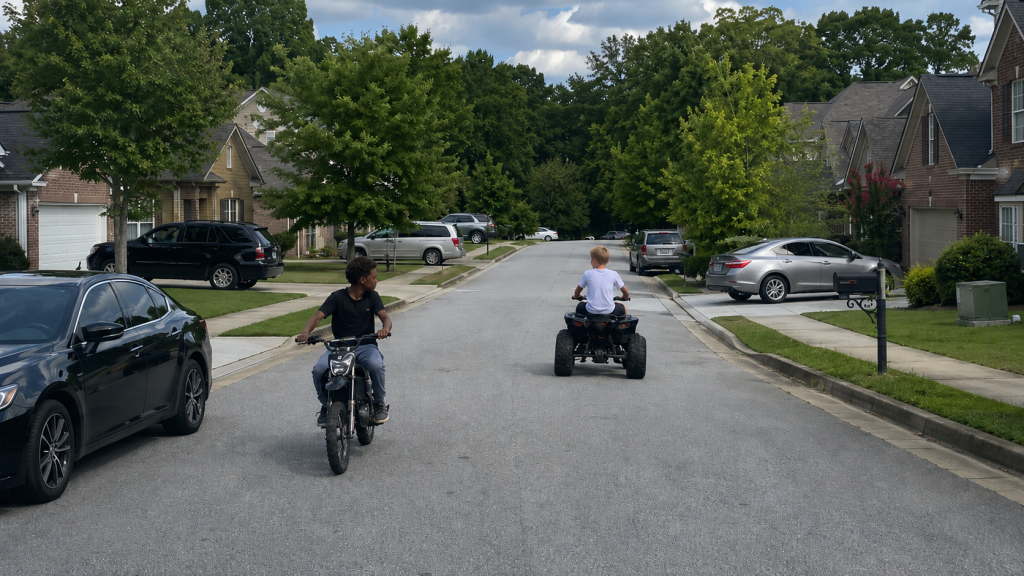
Residential streets are where children walk, families ride bicycles, neighbors back out of driveways, pets cross yards, delivery drivers stop, and vehicles move through narrow neighborhood spaces. That is why the use of small motorbikes, ATVs, UTVs and similar vehicles in residential streets and sidewalks deserves a calm, safety focused community conversation.
These vehicles can be fun, useful and safe when operated in the right setting, with the right supervision, and with the right safety equipment. Many are designed primarily for off road recreation, farm use, utility work or controlled riding areas. They are not always designed for mixed residential traffic, sidewalks, pedestrians, parked vehicles, driveways, blind corners and children playing near the street.
The concern is not about taking away someone’s enjoyment. The concern is preventing a serious injury before it happens.
What Residents Are Seeing
In many neighborhoods, residents have reported seeing children and teens riding small motorbikes, ATVs and UTVs without helmets or other visible safety protection. Some appear to be riding without direct adult supervision. In other cases, adults are also operating similar vehicles on residential streets or sidewalks. When that activity happens near moving traffic, driveways, pedestrians and other children, the margin for error becomes very small.
A child on a small motorbike or ATV may not have the judgment, strength, visibility, braking distance or traffic awareness needed to react when a vehicle backs out of a driveway, turns into a neighborhood street, or speeds through an area where families live. Even a low speed crash can result in serious head injuries, broken bones or long term consequences.
Supervision and Protective Gear
Helmets and protective gear matter. So does supervision. A safe ride begins before the vehicle starts moving. Parents and guardians should know where the vehicle is being operated, whether the operator is old enough and legally allowed to operate it, whether the vehicle is appropriate for the location, and whether the rider has proper protective equipment.
Legal Context
There is also a legal side that families should understand. Georgia law includes specific definitions for all terrain vehicles, off road vehicles, multipurpose off highway vehicles, mopeds, motorcycles, motor driven cycles and low speed vehicles. These categories are not interchangeable. A vehicle that looks small or recreational may still be regulated differently depending on its design, engine size, equipment, speed capability, road use and location.
A residential street is not automatically a private roadway simply because it is located inside a subdivision or neighborhood. In Georgia legal terms, a public residential street is generally a road that is publicly maintained and open to public vehicle travel. A private road or driveway is generally privately owned and used by the owner and those who have permission. Some gated communities, private developments or HOA maintained roads may involve private roadway issues, but that depends on recorded ownership, public dedication, maintenance responsibility and local records.
Sidewalks, Noise and Neighborhood Impact
Sidewalks should also be treated with special care. They are intended primarily for pedestrians. Children walking, residents exercising, families pushing strollers and people with mobility needs should not have to share sidewalks with motorized off road style vehicles.
Noise is another community issue. A loud exhaust, repeated passes through residential streets, or late day riding near homes can disturb families, shift workers, seniors, young children, pets and neighbors trying to enjoy their homes. This does not mean every rider is trying to be disrespectful. It does mean that the way a vehicle sounds and where it is operated can affect the whole neighborhood.
Safer Choices for Families
The safest approach is simple. Use these vehicles only where they are legally allowed. Keep children supervised. Use helmets and protective gear. Avoid sidewalks. Avoid residential traffic. Avoid repeated high noise riding near homes. Know whether the road is public or private. Understand that parents and vehicle owners may face legal, financial or civil consequences if a child is injured, causes an injury, damages property, violates local rules, or operates a vehicle where it is not allowed.
The bigger picture is community protection. Neighborhoods already face risks from speeding drivers, distracted motorists and people who treat residential streets like raceways. Adding unsupervised children on small motorbikes, ATVs or UTVs can create a dangerous combination that no family wants to face.
Losing one community child to a preventable riding incident is not worth it.
Community Reminder
This is a reminder for everyone to slow down, look out for children, respect neighborhood peace, and make safety the priority. These vehicles may have a place, but residential streets and sidewalks are often not that place.
Before allowing a child or teen to ride, families should check the applicable Georgia law, local city or county ordinances, vehicle classification, required equipment, licensing rules, helmet rules, insurance concerns and whether the riding area is actually legal for that vehicle.
A safer neighborhood does not require blame. It requires awareness, supervision and responsible decisions before someone gets hurt.
Sourcing
- Georgia Code § 40-7-3: Georgia defines an off road vehicle as a motorized vehicle designed for or capable of cross country travel over natural terrain and not intended predominantly for public road use. https://law.justia.com/codes/georgia/title-40/chapter-7/section-40-7-3/
- Georgia Code § 40-7-4: Georgia operating restrictions for off road vehicles include requirements related to brakes and mufflers or silencing equipment, private property permission, and perennial stream restrictions. https://law.justia.com/codes/georgia/title-40/chapter-7/section-40-7-4/
- Georgia Code § 40-1-1: Georgia law defines all terrain vehicles, multipurpose off highway vehicles, recreational off highway vehicles, personal transportation vehicles, private roads or driveways, residential districts, sidewalks and streets. https://law.justia.com/codes/georgia/title-40/chapter-1/article-1/section-40-1-1/
- Georgia Code §§ 40-6-359 through 40-6-362: Georgia law addresses required equipment, driver duties, lane use, and highway operation rules for low speed vehicles and multipurpose off highway vehicles. https://law.justia.com/codes/georgia/title-40/chapter-6/article-13/part-5/section-40-6-359/
- Georgia Department of Driver Services: Georgia DDS states that motorcycles and motor driven cycles require a Class M license or permit, and that scooters, motorbikes and mini bikes with engines 51cc or larger are treated within that category. https://dds.georgia.gov/georgia-licenseid/get-your-georgia-motorcycle-license
- Georgia Code § 40-6-315: Georgia law requires motorcycle riders and operators to wear approved protective headgear, with eye protection rules when the motorcycle lacks a windshield. https://law.justia.com/codes/georgia/title-40/chapter-6/article-13/part-2/section-40-6-315/
- Georgia DDS Mopeds and Scooters: Georgia DDS states that mopeds are motor driven cycles with engines not exceeding 50cc, operators must be at least 15, must have a valid license or permit, must wear a DOT approved motorcycle helmet, must obey traffic laws, and may not use limited access highways or roads where the minimum speed limit is above 35 mph. https://dds.georgia.gov/mopeds-and-scooters
- Chatham County Code Book, Chapter 12: Chatham County lists motor vehicle, road, street and highway provisions, including muffler requirements and racing on private property sections. https://www.chathamcountyga.gov/OurCounty/CodeBook
- Chatham County § 12-103: Chatham County requires motor vehicles, motor bikes, motor scooters and similar vehicles operated on county roads, streets or highways outside municipal limits to have engine exhaust muffled to substantially reduce noise. https://cccdn.blob.core.windows.net/cdn/Files/ChathamCounty/Code%20Book/Chapter12.PDF
- City of Savannah Code of Ordinances: Savannah’s motor vehicle and traffic code includes adoption of state law, vehicle obstruction, speed limits, racing motors prohibited, residential zone traffic provisions, and shared mobility device sections. https://online.encodeplus.com/regs/savannah-ga/doc-viewer.aspx?secid=2215
- City of Savannah Code, Bicycles, Mopeds and Skateboards: Savannah’s traffic code includes Sec. 7-1132 addressing bicycle and moped riding on certain sidewalks. https://online.encodeplus.com/regs/savannah-ga/doc-viewer.aspx?secid=2315
- City of Savannah Code, Noise Control: Savannah’s nuisance chapter includes an Article B noise control section that may be relevant to residential noise concerns. https://online.encodeplus.com/regs/savannah-ga/doc-viewer.aspx?secid=3610
- City of Pooler Ordinances: Pooler states that codified ordinances are available through Municode, while adopted and proposed ordinances posted by the city are not authoritative and should be verified through official sources. https://www.pooler-ga.gov/resources/ordinances/
- City of Pooler Motorized Cart and Low Speed Vehicle Registration Application: Pooler’s registration application states that all terrain vehicles or off road vehicles cannot be registered for, or operated on, streets, and that motorized carts may not operate on sidewalks. https://www.pooler-ga.gov/wp-content/uploads/2023/09/City-of-Pooler_Forms_Police_Motorized-Cart-Registration_2023_fillable.pdf
- City of Pooler Motorized Cart and Community Transportation Vehicle Ordinance: Pooler’s ordinance states it was adopted for public safety and notes that such vehicles are not designed or manufactured for use on public highways, streets and roads. https://mcclibraryfunctions.azurewebsites.us/api/ordinanceDownload/13422/549205/pdf
- City of Pooler Ordinance O2023-09.A: Pooler amended Chapter 82 traffic and vehicles provisions regarding motorized cart registration and public road use. https://mcclibraryfunctions.azurewebsites.us/api/ordinanceDownload/13422/1261921/pdf
FAQ’s
Frequently Asked Questions (FAQs)
Find clear answers about this E-Safe page, its available features, community resources, responsible use, and related services for Coastal Georgia residents. Use the source links and official contacts when making local decisions.
This section addresses commonly asked questions about this topic
What should residents do if they see children riding ATVs, UTVs or small motorbikes on residential streets or sidewalks?
If there is no immediate danger, residents should avoid confronting the rider directly, especially if the rider is a child. Make note of the location, direction of travel, vehicle description, time of day, and whether helmets or adult supervision are present. If the activity is unsafe, repeated, loud, or occurring in traffic, contact the appropriate non-emergency law enforcement number for the jurisdiction.
For unincorporated Chatham County, the 24/7 non-emergency number is 912-652-6500. For Savannah Police, the listed phone number is 912-651-6675. For Pooler Police, the listed non-emergency number is 912-748-7333, with after-hours Police and Fire non-emergency dispatch at 912-652-6500. Call 911 only when there is an emergency, injury, crash, immediate threat, or active danger.
When should someone call 911 instead of a non-emergency number?
Call 911 if a rider has crashed, someone is injured, a vehicle nearly struck a child, a rider is actively weaving through traffic, a driver is chasing or threatening a rider, or there is any immediate threat to people or property. The non-emergency number is more appropriate when the concern is ongoing unsafe riding, repeated neighborhood activity, excessive noise, riding on sidewalks, or a situation that does not require an immediate emergency response.
Should neighbors confront children or adults who are riding unsafely?
Residents should use caution before confronting anyone. A calm conversation may be appropriate when the person is a known neighbor and the situation is not heated, but direct confrontation can escalate quickly. A safer option is to document the concern and contact a parent, property manager, HOA, neighborhood association, or law enforcement non-emergency line when the conduct creates a safety risk or continues after warnings.
What information is helpful when reporting unsafe riding?
Useful information includes the exact location, nearest cross streets, time and date, vehicle type, color, number of riders, direction of travel, whether helmets were worn, whether the vehicle was on the street or sidewalk, whether a car had to brake or swerve, and whether the same activity has happened before. Residents should not follow riders, block them, or attempt to stop them. The goal is to report the safety concern without creating another hazard.
Why is this a safety issue even if no one has been hurt yet?
Residential streets have parked cars, driveways, pedestrians, children, pets, delivery vehicles, and limited visibility. A child on a small motorbike, ATV or UTV may not be able to react quickly when a vehicle backs out of a driveway or turns into the street. Helmets, supervision, legal riding areas, and responsible vehicle use reduce the chance of a preventable injury. The purpose of reporting unsafe activity is not punishment first. It is prevention before a child, pedestrian, driver, or neighbor is hurt.