
Share this article
Coastal Georgia News · E-Safe News
E-Safe Coastal Georgia Weekly Briefing – Week of April 13, 2026
A fact-driven Coastal Georgia briefing on Tybee Island safety, regional planning, climate mapping, housing pressure, and GDOT transportation impacts shaping local communities this week for Coastal GA.
The E-Safe Weekly Briefing provides a clear, fact driven overview of the developments most likely to affect residents across Coastal Georgia. Each week, E-Safe identifies, reviews, and explains the stories with the strongest impact on public safety, local planning, community wellbeing, infrastructure, and regional readiness.
The goal is simple. Deliver factual, reliable, actionable information that helps Coastal Georgia stay informed, aware, and prepared. Whether the issue involves law enforcement activity, environmental risk, development pressure, or transportation disruption, this briefing focuses on what matters most for families, neighborhoods, and local decision makers.
This week’s briefing reflects a region managing several pressures at once. Public safety concerns on Tybee Island, long range planning across the coast, climate adaptation tools, housing affordability strain, and major roadway work all point to the same larger reality. Coastal Georgia is growing, changing, and being forced to make more complex choices about safety, resilience, mobility, and quality of life.
Tybee Island Public Safety Debate Intensifies After Spring Break Gunfire Incident
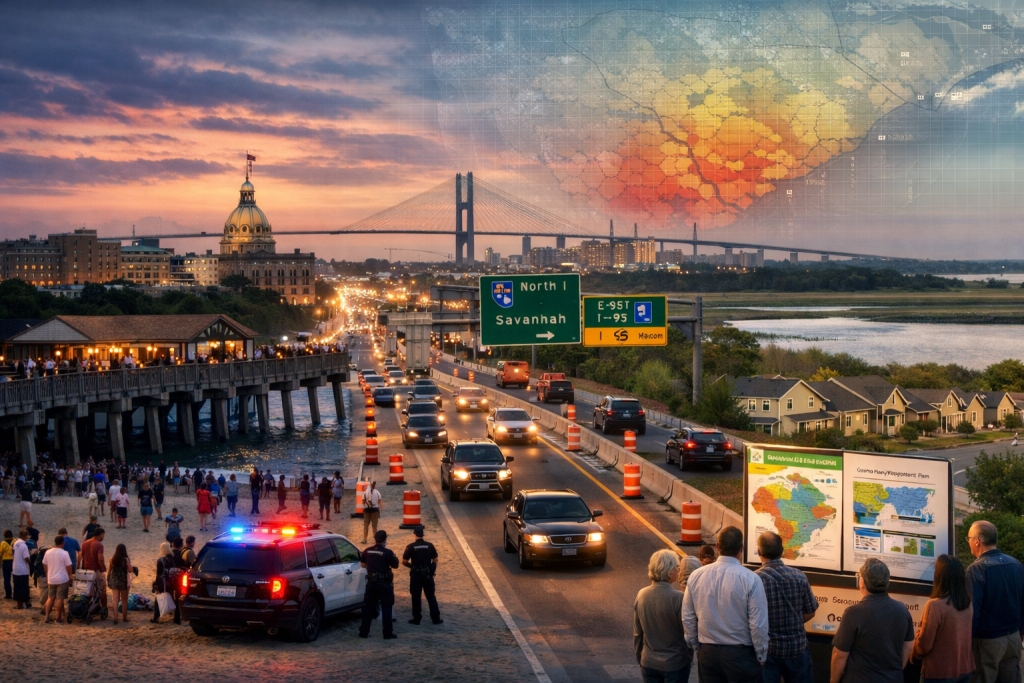
One of the most visible public safety stories of the week came from Tybee Island, where an unpermitted spring break style gathering near the pier and pavilion was interrupted by gunfire, sending a crowd running and triggering a large law enforcement response. No victims had come forward in the immediate aftermath, but the incident quickly became a flashpoint for broader concerns about crowd control, emergency response, and the strain large unsanctioned gatherings place on a small barrier island community.
The significance of the incident extends beyond one chaotic evening. Tybee Island sits at the center of a recurring seasonal tension between tourism, beach access, youth gatherings, and public order. Local leaders, residents, and businesses all benefit from spring traffic, but they also face the reality that informal events organized through social media can overwhelm available resources in a very short window. That creates heightened risks not only for visitors, but also for residents, workers, and first responders trying to move through already constrained corridors.
For Coastal Georgia residents, this story matters because it highlights how quickly a public gathering can become a regional safety issue. Tybee is not just a destination. It is part of the broader Savannah area economy and transportation network. Any significant disruption there affects law enforcement coordination, public confidence, travel planning, and the larger discussion about how communities should handle recurring high volume events.
Regional Planning Process Brings Growth, Housing, and Resource Protection Into Public View
Another major issue drawing local attention is the Coastal Regional Commission’s ongoing update of the Regional Plan, which guides long term thinking on growth, infrastructure, housing, transportation, and environmental stewardship across the coast. Public meetings have already been held in Darien and Statesboro, and a Savannah area open house was scheduled for early April, giving residents an opportunity to weigh in on what kind of region they want Coastal Georgia to become.
This is more than a paperwork exercise. Regional planning decisions shape how communities prepare for population growth, where transportation investments are prioritized, how housing needs are framed, and how marshes, wetlands, and other natural assets are protected. In a region that includes both fast growing suburban areas and environmentally sensitive coastal landscapes, those choices carry long lasting consequences.
The planning process is especially relevant now because many of the issues residents raise in everyday conversation are regional in nature even when they show up locally. Housing cost pressure in one county spills into another. Road congestion in one corridor affects regional labor access and emergency movement. Environmental decisions in one place can influence flooding and development risk elsewhere. For readers across Chatham, Bryan, Effingham, Liberty, and Bulloch counties, the Regional Plan is one of the clearest places where those concerns come together.
New Climate Outlook Maps Give Coastal Georgia More Localized Adaptation Tools
Climate resilience also moved higher on the public agenda this week with the rollout of new Georgia climate outlook maps that allow users to view projected heat, rainfall, frost day, and growing season changes at the county and city level through 2050. For Coastal Georgia, where development pressure meets flood exposure, stormwater concerns, and extreme weather risk, that kind of localized planning information has immediate value.
What makes these maps important is not just the science itself, but how usable the information has become for local decision making. Coastal communities can now look beyond historic averages and begin planning for conditions that may differ substantially from the past. That matters for drainage design, land use review, emergency planning, vulnerable population protection, and the siting of major facilities such as hospitals and other critical services.
For local governments and residents alike, this story is about preparedness. Coastal Georgia does not have the luxury of treating climate change as an abstract future issue. Sea level concerns, flood vulnerability, heat stress, and rainfall variability already affect daily life and public investment choices. Better tools do not solve those risks on their own, but they improve the region’s ability to make smarter and earlier decisions.
Housing Pressure Keeps Federal Investor Crackdown in Local Focus
Housing affordability remains a defining concern in Coastal Georgia, and a bipartisan housing package that advanced in the U.S. Senate in March has added new momentum to the local conversation. One of the most discussed provisions would restrict large institutional investors from continuing to accumulate large numbers of single family homes, a practice that local real estate professionals say has made it harder for individual buyers to compete in the Savannah area and nearby growth corridors.
That local angle is critical. The housing debate is not just about Washington policy. Coastal Georgia agents have described investor activity in new construction communities as a real challenge, especially for first time buyers already struggling with rising prices. When large buyers move aggressively into expanding markets, the effect can ripple outward from Savannah into Pooler, Bryan County, and other nearby areas where households are searching for slightly more attainable options.
The federal bill is not yet settled law, so its final effect remains uncertain. Still, the topic is highly relevant because it captures a broader truth about the region. Housing pressure is no longer a background concern. It is shaping where families can live, how far they must commute, and whether local workers can remain close to the communities they serve. That makes the policy debate worth watching even before any final federal outcome is decided.
GDOT Lane Closures and Major Corridor Projects Raise the Stakes for Spring Travel
Transportation also ranks among the week’s most consequential issues, with new lane closure activity and major project planning affecting travel across the Coastal Empire. Recent notices include closures and resurfacing impacts on I-95 in Bryan and Chatham counties, along with additional work farther south in McIntosh and Glynn counties. At the same time, larger discussions continue around the proposed widening of I-95 north of the Savannah area and the environmental review tied to the I-16 widening project from I-95 toward State Route 67.
For drivers, freight movement, and emergency response, the short term effect is straightforward. Lane closures and active work zones can mean slower commutes, route changes, and more uncertainty during already busy travel periods. But the larger story is about capacity. Coastal Georgia’s transportation system is carrying the weight of population growth, logistics expansion, tourism, and regional development all at once. The pressure is no longer limited to a few isolated chokepoints.
This matters to the community because transportation projects shape daily life in very practical ways. They affect school travel, work schedules, response times, delivery systems, and business access. They also reveal how closely infrastructure planning is tied to the broader growth story unfolding across Coastal Georgia. The region is investing in mobility because it has to, but every improvement comes with a temporary cost that residents feel in real time.
Conclusion
Taken together, this week’s five leading issues show a Coastal Georgia region balancing immediate disruptions with long term change. Tybee Island’s public safety concerns point to the challenge of managing major gatherings in tourism driven communities. The Regional Plan update shows how local leaders are trying to think ahead about housing, transportation, and natural resource protection. New climate outlook tools reinforce the need for smarter adaptation planning. The housing debate reflects growing anxiety about affordability and market access. GDOT activity underscores how urgently transportation systems must keep pace with regional demand.
The common thread is pressure. Pressure on public safety systems. Pressure on roads. Pressure on housing. Pressure on local governments to plan well and act early. For residents, that makes awareness more important than ever. Coastal Georgia’s future is being shaped now, not only in large policy debates, but in the day to day decisions that determine how safe, connected, affordable, and resilient this region will be.
Sourcing
WTOC. “Shots fired at unpermitted, pop-up event on Tybee Island.” Updated April 6, 2026. Accessed April 12, 2026. Used to confirm the unpermitted gathering near the pier and pavilion, the reported gunfire, the lack of reported victims at that time, and the multiagency response. Source link
Tybee Island Police Department. “Shots Fired Investigation – April 4, 2026.” Accessed April 12, 2026. Used to confirm the investigation timeline and that the incident tied back to April 4 rather than April 7. Source link
Coastal Regional Commission of Georgia. “Regional Plan.” Accessed April 12, 2026. Used to confirm that the Regional Plan update is underway and that public meetings were scheduled in Darien, Statesboro, and Savannah. Source link
Effingham County Board of Commissioners. “Coastal Regional Commission seeks survey participation.” Posted March 19, 2026. Accessed April 12, 2026. Used to confirm the public survey and the April 8 Savannah open house details. Source link
Statesboro Herald. “Designing a new plan for area growth.” Published March 24, 2026. Accessed April 12, 2026. Used for additional local context on the Regional Plan process and why it matters across multiple counties. Source link
Drawdown Georgia. “Climate Solutions Trackers + Tools.” Accessed April 12, 2026. Used to confirm that Georgia Climate Outlook Maps are available and designed for 2050 planning scenarios. Source link
University of Georgia Extension. “Drawdown Georgia Climate Outlook Maps now available.” Published March 30, 2026. Accessed April 12, 2026. Used to confirm the map release and the planning intent behind the tool. Source link
WABE. “New Georgia map tool offers local climate change insights.” Published April 10, 2026. Accessed April 12, 2026. Used for reporting on county and city level climate projections and the implications for infrastructure and local planning. Source link
U.S. Senate Committee on Banking, Housing, and Urban Affairs. “Scott, Warren Release 21st Century ROAD to Housing Act Legislative Package to Boost Housing Supply and Bring Down Costs.” Published March 2, 2026. Accessed April 12, 2026. Used to confirm the bipartisan package and its inclusion of restrictions on large institutional investors buying single family homes. Source link
WJCL. “Senate housing bill could reshape Coastal Georgia real estate market, agents say.” Updated March 17, 2026. Accessed April 12, 2026. Used to confirm the local Coastal Georgia angle, including reports that corporate buyers have acquired 30 to 45 homes in some new construction communities. Source link
National Council of State Housing Agencies. “Senate Passes Comprehensive Affordable Housing Bill with Several NCSHA Priorities.” Published March 12, 2026. Accessed April 12, 2026. Used to confirm the 350 home institutional investor threshold described in coverage of the Senate package. Source link
WTOC. “GDOT announces road work, lane closures across Coastal Empire.” Published April 10, 2026. Accessed April 12, 2026. Used to confirm active and near term lane closures affecting Chatham, Bryan, McIntosh, and Glynn counties. Source link
WTOC. “Local drivers weigh in on GDOT’s plan to widen I-95 in coastal Georgia.” Updated March 31, 2026. Accessed April 12, 2026. Used to confirm the proposed I-95 widening corridor, safety rationale, and expected travel impact concerns. Source link
Coastal Courier. “Environmental review underway as I-16 widening takes shape.” Published March 5, 2026. Accessed April 12, 2026. Used to confirm the scope of the I-16 widening project across Bulloch, Bryan, Effingham, and Chatham counties. Source link